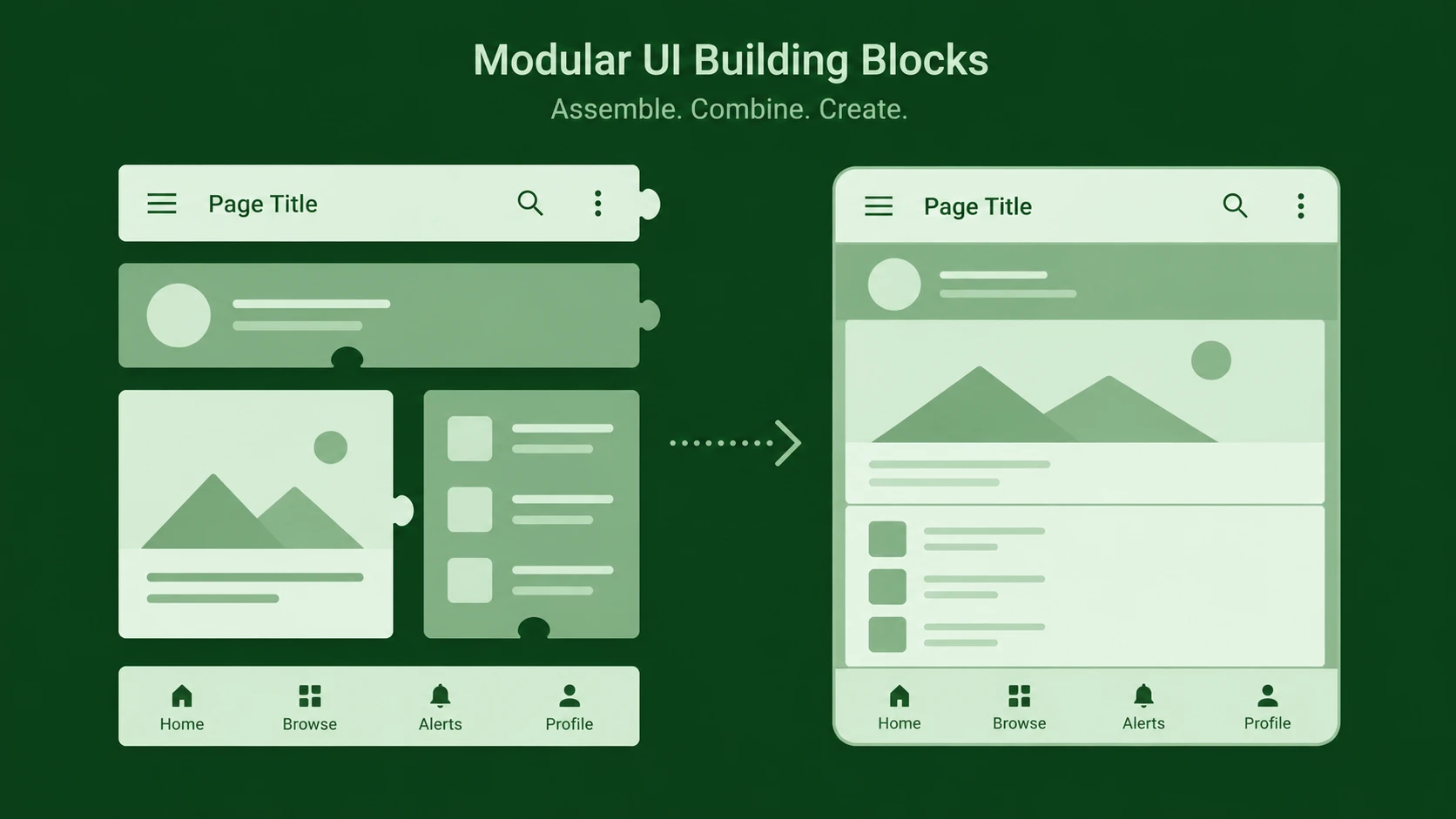
Introduction
Enterprise web applications have evolved far beyond simple document-based websites. Modern business systems now include hundreds of interface components, complex layouts, reusable widgets, interactive dashboards, and responsive user experiences that continue expanding throughout an application's lifecycle.
While HTML and JavaScript frameworks often receive significant architectural attention, CSS frequently grows without clear organizational standards. Over time, large stylesheets become increasingly difficult to understand, maintain, and extend. Developers introduce duplicate rules, conflicting selectors, and highly specific overrides that eventually slow feature development.
Several architectural methodologies have emerged to address these problems. Block Element Modifier (BEM), Scalable and Modular Architecture for CSS (SMACSS), and CSS preprocessors such as SASS encourage modular organization, reusable components, and maintainable styling practices.
For enterprise development teams, these approaches represent a shift from writing isolated style rules toward designing scalable front-end architecture.
Industry Background
The growth of Single Page Applications, responsive design, and component-based interfaces has dramatically increased the amount of CSS required by enterprise software.
Modern applications frequently include:
- ◆Responsive layouts
- ◆Navigation systems
- ◆Interactive forms
- ◆Data grids
- ◆Charts and dashboards
- ◆Modal dialogs
- ◆Reusable widgets
- ◆Mobile-specific interfaces
Managing these interfaces through a single stylesheet becomes increasingly impractical as applications expand.
Organizations are therefore adopting structured CSS methodologies to improve consistency and maintainability.
The Business Problem
Large CSS codebases commonly experience:
- ◆Duplicate selectors
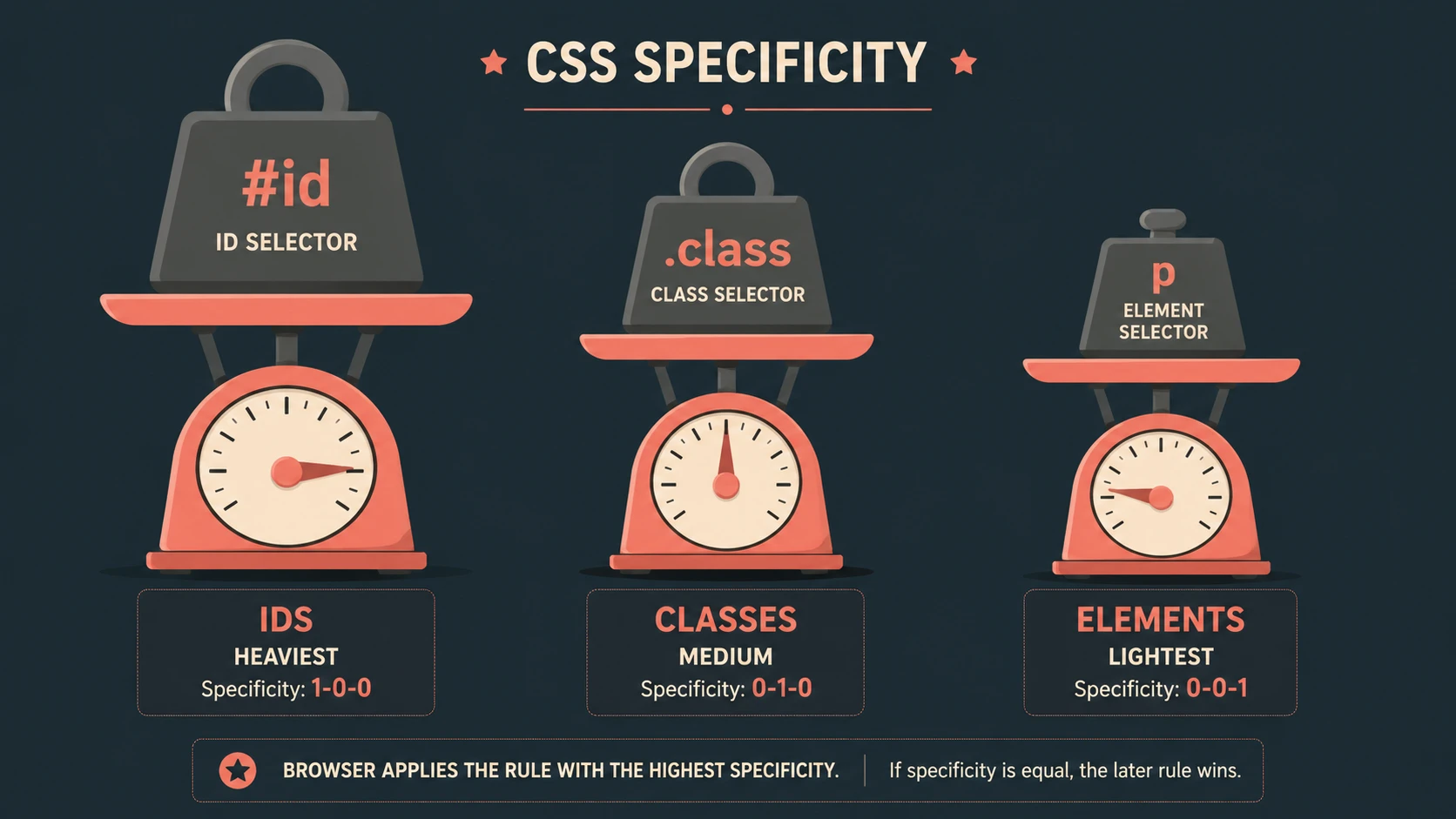
- ◆Increasing specificity conflicts
- ◆Difficult maintenance
- ◆Unpredictable style inheritance
- ◆Poor naming consistency
- ◆Limited component reuse
Without architectural discipline, front-end development slows as styling complexity grows.
Understanding Modular CSS Architecture
Modular CSS architecture treats styling as an organized software system rather than a collection of unrelated rules.
Core objectives include:
- ◆Component isolation
- ◆Predictable naming
- ◆Reusable styles
- ◆Reduced selector conflicts
- ◆Improved maintainability
- ◆Simplified collaboration
Rather than organizing CSS by individual pages, modular approaches organize styles according to reusable interface components.
Core Architecture
A modular CSS architecture typically consists of several complementary layers.
| Layer | Responsibility |
|---|---|
| Base Styles | Typography and global defaults |
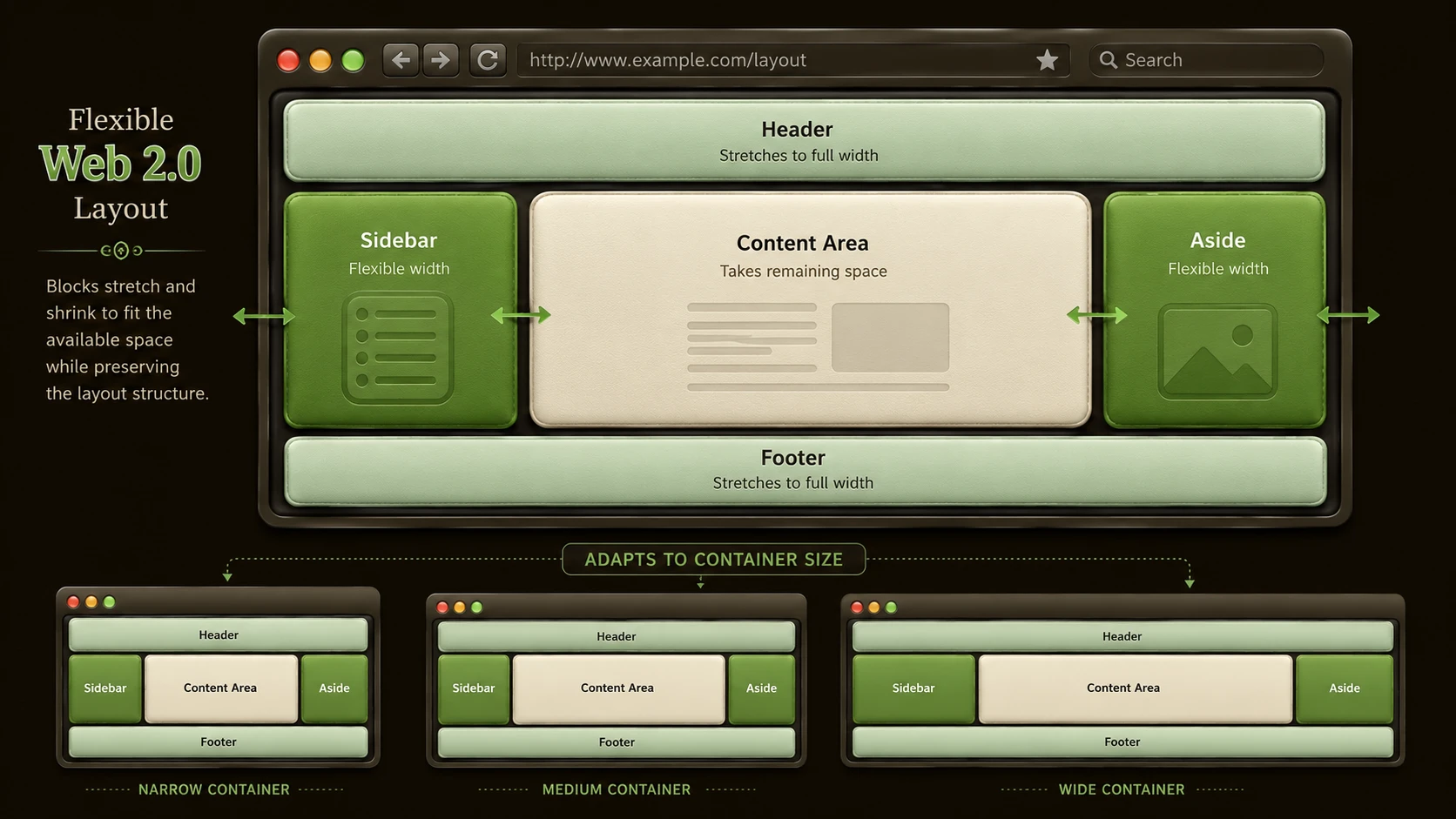
| Layout | Page structure and positioning |
| Components | Reusable interface elements |
| Modules | Independent functional sections |
| Utilities | Helper classes |
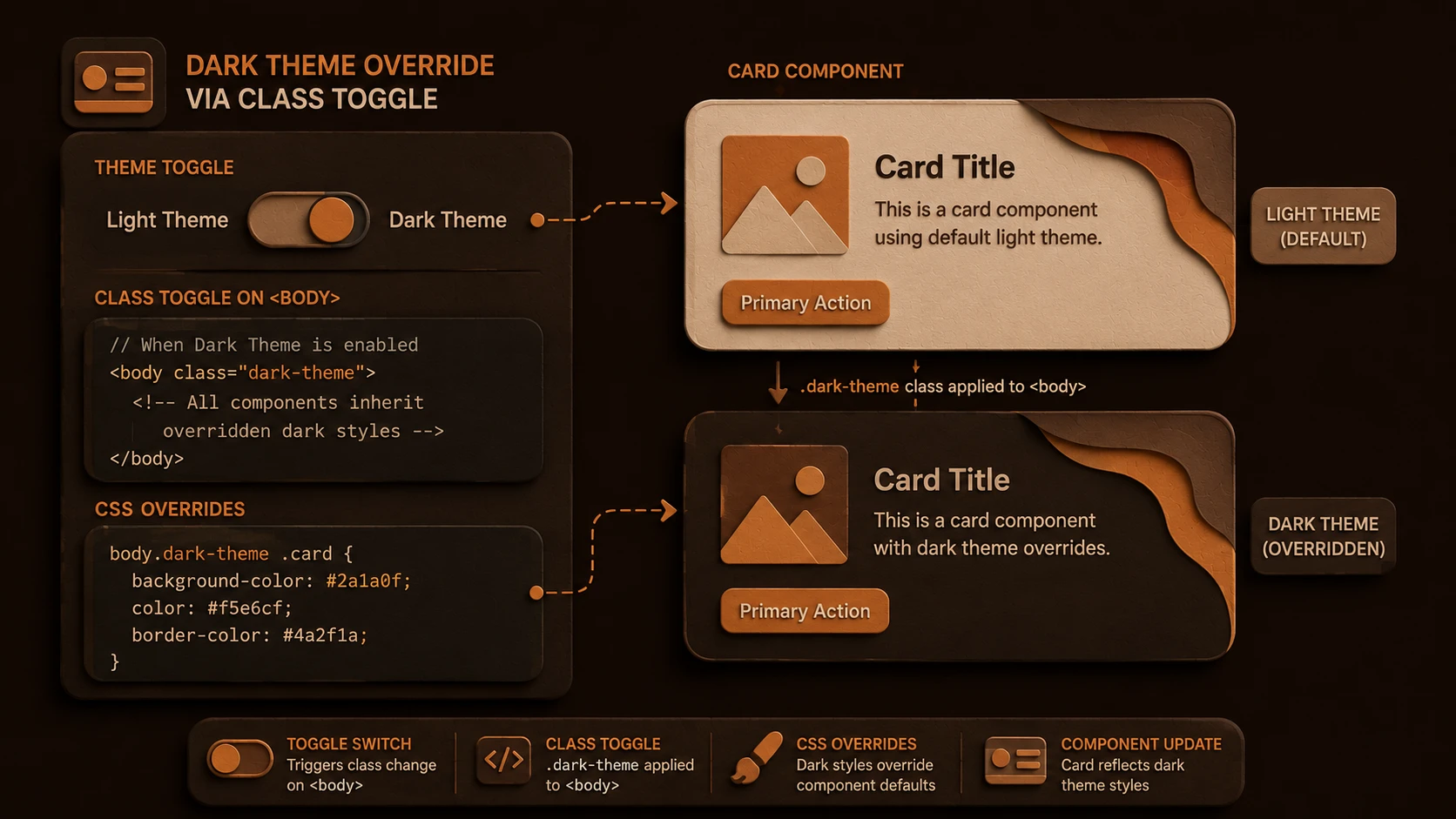
| Themes | Visual customization |
| Responsive Rules | Device-specific adaptations |
Separating these concerns improves readability while reducing unintended interactions between styles.
BEM Methodology
// BEM (Block, Element, Modifier) naming convention implementation in SASS SCSS
.card {
  display: flex;
  flex-direction: column;
  border-radius: 8px;
  border: 1px solid rgba(255, 255, 255, 0.1);

  &__title { // Element
    font-size: 1.25rem;
    font-weight: bold;
    color: #ffffff;
  }

  &__button { // Element
    padding: 8px 16px;
    background: #00e5ff;

    &--disabled { // Modifier
      background: #555555;
      cursor: not-allowed;
    }
  }
}
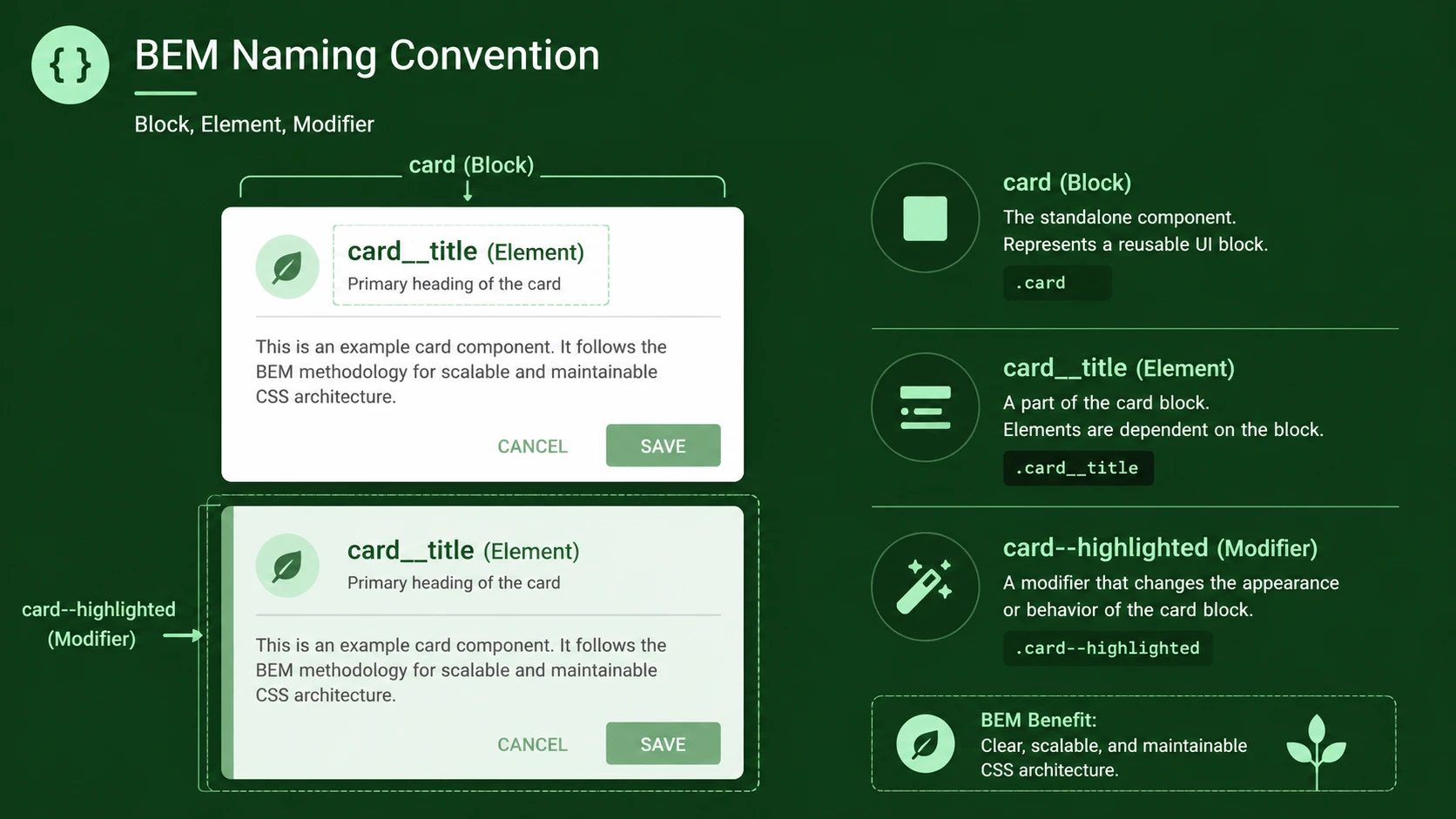
Block Element Modifier (BEM) introduces a naming convention designed to improve clarity and reduce ambiguity.
Its structure consists of:
- ◆Block
- ◆Element
- ◆Modifier
Examples include:
- ◆navigation
- ◆navigation__item
- ◆navigation__item--active
Each component becomes largely independent, minimizing reliance on deeply nested selectors.
Advantages include:
- ◆Predictable naming
- ◆Improved readability
- ◆Better component reuse
- ◆Reduced selector specificity
- ◆Easier team collaboration
BEM encourages developers to think in terms of reusable interface building blocks rather than page-specific styling.
SMACSS
Scalable and Modular Architecture for CSS (SMACSS) focuses on organizing styles into logical categories.
Common categories include:
- ◆Base
- ◆Layout
- ◆Module
- ◆State
- ◆Theme
Instead of emphasizing naming conventions alone, SMACSS provides broader guidance for structuring large CSS projects.
Enterprise teams benefit from clearer separation of responsibilities and improved stylesheet organization.
SASS
SASS extends CSS by introducing programming-oriented capabilities that simplify stylesheet management.
Important features include:
- ◆Variables
- ◆Nesting
- ◆Mixins
- ◆Partials
- ◆Functions
- ◆Imports
These capabilities reduce duplication while improving maintainability.
For enterprise projects, SASS enables centralized management of colors, typography, spacing, and reusable layout patterns.
How Modular CSS Works
A typical enterprise styling workflow includes:
System architecture diagram and conceptual workflow layout for Modular CSS Architectures.
- 1.Design reusable interface components.
- 2.Organize styles according to architectural guidelines.
- 3.Build reusable SASS partials.
- 4.Apply consistent BEM naming.
- 5.Group modules according to SMACSS categories.
- 6.Compile optimized production stylesheets.
- 7.Deploy a maintainable CSS architecture.
Rather than treating each page independently, the application evolves through reusable design components.
Enterprise Use Cases
Modular CSS architectures provide advantages across numerous enterprise scenarios.
Enterprise Portals
Large business applications benefit from consistent interface components across numerous modules.
Software as a Service
Reusable components simplify long-term product development.
Administrative Dashboards
Shared layout components reduce styling duplication across reporting interfaces.
Design Systems
Organizations creating reusable UI standards can establish consistent styling conventions.
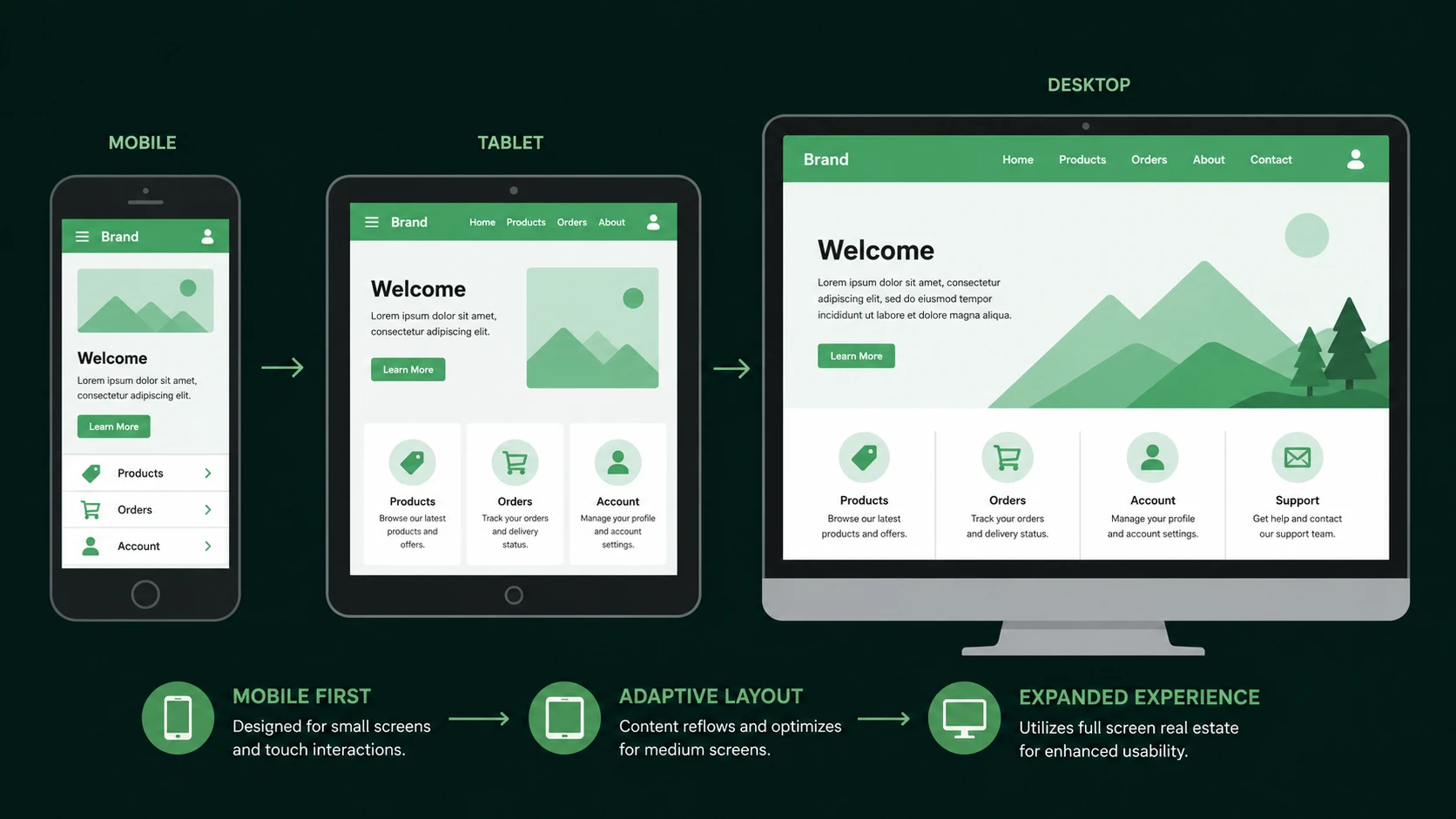
Responsive Applications
Device-specific styling becomes easier to manage within organized component libraries.
Performance Considerations
Although modular architectures primarily improve maintainability, they also contribute to front-end performance.
Potential benefits include:
- ◆Reduced duplicate CSS
- ◆Smaller production stylesheets
- ◆Better browser caching
- ◆Simplified optimization
- ◆Improved maintainability
- ◆Easier code reviews
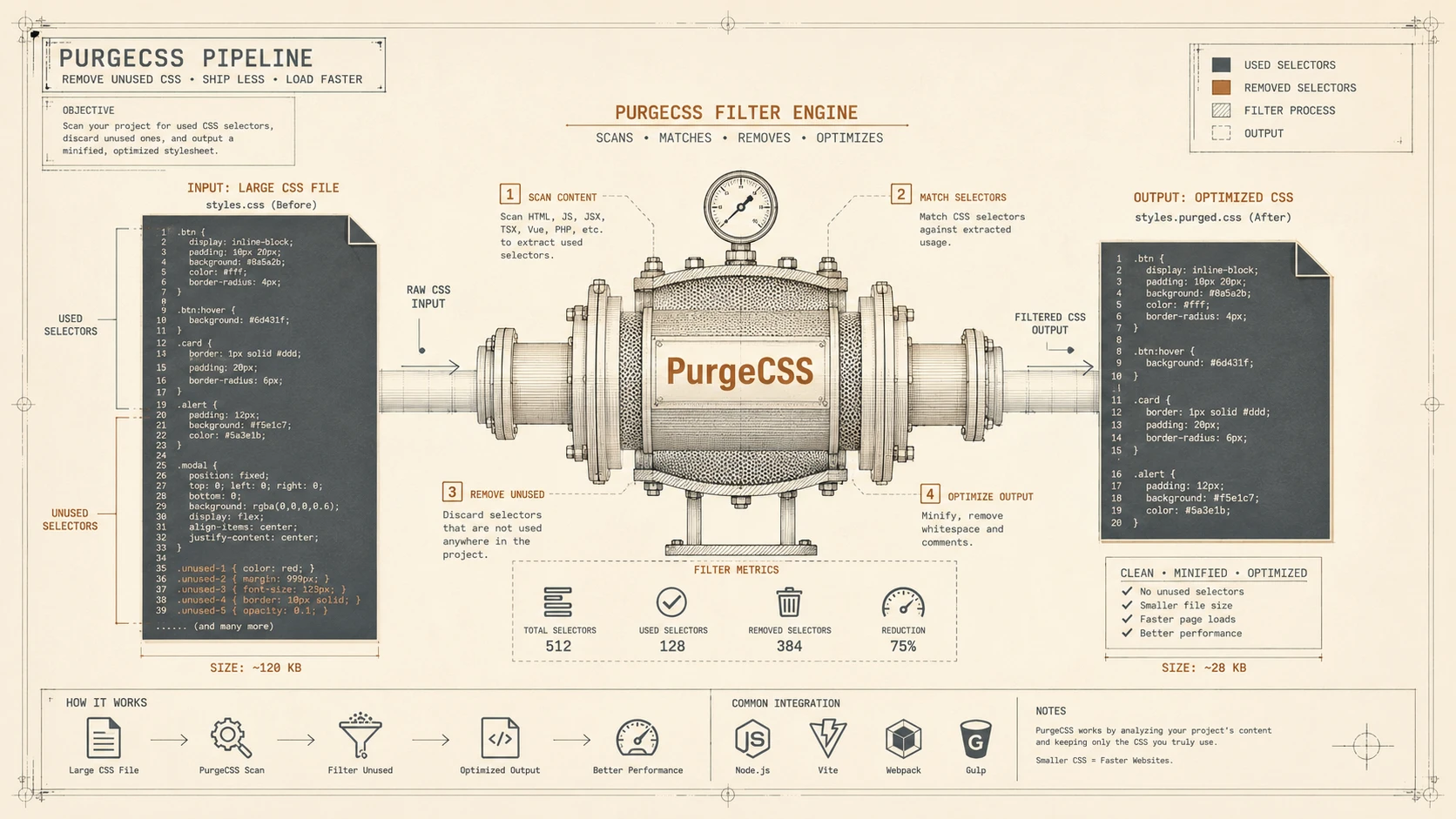
Developers should continue minimizing unnecessary selectors and unused styles during production deployment.
Security Considerations
CSS itself introduces relatively few direct security concerns.
Nevertheless, enterprise applications should continue implementing:
- ◆Secure content delivery
- ◆Controlled asset deployment
- ◆Version management
- ◆Protected build infrastructure
- ◆Secure third-party dependency management
Styling architecture should complement broader application security practices.
Scalability
One of the primary advantages of modular CSS is long-term scalability.
Benefits include:
- ◆Component reuse
- ◆Predictable maintenance
- ◆Easier onboarding of developers
- ◆Reduced regression risk
- ◆Improved collaboration
- ◆Consistent application appearance
Large enterprise applications become significantly easier to evolve when styling follows architectural standards.
Best Practices
Organizations adopting modular CSS should consider the following recommendations.
- ◆Design reusable interface components.
- ◆Follow consistent naming conventions.
- ◆Keep selectors simple.
- ◆Minimize specificity.
- ◆Organize SASS partials logically.
- ◆Separate layout from presentation.
- ◆Document architectural standards.
- ◆Conduct regular stylesheet reviews.
Common Mistakes
| Mistake | Enterprise Impact |
|---|---|
| Deep selector nesting | Reduced maintainability |
| Inconsistent naming | Difficult collaboration |
| Duplicate styling rules | Larger stylesheets |
| Mixing layout and component logic | Architectural confusion |
| Excessive specificity | Override conflicts |
| Ignoring modular organization | Growing technical debt |
Successful CSS architecture depends more upon consistency than any individual methodology.
Technology Comparison
| Capability | Traditional CSS | BEM | SMACSS | SASS |
|---|---|---|---|---|
| Naming Convention | Unstructured | Strong | Flexible | Not Applicable |
| Architecture Guidance | Limited | Component Focus | Project Structure | Language Extension |
| Reusability | Moderate | High | High | High |
| Maintainability | Moderate | Excellent | Excellent | Excellent |
| Variables | No | No | No | Yes |
| Compilation Required | No | No | No | Yes |
These approaches are complementary rather than mutually exclusive. Many enterprise teams combine SASS with either BEM or SMACSS to achieve both maintainability and development efficiency.
Adoption Strategy
Organizations modernizing front-end development should proceed incrementally.
Recommended steps include:
- 1.Audit existing CSS.
- 2.Establish architectural standards.
- 3.Select a naming convention.
- 4.Introduce SASS preprocessing.
- 5.Refactor reusable components.
- 6.Standardize responsive layouts.
- 7.Document development guidelines.
- 8.Expand modular architecture across future projects.
Gradual adoption minimizes disruption while improving long-term maintainability.
Limitations
Although modular CSS significantly improves organization, several considerations remain.
- ◆Teams require consistent coding standards.
- ◆Existing applications may require substantial refactoring.
- ◆Naming conventions increase initial discipline requirements.
- ◆Build processes become more sophisticated when preprocessors are introduced.
- ◆Architectural consistency depends upon team adoption rather than tooling alone.
Organizations should therefore establish governance alongside technical implementation.
Looking Ahead
From the perspective of January 2014, modular CSS methodologies are becoming an essential part of enterprise front-end engineering. As applications continue growing in complexity and development teams expand, structured approaches such as BEM, SMACSS, and SASS provide practical solutions for controlling stylesheet complexity while improving long-term maintainability.
Rather than viewing CSS as a collection of presentation rules, enterprise organizations are increasingly recognizing it as an architectural discipline that benefits from the same planning, modularity, and engineering rigor applied to application code. Teams adopting these methodologies today will be better positioned to maintain scalable, consistent, and responsive web applications as front-end development continues to evolve.