Enterprise web application development continues to evolve rapidly. Organizations are increasingly demanding applications that are easier to maintain, simpler to test, and capable of supporting rapidly changing business requirements. Traditional Web Forms applications remain widely used throughout enterprise environments, but many development teams have begun adopting the Model-View-Controller (MVC) architectural pattern to improve separation of concerns and long-term maintainability.
Since its initial release, ASP.NET MVC has gained considerable momentum among Microsoft developers. The framework encourages clean architecture, test-driven development, and greater control over generated HTML while leveraging the mature ASP.NET platform.
With the release of ASP.NET MVC 3, Microsoft introduces several enhancements aimed at simplifying application development and improving developer productivity. Among the most notable additions are the new Razor view engine and Global Filters, both of which reduce repetitive code while promoting cleaner application architecture.
This article examines the most significant improvements introduced in ASP.NET MVC 3 and discusses how enterprise development teams can begin evaluating the framework for modern web applications.
Why MVC Continues to Gain Enterprise Adoption
Large enterprise applications often grow into complex systems involving multiple development teams, evolving business requirements, and long maintenance lifecycles.
Development teams increasingly seek architectures that provide:
- ◆Clear separation of concerns
- ◆Testable business logic
- ◆Flexible routing
- ◆Clean HTML generation
- ◆Better maintainability
- ◆Easier collaboration between developers and designers
ASP.NET MVC addresses these objectives by separating application responsibilities into Models, Views, and Controllers.
Rather than relying on event-driven page lifecycles, MVC encourages request-oriented application design that closely aligns with the HTTP protocol.
Understanding the MVC Architecture
The framework divides responsibilities into three primary components.
| Component | Responsibility |
|---|---|
| Model | Business data and application rules |
| View | User interface and presentation |
| Controller | Request handling and application flow |
This separation simplifies maintenance because changes to one layer typically have minimal impact on others.
Typical architecture:
Browser
   |
Routing Engine
   |
Controller
   |
Business Services
   |
Repository Layer
   |
Database
   |
Controller
   |
View
   |
Browser Response
The controller coordinates application logic while the view focuses solely on presentation.
Introducing the Razor View Engine
One of the most anticipated features in ASP.NET MVC 3 is the Razor View Engine.
Earlier MVC applications primarily relied on the Web Forms view engine, which required verbose syntax when embedding server-side code within HTML.
Razor introduces a more concise and readable syntax using the @ character.
Example:
<h2>@Model.CustomerName</h2>

<p>Welcome, @Model.CustomerName</p>
Compared to earlier approaches, Razor significantly reduces markup complexity while making views easier to read and maintain.
Advantages of Razor
The Razor syntax offers several practical benefits.
Cleaner Markup
HTML remains the primary focus of the page, making templates easier to understand.
Reduced Boilerplate Code
Developers write less server-side markup while maintaining full access to C#.
Improved Readability
Views become easier to review during code inspections and collaborative development.
Better Designer Collaboration
Simplified markup allows front-end developers and designers to work more comfortably alongside back-end developers.
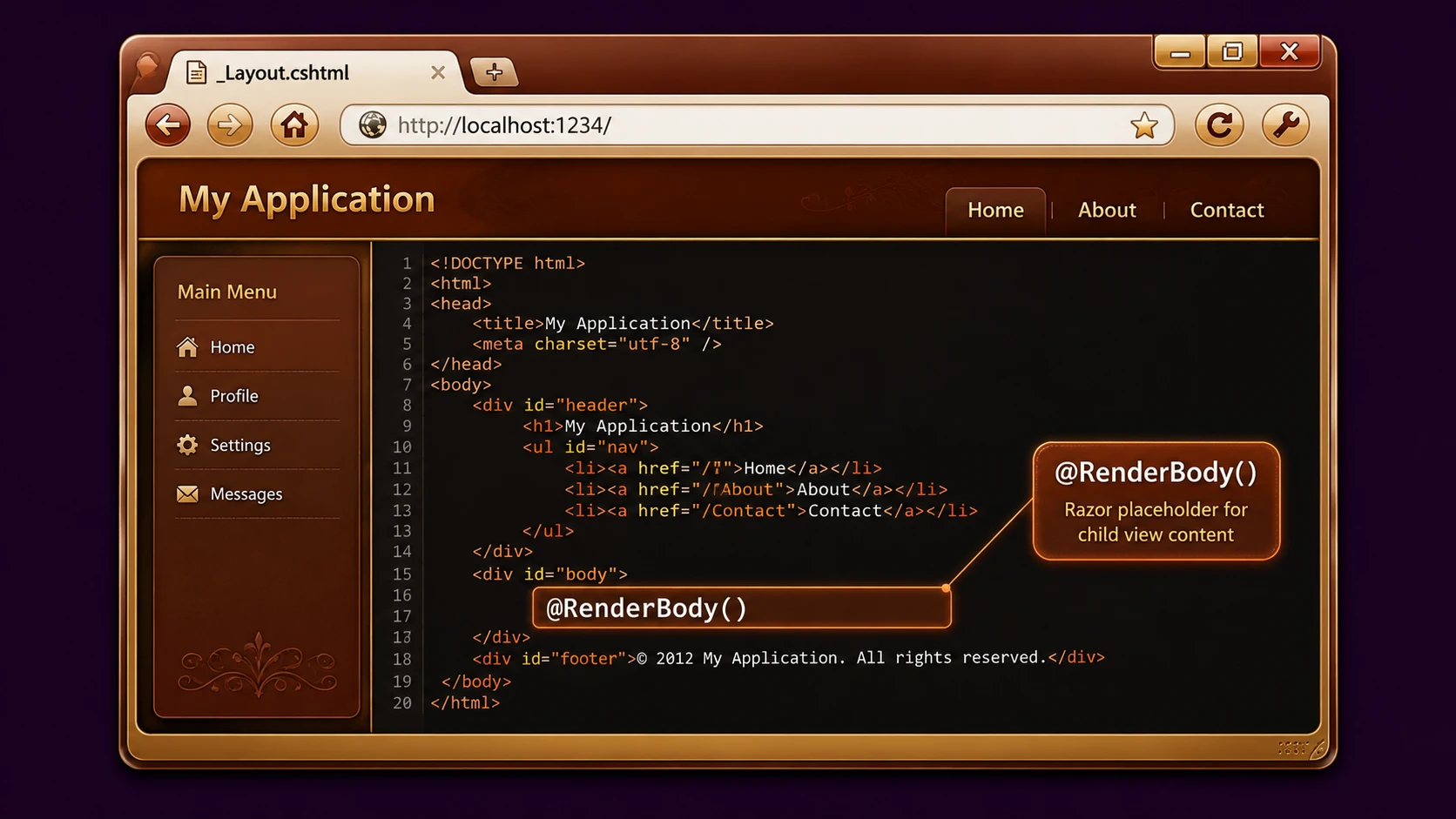
Layout Pages
ASP.NET MVC 3 continues supporting reusable layouts that define common page structure.
Typical layout sections include:
- ◆Header
- ◆Navigation
- ◆Footer
- ◆Sidebar
- ◆Shared scripts
Individual views focus only on page-specific content while sharing a consistent application design.
This reduces duplication throughout enterprise applications.
Partial Views
Large applications frequently reuse interface components.
Examples include:
- ◆Login panels
- ◆Customer summaries
- ◆Navigation menus
- ◆Product lists
- ◆Notification areas
Partial views encourage modular user interface development and simplify long-term maintenance.
Introducing Global Filters
ASP.NET MVC 3 introduces Global Filters, allowing developers to register filters once for the entire application.
Previously, many filters required repeated decoration across numerous controllers or actions.
Global Filters centralize this configuration.
Common filter categories include:
- ◆Authorization
- ◆Exception handling
- ◆Action logging
- ◆Performance monitoring
- ◆Output caching
Central registration improves consistency and reduces repetitive code.
Typical Filter Pipeline
Incoming Request
        |
Global Filters
        |
Controller
        |
Action Method
        |
View Rendering
        |
Response
The pipeline allows cross-cutting concerns to remain separate from business logic.
Handling Cross-Cutting Concerns
Enterprise applications frequently require functionality that applies throughout the application.
Examples include:
- ◆Authentication
- ◆Authorization
- ◆Logging
- ◆Auditing
- ◆Exception handling
- ◆Performance monitoring
Global Filters provide a cleaner mechanism for implementing these concerns without duplicating controller code.
Improved Dependency Injection Support
Enterprise systems commonly depend upon loosely coupled architectures.
Controllers frequently require services such as:
- ◆CustomerService
- ◆OrderService
- ◆EmailService
- ◆InventoryService
ASP.NET MVC 3 improves integration with dependency injection patterns, making controller construction more flexible.
This facilitates:
- ◆Unit testing
- ◆Mock implementations
- ◆Separation of concerns
- ◆Maintainable application architecture
Enhanced Validation Support
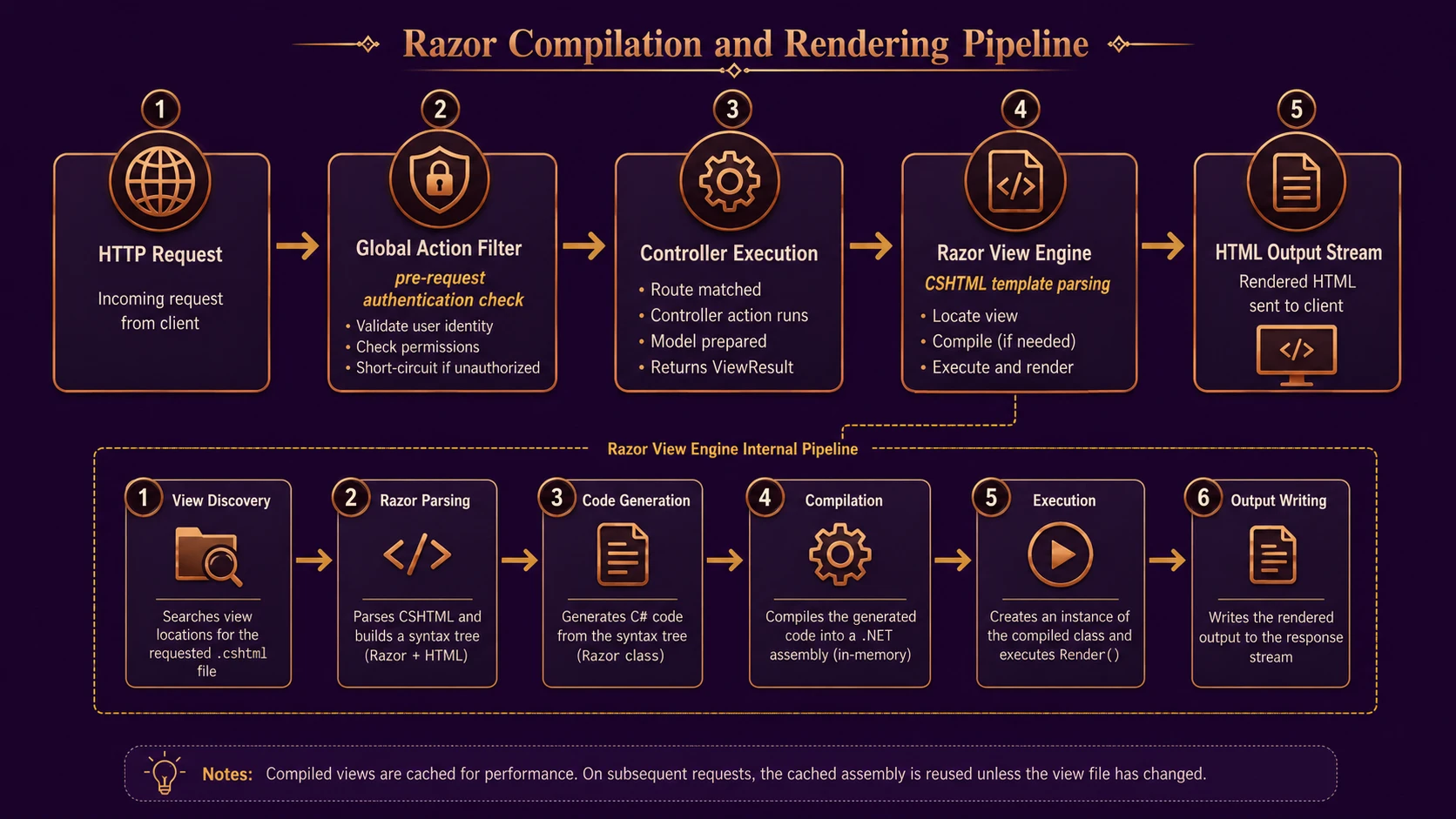
Model-View-Controller processing pipeline resolving client requests into dynamic pages.
Validation remains an essential component of enterprise web applications.
ASP.NET MVC continues supporting validation through model metadata and validation attributes.
Benefits include:
- ◆Centralized validation rules
- ◆Improved consistency
- ◆Reduced duplicate validation logic
- ◆Better maintainability
Proper validation improves application reliability while reducing server-side processing errors.
Enterprise Architecture Example
A well-designed MVC application may follow this layered architecture.
Browser
      |
MVC Controllers
      |
Application Services
      |
Business Layer
      |
Repositories
      |
Entity Framework
      |
SQL Server
Each layer maintains clear responsibilities, making applications easier to evolve over time.
Enterprise Use Cases
Customer Relationship Management
MVC applications can support:
- ◆Customer management
- ◆Sales tracking
- ◆Opportunity management
- ◆Reporting dashboards
Financial Services
Financial organizations can build:
- ◆Account portals
- ◆Loan processing systems
- ◆Administrative dashboards
- ◆Internal management tools
Healthcare
Healthcare applications may include:
- ◆Patient administration
- ◆Appointment scheduling
- ◆Clinical reporting
- ◆Staff management
Manufacturing
Manufacturing organizations can develop:
- ◆Inventory systems
- ◆Production dashboards
- ◆Supplier portals
- ◆Equipment management
The framework's layered architecture adapts well to a variety of enterprise scenarios.
Performance Considerations
Enterprise applications should be designed with scalability in mind.
Recommended practices include:
- ◆Minimize unnecessary controller processing.
- ◆Use partial views appropriately.
- ◆Cache frequently accessed data.
- ◆Reduce database round trips.
- ◆Optimize generated HTML.
- ◆Monitor application performance under realistic workloads.
Performance optimization should be considered throughout development rather than after deployment.
Best Practices
Organizations adopting ASP.NET MVC 3 should consider the following recommendations.
Keep Controllers Lightweight
Controllers should coordinate application flow rather than contain extensive business logic.
Use Razor Consistently
Standardizing on Razor simplifies view maintenance across development teams.
Centralize Cross-Cutting Concerns
Leverage Global Filters for common application behaviors.
Maintain Layered Architecture
Business logic should remain independent of presentation concerns.
Build Reusable Views
Shared layouts and partial views reduce duplication while improving consistency.
Common Mistakes
Enterprise teams adopting MVC often encounter similar issues.
Placing Business Logic Inside Controllers
Controllers should delegate work to business services rather than implement complex business rules directly.
Duplicating View Code
Failure to use layouts and partial views increases maintenance effort.
Overusing View Logic
Views should focus on presentation rather than application behavior.
Ignoring Dependency Injection
Tightly coupled controllers become more difficult to test and maintain.
Inconsistent Filter Usage
Global Filters should manage application-wide behaviors rather than repeating filter attributes throughout the project.
Migrating Existing ASP.NET Applications
Organizations with existing Web Forms applications should approach MVC adoption incrementally.
Recommended roadmap:
- 1.Evaluate suitable new modules.
- 2.Introduce MVC for greenfield development.
- 3.Standardize project architecture.
- 4.Adopt Razor for new views.
- 5.Register common behaviors using Global Filters.
- 6.Implement dependency injection where appropriate.
- 7.Expand MVC adoption based on project success.
An incremental migration strategy minimizes disruption while allowing development teams to gain practical experience.
ASP.NET MVC 3 Compared with Earlier MVC Versions
| Earlier MVC Releases | ASP.NET MVC 3 |
|---|---|
| Web Forms view engine commonly used | Razor view engine available |
| Repeated filter registration | Global Filters |
| Good extensibility | Enhanced extensibility |
| MVC architecture | Improved developer productivity |
| Testable applications | Continued focus on testability |
The framework builds upon earlier MVC releases while introducing features that simplify day-to-day development.
Adoption Recommendations
Organizations evaluating ASP.NET MVC 3 should focus on architectural consistency rather than simply adopting new framework features.
Recommended priorities include:
- ◆Standardize Razor usage.
- ◆Implement layered application architecture.
- ◆Keep controllers lightweight.
- ◆Centralize common functionality with Global Filters.
- ◆Invest in automated testing.
- ◆Encourage code reviews and architectural governance.
Following these practices will improve maintainability as enterprise applications continue to grow.
Looking Ahead
ASP.NET MVC 3 represents another important milestone in Microsoft's modern web application framework. The introduction of the Razor view engine simplifies view development through cleaner syntax, while Global Filters provide a more elegant solution for managing cross-cutting application concerns.
For enterprise development teams planning new web applications, ASP.NET MVC 3 offers a compelling combination of flexibility, maintainability, and architectural discipline. Organizations that adopt sound MVC practices, embrace clean separation of concerns, and establish consistent development standards will be well positioned to build scalable web applications capable of adapting to changing business requirements.