Introduction
Modern web applications have grown considerably more complex over the past decade. Rich JavaScript applications, AJAX-driven interfaces, multimedia content, and increasingly interactive user experiences have dramatically increased the number of HTTP requests required to render a single web page.
While broadband connectivity continues to improve, latency remains one of the most significant obstacles to delivering responsive web applications. Opening multiple TCP connections, repeatedly transmitting HTTP headers, and processing requests sequentially all contribute to unnecessary delays.
To address these limitations, Google introduced the SPDY protocol, an experimental application-layer protocol designed to improve web performance while preserving compatibility with existing HTTP semantics. Rather than replacing HTTP entirely, SPDY seeks to optimize how HTTP messages are transported between clients and servers.
For enterprise architects, web platform engineers, and infrastructure teams, SPDY represents an important architectural development that demonstrates how protocol-level innovation can significantly improve application responsiveness without requiring major application rewrites.
Industry Background
HTTP has served as the foundation of the World Wide Web for many years. Its simplicity and widespread adoption have made it one of the most successful application protocols ever developed. However, HTTP was originally designed during an era when web pages consisted primarily of static documents and relatively few embedded resources.
Contemporary websites routinely require dozens or even hundreds of requests to retrieve:
- ◆Images
- ◆Cascading Style Sheets
- ◆JavaScript libraries
- ◆Fonts
- ◆AJAX responses
- ◆Multimedia assets
- ◆API requests
Although HTTP/1.1 introduced persistent connections and pipelining, practical limitations have prevented these features from fully addressing modern performance requirements.
Browser vendors have instead relied upon techniques such as opening multiple parallel connections to improve throughput, increasing infrastructure complexity.
The Business Problem
Enterprise organizations increasingly depend upon web-based applications for customer engagement and internal operations. Poor application responsiveness directly affects productivity, customer satisfaction, and infrastructure efficiency.
Common performance challenges include:
- ◆High request latency
- ◆Excessive TCP connection establishment
- ◆Duplicate HTTP header transmission
- ◆Blocking caused by sequential request processing
- ◆Inefficient resource prioritization
- ◆Increased bandwidth consumption
As applications become richer, these inefficiencies become more pronounced.
Understanding SPDY
SPDY is designed to reduce page load times by improving the transport characteristics of HTTP communications.
Importantly, SPDY does not alter the HTTP request and response model visible to application developers. Existing web applications continue to operate using familiar HTTP methods, status codes, cookies, and URIs.
Instead, SPDY introduces an optimized communication layer between browsers and servers.
Its primary objectives include:
- ◆Lower latency
- ◆Better bandwidth utilization
- ◆Fewer TCP connections
- ◆Reduced protocol overhead
- ◆Improved resource prioritization
- ◆More efficient encrypted communication
This architectural approach allows applications to benefit from protocol improvements without requiring significant redesign.
Core Architecture
SPDY introduces several enhancements over conventional HTTP transport.
| Component | Responsibility |
|---|---|
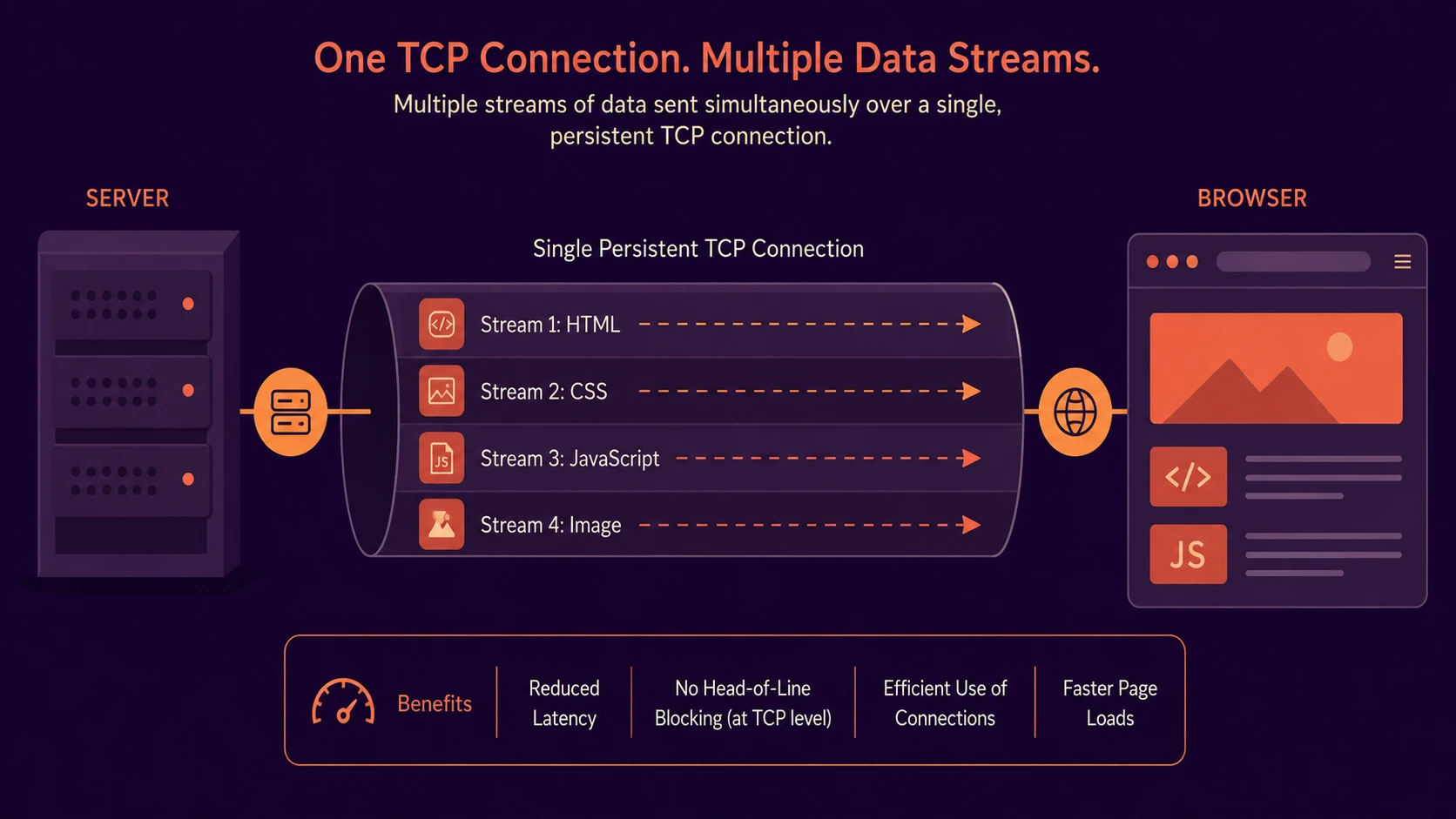
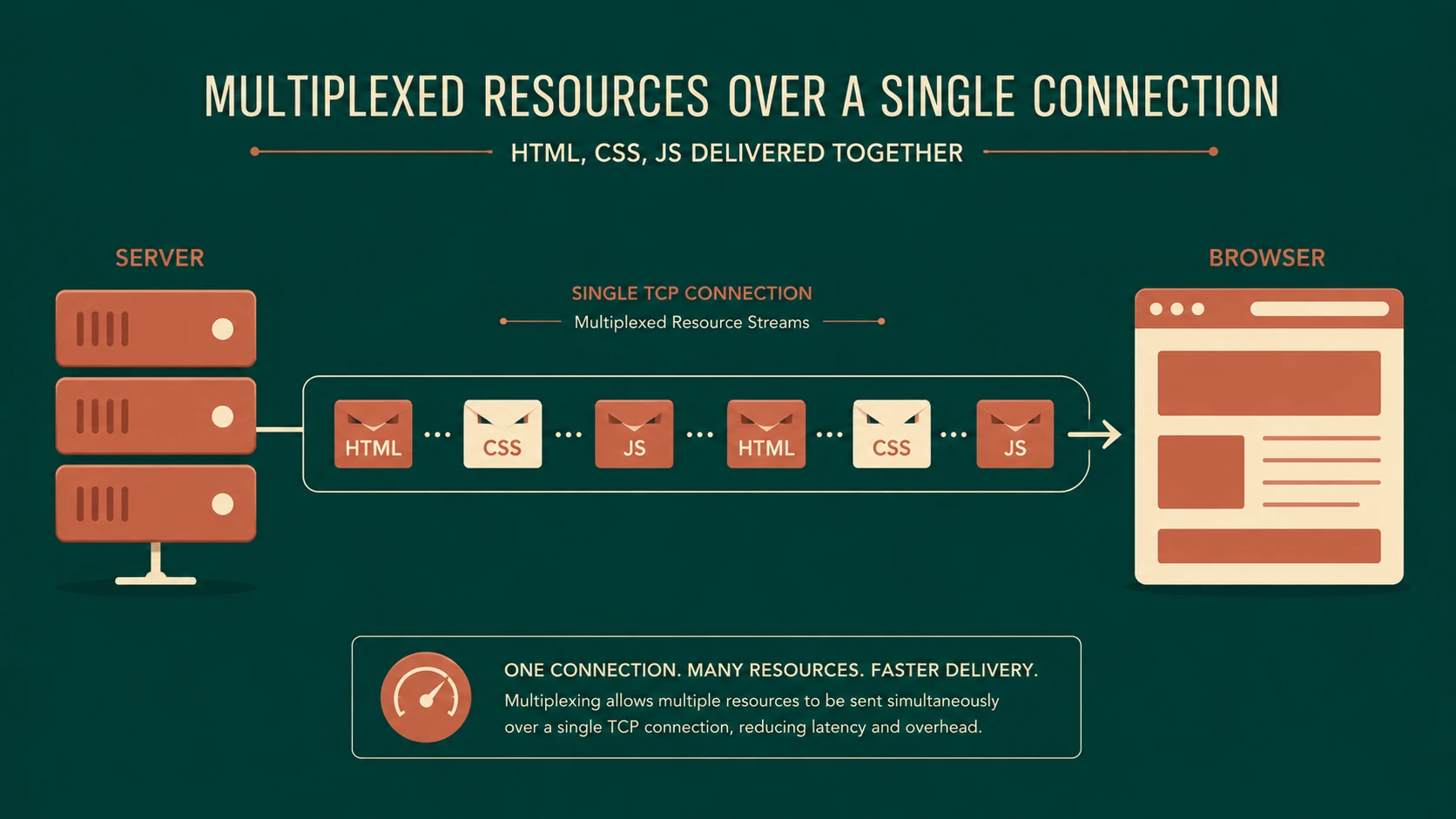
| Single TCP Connection | Carries multiple concurrent requests |
| Multiplexed Streams | Eliminates blocking between requests |
| Header Compression | Reduces repetitive metadata |
| Stream Prioritization | Delivers important resources first |
| Server Push | Allows proactive resource delivery |
| SSL/TLS Transport | Secure communication channel |
Together, these capabilities reduce unnecessary network overhead while improving responsiveness.
How SPDY Works
A simplified request lifecycle includes:
- 1.Browser establishes a secure connection.
- 2.Multiple logical streams are created within the same connection.
- 3.Requests are transmitted concurrently.
- 4.HTTP headers are compressed before transmission.
- 5.Server prioritizes responses.
- 6.Important resources are delivered first.
- 7.Additional resources may be pushed proactively when appropriate.
Unlike traditional HTTP communication, multiple requests no longer require numerous independent TCP connections.
Key Features
Stream Multiplexing
// Node.js HTTP/2 SPDY-like multiplexed connection handling multiple asset streams
const http2 = require('http2');
const fs = require('fs');

const server = http2.createSecureServer({
  key: fs.readFileSync('server-key.pem'),
  cert: fs.readFileSync('server-cert.pem')
});

server.on('stream', (stream, headers) => {
  // Multi-stream response sending text and binary frames over the single connection
  stream.respond({
    'content-type': 'text/html; charset=utf-8',
    ':status': 200
  });
  stream.end('<h1>Multiplexed Stream Loaded Natively!</h1>');
});

server.listen(8443);
Multiple requests share a single network connection, significantly reducing connection establishment overhead.
Header Compression
Repeated HTTP headers consume considerable bandwidth. SPDY compresses these headers to reduce transmission size.
Request Prioritization
Browsers may indicate resource importance, allowing critical assets to be delivered before lower-priority requests.
Server Push
Servers can proactively transmit resources likely to be required by the client without waiting for explicit requests.
Persistent Secure Connections
SPDY encourages long-lived encrypted connections, minimizing repeated connection negotiation.
Enterprise Use Cases
Organizations operating large web platforms may benefit from SPDY in several scenarios.
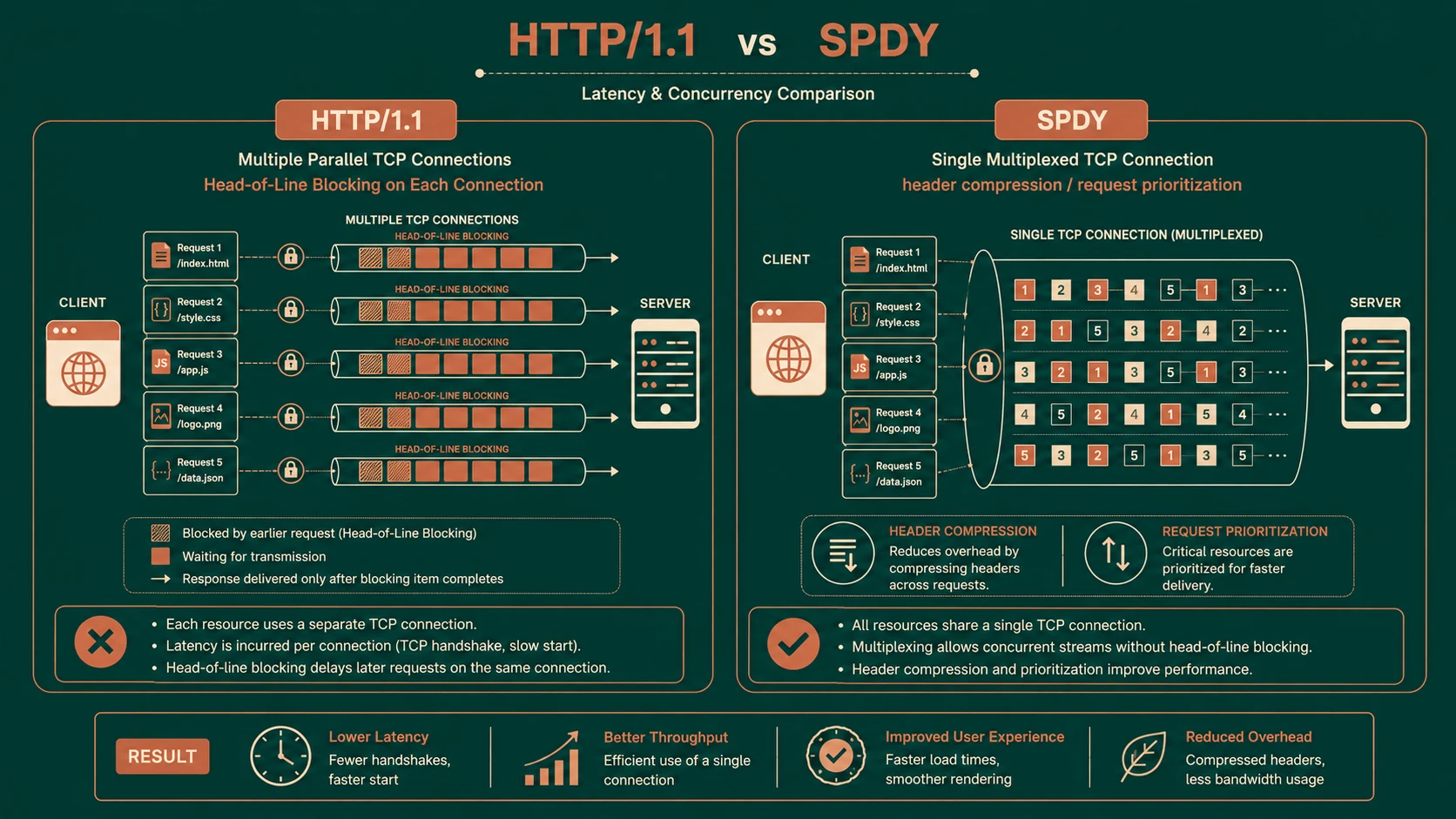
System architecture diagram and conceptual workflow layout for Web Performance.
Enterprise Portals
Applications containing numerous interface assets can reduce latency through multiplexed communication.
E-Commerce Platforms
Faster page rendering may improve browsing responsiveness during customer interactions.
Software as a Service
Cloud-hosted applications serving geographically distributed users benefit from reduced protocol overhead.
Content Management Systems
Large websites containing substantial static resources may experience improved resource delivery.
Mobile Web Applications
Reducing round-trip communication becomes increasingly valuable on higher-latency mobile networks.
Performance Considerations
SPDY focuses primarily on reducing latency rather than increasing raw bandwidth.
Potential performance improvements include:
- ◆Fewer TCP handshakes
- ◆Reduced protocol overhead
- ◆Lower page rendering times
- ◆Better network utilization
- ◆Improved encrypted communication efficiency
- ◆Reduced blocking between requests
Actual performance gains depend upon application architecture, network conditions, browser support, and server implementation.
Security Considerations
SPDY is commonly deployed over SSL/TLS, encouraging encrypted communication as the default transport.
Enterprise deployments should continue implementing:
- ◆Strong certificate management
- ◆Secure authentication
- ◆Session protection
- ◆Network monitoring
- ◆Secure key management
- ◆Regular server updates
Although SPDY improves transport efficiency, application-layer security remains the responsibility of developers and infrastructure administrators.
Scalability
From an infrastructure perspective, SPDY provides several scalability advantages.
These include:
- ◆Reduced connection management overhead
- ◆Improved server resource utilization
- ◆Better bandwidth efficiency
- ◆Lower latency under concurrent workloads
- ◆Simplified handling of resource-heavy web pages
Organizations operating high-traffic web platforms should nevertheless perform extensive performance testing before production deployment.
Best Practices
Organizations evaluating SPDY should consider the following recommendations.
- ◆Enable SSL/TLS correctly.
- ◆Benchmark representative workloads.
- ◆Optimize static resource delivery.
- ◆Continue minimizing unnecessary HTTP requests.
- ◆Monitor connection utilization.
- ◆Test browser compatibility thoroughly.
- ◆Profile application performance before and after deployment.
- ◆Integrate protocol optimization with broader web performance initiatives.
Common Mistakes
| Mistake | Enterprise Impact |
|---|---|
| Assuming SPDY replaces application optimization | Limited performance gains |
| Ignoring browser compatibility | Inconsistent user experience |
| Poor SSL configuration | Reduced security |
| Excessive resource payloads | Increased latency |
| Neglecting performance measurement | Unclear deployment value |
| Overlooking caching strategy | Unnecessary network traffic |
Protocol improvements complement, rather than replace, efficient application design.
Technology Comparison
| Capability | HTTP/1.1 | SPDY |
|---|---|---|
| Multiple TCP Connections | Typically Required | Single Shared Connection |
| Request Multiplexing | Limited | Yes |
| Header Compression | No | Yes |
| Request Prioritization | No | Yes |
| Server Push | No | Yes |
| Latency Optimization | Limited | Improved |
SPDY maintains compatibility with HTTP semantics while modernizing the transport layer.
Adoption Strategy
Organizations interested in SPDY should begin with controlled deployments.
Recommended steps include:
- 1.Identify latency-sensitive applications.
- 2.Upgrade compatible web servers.
- 3.Verify browser support.
- 4.Benchmark application performance.
- 5.Monitor network utilization.
- 6.Measure user experience improvements.
- 7.Expand deployment incrementally.
- 8.Continue optimizing application architecture alongside protocol enhancements.
A phased rollout reduces operational risk while allowing infrastructure teams to validate measurable improvements.
Limitations
Although SPDY introduces important innovations, organizations should recognize several limitations.
- ◆Browser support is still evolving.
- ◆Server implementations remain relatively new.
- ◆Existing infrastructure may require upgrades.
- ◆Performance improvements vary according to workload characteristics.
- ◆Protocol optimization cannot compensate for inefficient application design.
Enterprises should therefore evaluate SPDY as one component of a comprehensive web performance strategy.
Looking Ahead
From the perspective of July 2012, SPDY represents one of the most ambitious attempts to modernize web communication without abandoning the established HTTP application model. Its innovations in multiplexing, header compression, request prioritization, and server push demonstrate that substantial performance improvements can be achieved through protocol engineering rather than application redesign.
As browser vendors, server developers, and standards organizations continue exploring more efficient approaches to web communication, many of the architectural concepts demonstrated by SPDY are expected to influence future discussions surrounding the evolution of HTTP. For enterprise architects planning long-term web infrastructure investments, SPDY provides valuable insight into the direction of next-generation web protocol optimization.