Introduction
Enterprise IT has evolved significantly over the past decade. Organizations are no longer building isolated business applications that operate independently. Instead, customer relationship management systems, ERP platforms, financial applications, partner portals, mobile clients, reporting solutions, and Software-as-a-Service (SaaS) offerings increasingly require seamless communication.
Web services have emerged as the preferred approach for enabling interoperability between heterogeneous systems. Whether integrating applications developed in Java, .NET, PHP, Python, or other technologies, standardized service interfaces reduce coupling and improve long-term maintainability.
Two architectural approaches dominate current discussions: SOAP (Simple Object Access Protocol) and REST (Representational State Transfer). SOAP has been widely adopted for enterprise service-oriented architecture (SOA) initiatives, while REST is gaining momentum due to its simplicity, lightweight communication model, and growing use by public web platforms.
As of September 2010, many enterprise architects face an important decision. Should new integration projects continue to rely on mature SOAP-based infrastructure, or is REST sufficiently capable for enterprise workloads?
The answer depends on business requirements, governance, interoperability, security expectations, and operational complexity.
This article explores both architectural styles, compares their strengths and weaknesses, discusses enterprise use cases, and provides practical guidance for organizations evaluating service-oriented architectures today.
Why Enterprise Integration Matters
Modern enterprises depend upon multiple business applications working together.
Typical integration scenarios include:
- ◆ERP communicating with CRM
- ◆Customer portals accessing internal systems
- ◆Financial platforms exchanging transaction data
- ◆Inventory systems synchronizing with e-commerce applications
- ◆Business intelligence platforms aggregating operational information
- ◆External partner integrations
Without standardized service interfaces, organizations often rely on fragile point-to-point integrations that become increasingly difficult to maintain as systems grow.
Web services reduce this complexity by exposing business functionality through standardized interfaces.
Understanding SOAP
SOAP is a protocol specification designed for structured information exchange between applications.
SOAP messages are XML-based and generally transported over HTTP, although other transport mechanisms are also supported.
SOAP services commonly rely on:
- ◆XML messaging
- ◆WSDL (Web Services Description Language)
- ◆XML Schema
- ◆Standardized message contracts
- ◆WS-* specifications
These standards provide consistency and interoperability across multiple enterprise platforms.
A Typical SOAP Architecture
Client Application
        |
    SOAP Request (XML)
        |
    HTTP Transport
        |
Application Server
        |
Business Logic
        |
Enterprise Database
Because the service contract is formally defined using WSDL, client applications can often generate proxy classes automatically.
Strengths of SOAP
SOAP has gained significant enterprise adoption because it addresses many enterprise integration requirements.
Key strengths include:
- ◆Strong contract definition through WSDL
- ◆Platform independence
- ◆Extensive tooling support
- ◆Mature standards
- ◆Built-in extensibility
- ◆Enterprise interoperability
- ◆Support for complex messaging scenarios
Large organizations implementing Service-Oriented Architecture (SOA) frequently appreciate the governance provided by SOAP standards.
Understanding REST
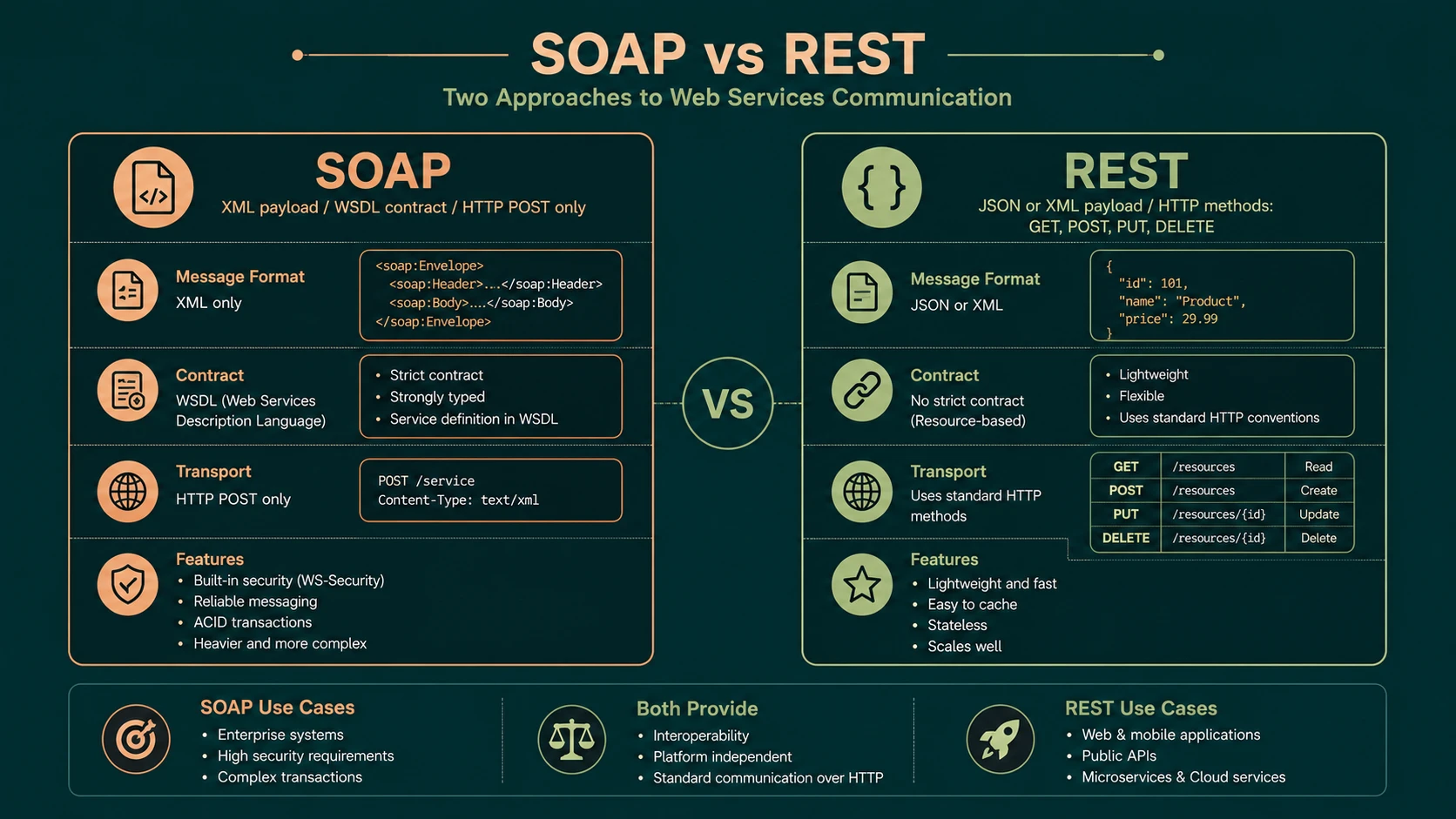
REST is an architectural style rather than a protocol.
RESTful services leverage standard HTTP capabilities while representing resources using URLs.
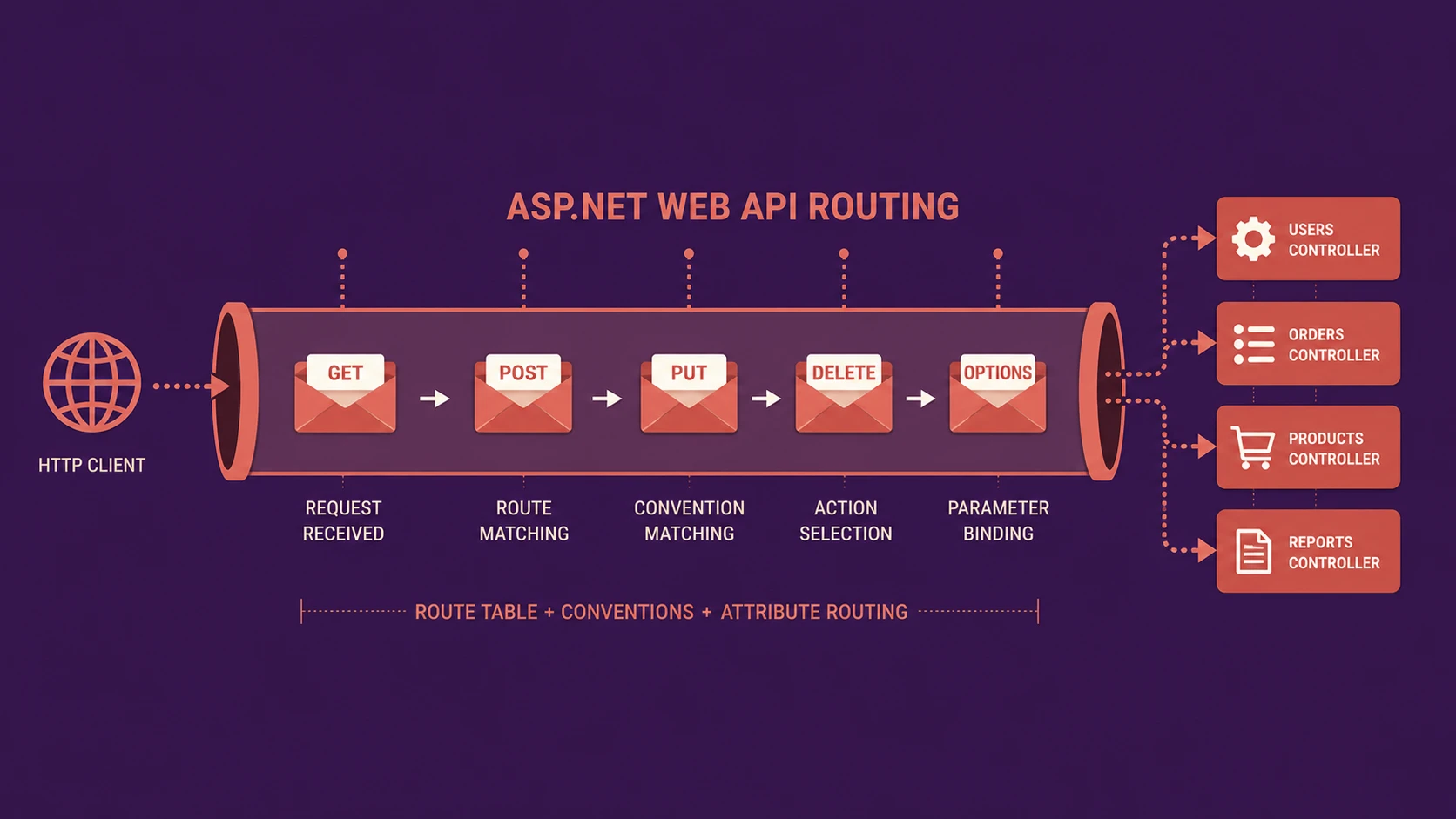
Rather than defining operations through formal contracts, REST focuses on manipulating resources using HTTP methods such as:
- ◆GET
- ◆POST
- ◆PUT
- ◆DELETE
Resources are commonly represented using XML, although other representations may also be used.
The emphasis is on simplicity, stateless communication, and efficient resource access.
A Typical REST Architecture
Client
   |
HTTP Request
(GET /customers/100)
   |
REST Service
   |
Business Logic
   |
Database
Because REST relies heavily on standard HTTP semantics, services are often easier to understand and consume.
SOAP vs REST Comparison
| Feature | SOAP | REST |
|---|---|---|
| Architecture | Protocol | Architectural Style |
| Data Format | XML | Commonly XML |
| Contract | WSDL | Resource-Based |
| Complexity | Higher | Lower |
| Message Size | Larger | Smaller |
| HTTP Dependency | Optional | Fundamental |
| Learning Curve | Steeper | Easier |
| Enterprise Standards | Extensive | Emerging |
| State Management | Flexible | Stateless |
Both approaches provide valuable capabilities, but they address different architectural priorities.
Enterprise Architecture Considerations
Selecting between SOAP and REST requires evaluating enterprise requirements rather than following industry trends.
A typical enterprise architecture may include both approaches.
Web Browser
      |
REST Services
      |
Portal Application
      |
Enterprise Service Layer
      |
SOAP Services
      |
ERP / CRM / Legacy Systems
In many organizations, REST services expose lightweight interfaces to web applications while SOAP continues supporting internal enterprise integration.
Security Considerations
Security remains a primary concern for enterprise integration.
SOAP implementations frequently leverage mature enterprise security standards available through the WS-* family of specifications.
Common enterprise requirements include:
- ◆Authentication
- ◆Authorization
- ◆Message integrity
- ◆Confidentiality
- ◆Digital signatures
- ◆Secure communication
REST services typically rely upon transport-level security such as HTTPS together with application-specific authentication mechanisms.
Organizations should evaluate whether their security requirements align with the chosen architecture.
Performance Considerations
Performance characteristics differ between the two approaches.
SOAP messages generally contain additional XML structure, increasing message size.
REST requests often involve:
Service-Oriented Architecture (SOA) channel bindings and message security configurations.
- ◆Smaller payloads
- ◆Simpler parsing
- ◆Reduced bandwidth usage
- ◆Lower processing overhead
For high-volume web applications, these differences may influence architectural decisions.
However, performance should always be measured within the context of the complete application rather than evaluated solely at the protocol level.
Enterprise Use Cases
Financial Systems
Financial institutions frequently require standardized contracts, robust security, and reliable enterprise integration.
SOAP often aligns well with these requirements.
Customer Portals
Public-facing websites benefit from lightweight communication and straightforward resource access.
REST can simplify browser-based interactions.
Mobile and Lightweight Clients
Although mobile platforms are still evolving, lightweight service interfaces reduce network overhead and simplify application development.
Internal Business Applications
Organizations modernizing existing systems may choose SOAP for internal service contracts while exposing REST interfaces for newer web-based applications.
Business Partner Integration
Partner requirements often determine service architecture.
Some organizations already depend heavily on SOAP-based interfaces, while others increasingly request RESTful services.
Best Practices
Successful enterprise service implementations follow consistent engineering principles regardless of architectural style.
- ◆Design stable service interfaces.
- ◆Maintain backward compatibility.
- ◆Validate all input.
- ◆Document service contracts clearly.
- ◆Secure communication channels.
- ◆Implement centralized logging.
- ◆Monitor service availability.
- ◆Apply consistent error handling.
- ◆Version services carefully.
- ◆Minimize unnecessary network calls.
These practices improve maintainability and reduce long-term operational risk.
Common Mistakes
Several implementation issues frequently affect enterprise integration projects.
Choosing Technology Before Requirements
Architectural decisions should follow business needs rather than technology preferences.
Creating Chatty Services
Large numbers of small network requests can negatively impact overall performance.
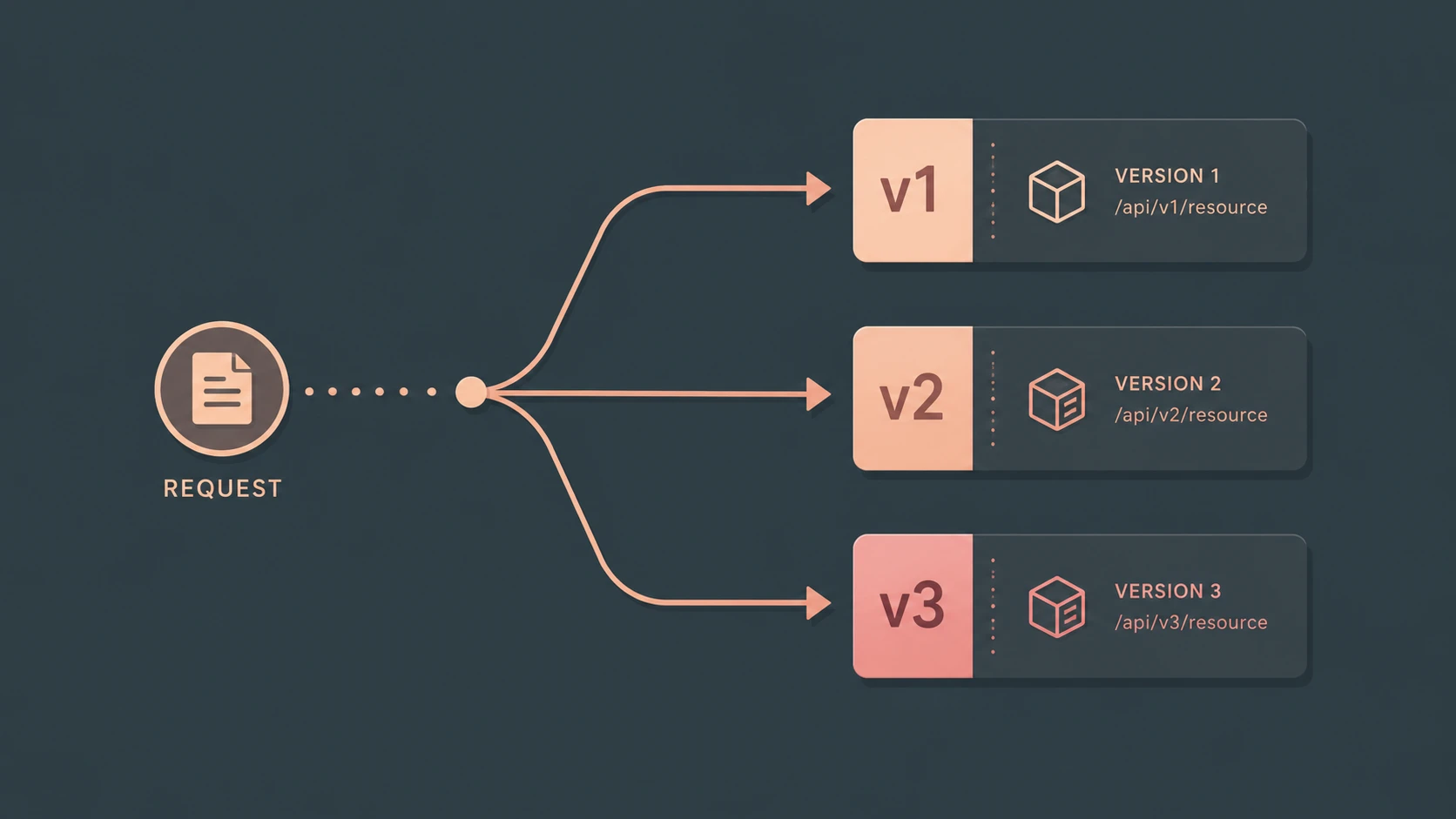
Ignoring Versioning
Service interfaces inevitably evolve over time. Versioning strategies should be established early.
Weak Documentation
Undocumented services become difficult to maintain and integrate.
Overcomplicating Service Design
Not every application requires the full capabilities of enterprise messaging standards.
Keeping services focused improves maintainability.
Adoption Recommendations
Organizations evaluating REST and SOAP should adopt a pragmatic strategy.
Phase 1
- ◆Inventory existing integration points.
- ◆Define enterprise integration standards.
- ◆Identify security requirements.
Phase 2
- ◆Standardize service governance.
- ◆Build reusable service templates.
- ◆Establish monitoring and logging practices.
Phase 3
- ◆Introduce REST for lightweight web-facing services where appropriate.
- ◆Continue leveraging SOAP for existing enterprise integrations requiring mature standards.
Phase 4
- ◆Review architectural consistency.
- ◆Measure operational performance.
- ◆Continue refining enterprise integration practices.
A balanced approach enables organizations to benefit from both technologies while minimizing disruption.
Factors Influencing the Decision
Before selecting an architecture, enterprise teams should evaluate:
- ◆Existing technology investments
- ◆Development expertise
- ◆Tooling availability
- ◆Security requirements
- ◆Interoperability expectations
- ◆Performance objectives
- ◆Governance policies
- ◆Long-term maintenance considerations
No single architecture satisfies every integration scenario.
Building an Enterprise Integration Strategy
Successful enterprise integration depends less on selecting a particular protocol and more on establishing sound architectural principles.
Organizations should focus on:
- ◆Loose coupling
- ◆Service reusability
- ◆Clear interface contracts
- ◆Consistent security policies
- ◆Operational monitoring
- ◆Scalable deployment architectures
These principles remain valuable regardless of whether services are implemented using SOAP or REST.
Looking Ahead
Enterprise integration continues to evolve as organizations connect an increasing number of internal systems, partner platforms, and web applications. SOAP remains a mature and proven foundation for many enterprise SOA initiatives, while REST is rapidly gaining attention for its simplicity, efficient use of HTTP, and suitability for modern web applications.
As enterprises continue evaluating integration strategies throughout 2010, architects should avoid treating REST and SOAP as mutually exclusive alternatives. Instead, they should select the approach that best aligns with each application's functional requirements, governance expectations, and operational objectives. A thoughtful combination of both architectural styles may provide the flexibility needed to support current business initiatives while accommodating future integration requirements.