Introduction
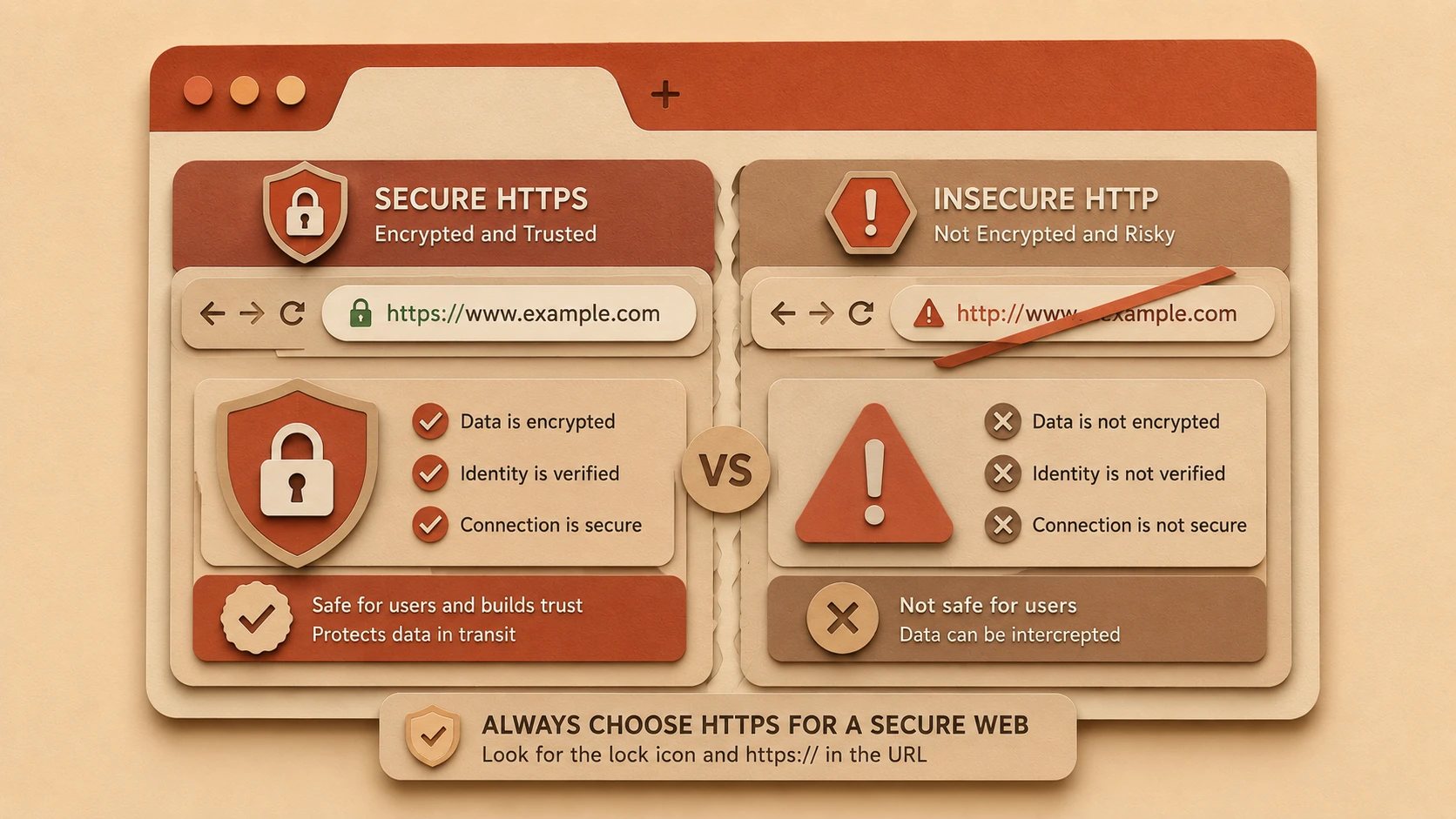
Transport Layer Security (TLS) has become a fundamental requirement for modern web applications. Enterprise portals, Software as a Service (SaaS) platforms, customer-facing websites, RESTful APIs, and cloud-hosted business applications increasingly rely on encrypted communication to protect sensitive information exchanged over public networks.
Although HTTPS adoption has steadily increased, certificate deployment and renewal remain operational challenges for many organizations. Traditional certificate issuance often involves manual requests, domain validation procedures, installation steps, and periodic renewal activities. These manual processes can result in expired certificates, service interruptions, administrative overhead, and inconsistent security practices.
Let's Encrypt enters public beta with the objective of making certificate issuance automatic and freely available. Built around the Automated Certificate Management Environment (ACME) protocol, Let's Encrypt enables web servers to request, validate, install, and renew certificates through standardized automated workflows.
For enterprise architects and infrastructure engineers, this represents an important step toward reducing operational complexity while encouraging broader adoption of HTTPS.
Industry Background
As cloud computing, mobile applications, and API-driven architectures continue expanding, encrypted communication has become increasingly important. Browsers, search engines, and security professionals continue encouraging organizations to protect web traffic using HTTPS.
Historically, certificate management has involved:
- ◆Manual certificate requests
- ◆Domain ownership validation
- ◆Administrative approval
- ◆Server installation
- ◆Periodic renewal
- ◆Certificate replacement
These processes often require coordination between infrastructure, operations, and security teams.
Let's Encrypt seeks to automate much of this lifecycle through standardized protocols.
The Business Problem
Organizations commonly experience:
- ◆Certificate expiration
- ◆Manual renewal procedures
- ◆Administrative overhead
- ◆Inconsistent deployment practices
- ◆Higher operational costs
- ◆Delayed HTTPS adoption
- ◆Difficult certificate inventory management
Manual certificate administration becomes increasingly difficult as organizations deploy larger numbers of websites and services.
Automation addresses these operational challenges while reducing the likelihood of configuration errors.
Understanding Let's Encrypt
Let's Encrypt is a Certificate Authority (CA) designed to automate the issuance and renewal of SSL/TLS certificates.
Rather than requiring manual interaction for every certificate request, Let's Encrypt relies on software clients implementing the ACME protocol.
The overall objective is to simplify HTTPS deployment by allowing certificate management to become part of normal infrastructure automation.
The service is currently available as a public beta in October 2015.
Core Architecture
| Component | Responsibility |
|---|---|
| Web Server | Hosts secured applications |
| ACME Client | Requests and manages certificates |
| Let's Encrypt CA | Issues certificates |
| Domain Validation Service | Verifies domain control |
| Certificate Store | Maintains issued certificates |
| TLS Stack | Provides encrypted communication |
Each component contributes to an automated certificate lifecycle while reducing manual operational effort.
Understanding ACME
The Automated Certificate Management Environment (ACME) protocol defines a standardized mechanism for requesting and managing certificates.
Instead of manually completing certificate requests, software clients communicate directly with the Certificate Authority.
Typical responsibilities include:
- ◆Account registration
- ◆Certificate requests
- ◆Domain validation
- ◆Certificate retrieval
- ◆Renewal automation
Automation minimizes repetitive administrative work while improving deployment consistency.
Certificate Lifecycle
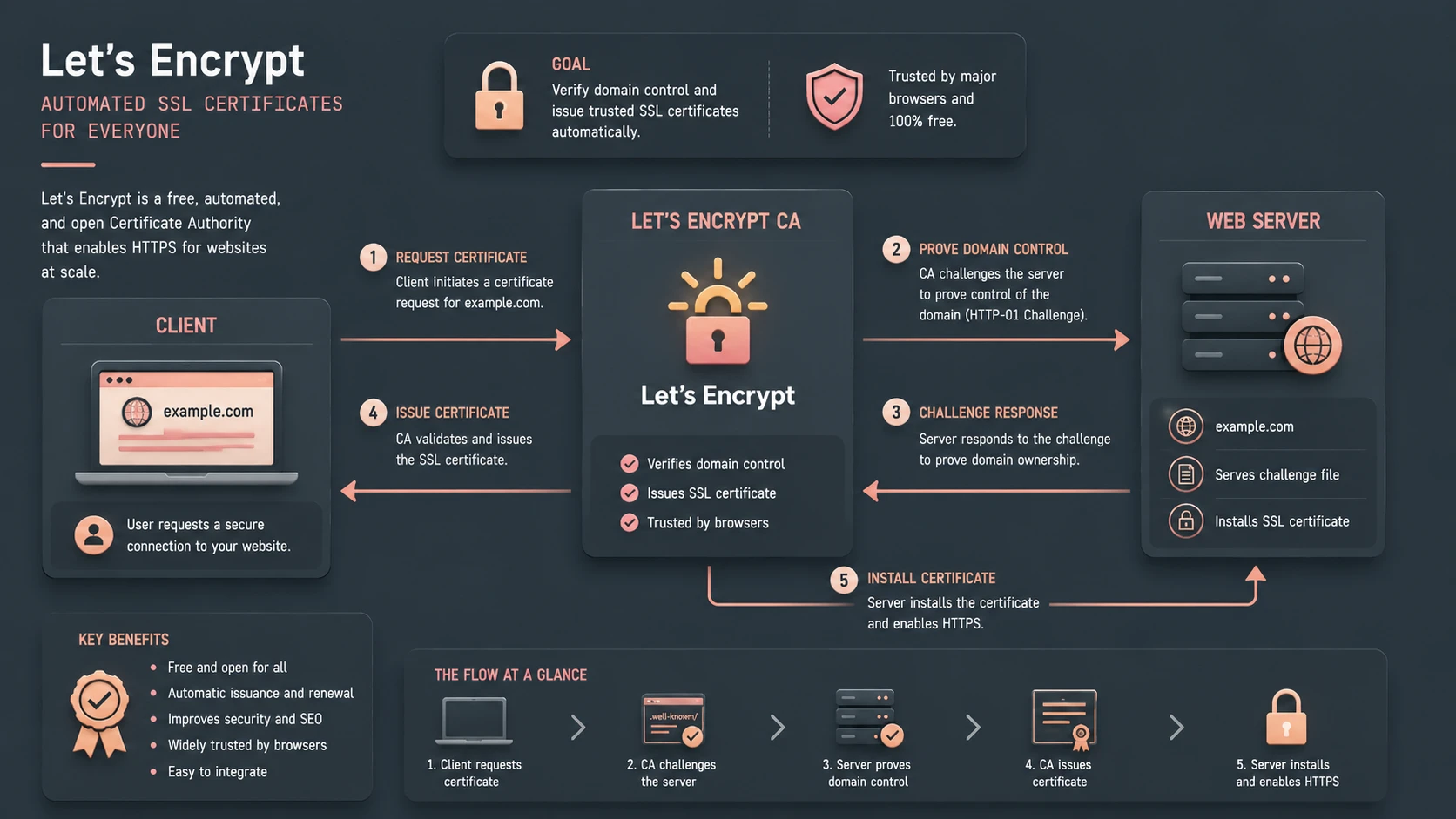
A typical certificate workflow proceeds as follows:
- 1.An ACME client requests a certificate.
- 2.The Certificate Authority issues a domain validation challenge.
- 3.The client proves control of the requested domain.
- 4.Validation succeeds.
- 5.The certificate is issued.
- 6.The certificate is installed.
- 7.Renewal is performed automatically before expiration.
This workflow significantly reduces manual certificate administration.
Domain Validation
# Let's Encrypt domain validation via certbot CLI using ACME HTTP-01 challenge
certbot certonly --webroot \
  -w /var/www/html/ \
  -d secure.shivamitcs.com \
  --email admin@shivamitcs.com \
  --agree-tos \
  --non-interactive
Before issuing a certificate, the Certificate Authority must verify domain ownership.
Validation generally demonstrates that the requesting system controls the specified domain.
Successful validation prevents unauthorized certificate issuance for domains owned by others.
Automated validation enables certificates to be issued rapidly while preserving trust in the certificate ecosystem.
Automating Certificate Renewal
One of Let's Encrypt's most important capabilities is automated renewal.
Traditional certificate management often depends upon administrators remembering renewal dates.
Automation provides several benefits:
- ◆Reduced operational effort
- ◆Lower risk of expired certificates
- ◆Consistent deployment practices
- ◆Simplified infrastructure management
Renewal becomes a routine operational process rather than a periodic administrative project.
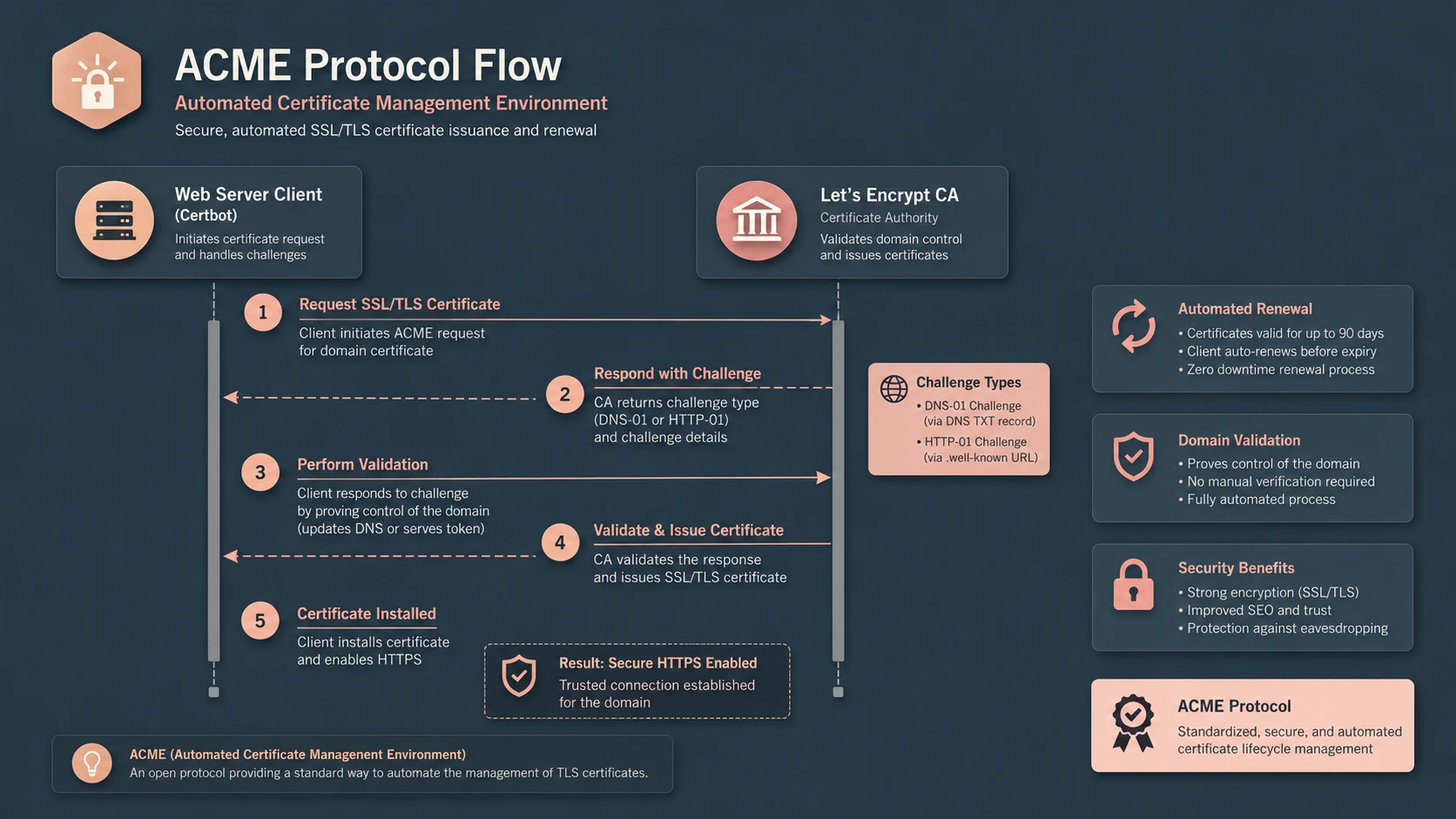
System architecture diagram and conceptual workflow layout for Let's Encrypt Public Beta.
Integrating with Web Infrastructure
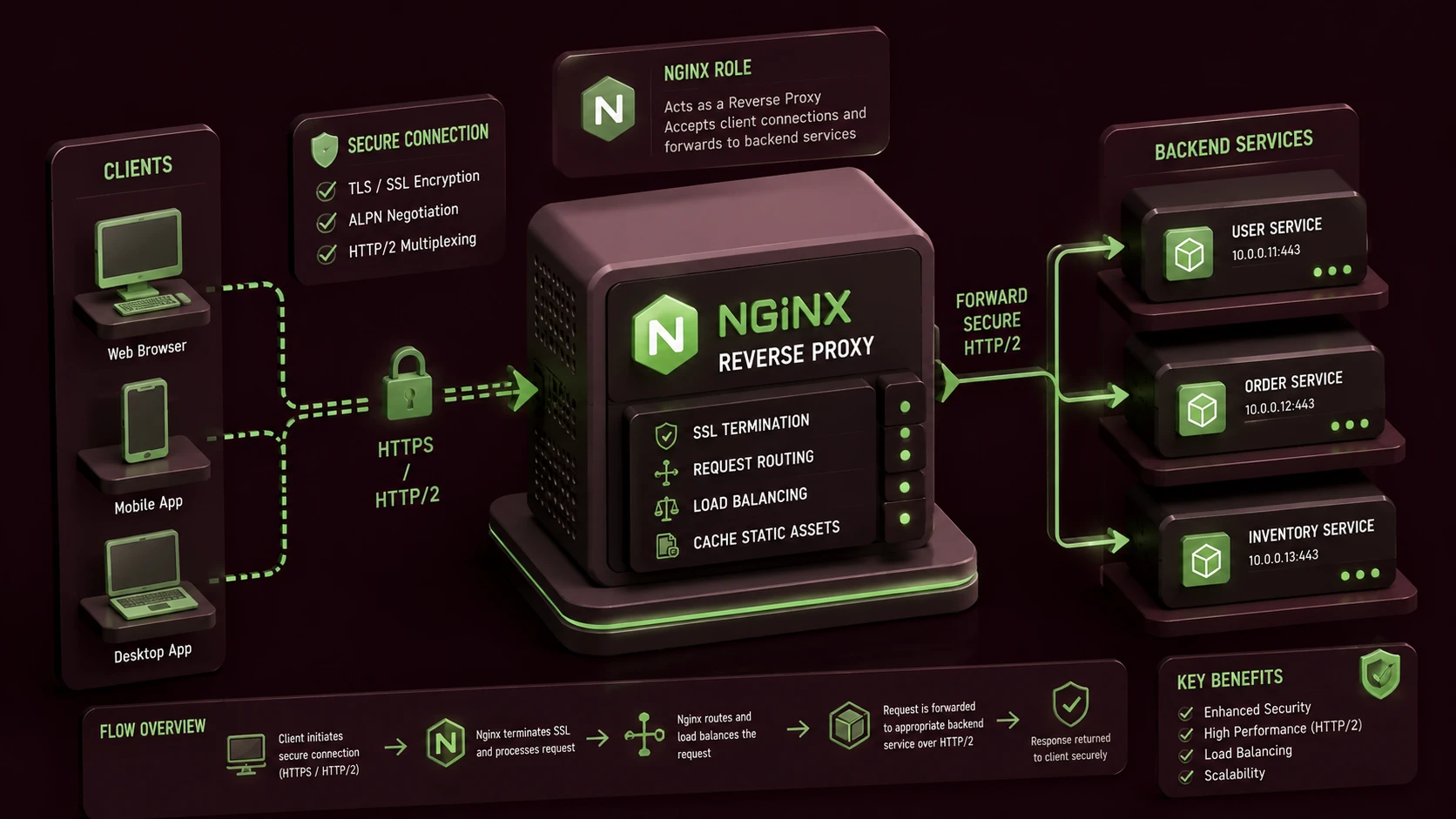
Let's Encrypt is designed to integrate with common web infrastructure.
Enterprise deployments may include:
- ◆Apache HTTP Server
- ◆Nginx
- ◆Reverse proxies
- ◆Load balancers
- ◆REST API gateways
- ◆Cloud-hosted web applications
Automation tools can incorporate certificate provisioning into deployment workflows.
Enterprise Use Cases
| Scenario | Benefit |
|---|---|
| SaaS Platforms | Automated certificate management |
| Enterprise Websites | Reduced administrative overhead |
| REST APIs | Simplified HTTPS deployment |
| Cloud Infrastructure | Automated lifecycle management |
| Development Environments | Consistent certificate provisioning |
| Customer Portals | Improved operational reliability |
Organizations operating numerous web services benefit most from certificate automation.
Performance Considerations
Certificate management has minimal impact on normal application performance.
Operational planning should instead consider:
- ◆Automated renewal scheduling
- ◆Deployment automation
- ◆Certificate storage
- ◆Validation reliability
- ◆Monitoring of renewal status
Reliable automation is generally more valuable than optimizing certificate issuance speed.
Security Considerations
Let's Encrypt improves certificate accessibility but does not eliminate the need for secure operational practices.
Organizations should continue implementing:
- ◆Secure private key storage
- ◆Strong server configuration
- ◆HTTPS-only deployment where appropriate
- ◆Access control for certificate management systems
- ◆Monitoring certificate expiration
- ◆Regular security reviews
Protecting private keys remains as important as obtaining certificates.
Scalability
Automated certificate provisioning supports infrastructure growth by:
- ◆Reducing manual administration
- ◆Standardizing deployment
- ◆Supporting large numbers of domains
- ◆Simplifying renewal processes
- ◆Integrating with automated infrastructure
These characteristics align well with cloud-based deployment models.
Best Practices
Organizations evaluating Let's Encrypt should:
- ◆Automate certificate issuance.
- ◆Automate certificate renewal.
- ◆Protect private keys carefully.
- ◆Monitor certificate status.
- ◆Integrate certificate management into deployment pipelines.
- ◆Test renewal procedures regularly.
- ◆Maintain inventory of deployed certificates.
- ◆Validate HTTPS configuration after deployment.
Operational automation should be accompanied by continuous monitoring.
Common Mistakes
Early adopters should avoid:
- ◆Assuming automation eliminates operational oversight.
- ◆Failing to monitor renewal jobs.
- ◆Insecure storage of private keys.
- ◆Treating certificate issuance as a substitute for secure server configuration.
- ◆Ignoring deployment testing after certificate updates.
- ◆Managing automated and manual certificates inconsistently.
Automation improves reliability but still requires sound operational governance.
Technology Comparison
| Capability | Traditional Certificate Management | Let's Encrypt with ACME |
|---|---|---|
| Certificate Requests | Manual | Automated |
| Renewal Process | Manual | Automated |
| Administrative Effort | High | Lower |
| Deployment Consistency | Varies | Improved |
| Operational Scalability | Moderate | High |
| Integration with Automation | Limited | Strong |
The primary advantage lies in automating certificate lifecycle management rather than changing TLS itself.
Adoption Strategy
Organizations should introduce automated certificate management gradually.
A practical approach includes:
- 1.Identify suitable public web services.
- 2.Deploy an ACME-compatible client.
- 3.Automate certificate issuance.
- 4.Validate HTTPS functionality.
- 5.Enable automated renewal.
- 6.Monitor renewal operations.
- 7.Expand deployment across additional web properties.
Incremental adoption allows operational teams to validate automation before broader deployment.
Limitations
As of October 2015, Let's Encrypt remains in public beta, and organizations should evaluate the service accordingly.
Current considerations include:
- ◆Production policies may continue evolving during the beta period.
- ◆Operational tooling continues to mature.
- ◆Organizations should validate compatibility with existing infrastructure.
- ◆Certificate automation should be incorporated into established operational processes.
Pilot deployments provide a practical method for evaluating the service before widespread production use.
Looking Ahead
The public beta of Let's Encrypt represents an important milestone in the effort to make encrypted web communication easier to deploy and maintain. By combining free certificate issuance with the ACME protocol, the project encourages organizations to replace manual certificate administration with standardized automation.
As of October 2015, enterprise architects should closely evaluate Let's Encrypt for web applications, APIs, and cloud-hosted services where automated certificate lifecycle management can reduce operational complexity. If broadly adopted, automated certificate provisioning has the potential to make HTTPS deployment more consistent, scalable, and reliable across modern enterprise infrastructure.