Introduction
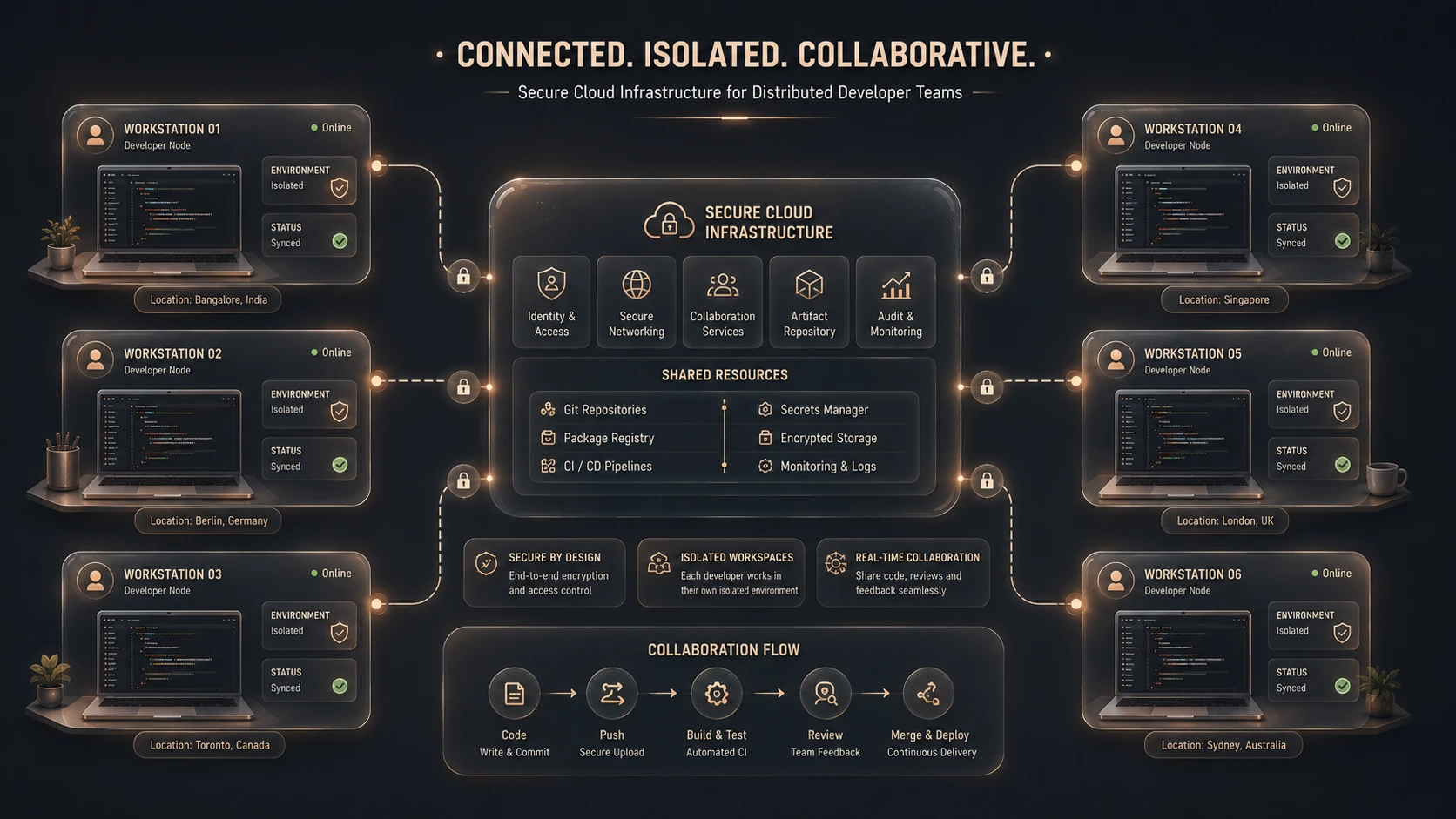
Enterprise cybersecurity has entered a period of significant transformation. Over the past decade, organizations have steadily migrated workloads from traditional on-premises data centers to cloud platforms, adopted Software-as-a-Service (SaaS) applications, embraced hybrid work environments, and expanded digital collaboration across employees, partners, contractors, and customers.
These changes have fundamentally altered the enterprise security landscape. Traditional network security models were largely designed around the assumption that users, devices, and applications operating inside a corporate network could be trusted by default. However, distributed workforces, cloud-native architectures, mobile devices, and increasingly sophisticated cyber threats have challenged that assumption.
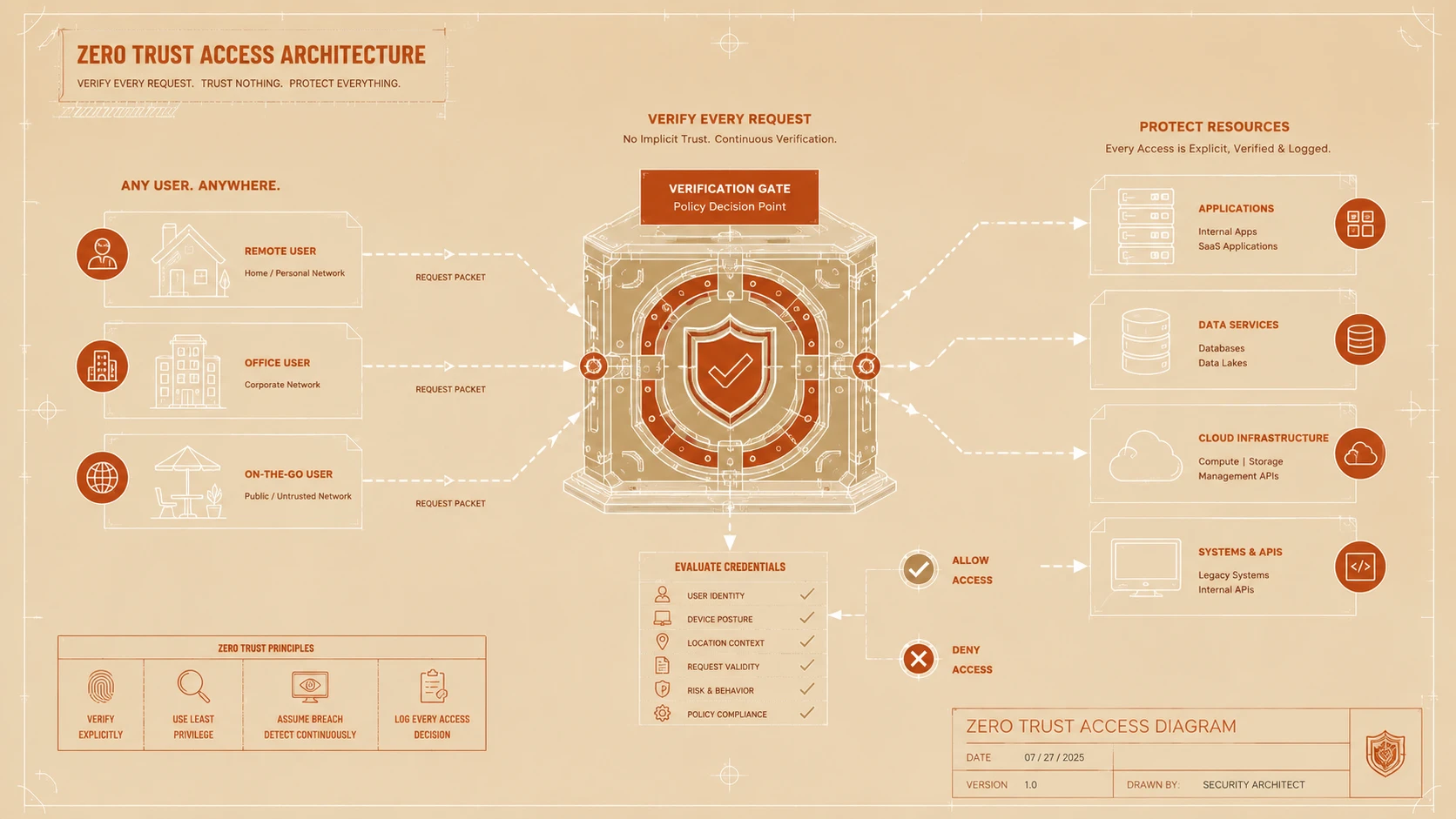
The growing adoption of Zero Trust Architecture (ZTA) reflects a shift toward a security model that continuously validates identity, device posture, application access, and contextual risk before granting access to enterprise resources. Instead of relying solely on network boundaries, Zero Trust focuses on verifying every request regardless of where it originates.
As of February 2022, Zero Trust has evolved from a conceptual security model into a strategic initiative for many enterprises modernizing their cybersecurity programs.
Industry Background
Several technology trends are accelerating Zero Trust adoption:
- ◆Hybrid work environments
- ◆Cloud computing
- ◆Multi-cloud deployments
- ◆Software-as-a-Service platforms
- ◆Identity-centric security
- ◆API-driven architectures
- ◆DevSecOps practices
- ◆Increasing ransomware activity
Organizations increasingly recognize that corporate networks alone no longer represent a reliable security boundary.
The Business Problem
Traditional perimeter-based security introduces several challenges:
- ◆Excessive implicit trust
- ◆Broad network access after authentication
- ◆Lateral movement opportunities for attackers
- ◆Inconsistent visibility across cloud services
- ◆Rapid growth of unmanaged devices
- ◆Identity theft and credential compromise
- ◆Complex access governance
Modern enterprises require security architectures capable of protecting users, workloads, and applications regardless of physical location.
Understanding Zero Trust
Zero Trust is a cybersecurity strategy based on a simple principle:
Never trust implicitly. Always verify explicitly.
Rather than assuming users inside a corporate network are trustworthy, Zero Trust evaluates every access request using multiple signals before allowing access.
Typical evaluation factors include:
- ◆User identity
- ◆Device health
- ◆Authentication strength
- ◆Requested resource
- ◆Location
- ◆Session context
- ◆Organizational policy
Access decisions become dynamic instead of permanent.
Core Architecture
| Component | Responsibility |
|---|---|
| Identity Provider | Authenticates users |
| Multi-Factor Authentication | Strengthens identity verification |
| Policy Engine | Evaluates access decisions |
| Endpoint Security | Validates device posture |
| Application Gateway | Controls application access |
| Security Monitoring | Detects anomalous behavior |
| Logging Platform | Records security events |
Together these components create an identity-centric security model that continuously evaluates trust.
Core Principles
Although implementations vary, most Zero Trust strategies share several foundational principles.
Verify Explicitly
Every request should be authenticated and authorized using available security signals.
Typical inputs include:
- ◆Identity
- ◆Authentication method
- ◆Device compliance
- ◆User role
- ◆Risk indicators
Verification occurs continuously rather than only during initial login.
Least Privilege Access
Users receive only the permissions necessary to perform their assigned responsibilities.
Potential benefits include:
- ◆Reduced attack surface
- ◆Lower insider risk
- ◆Easier compliance
- ◆Improved access governance
Granular authorization minimizes unnecessary exposure.
Assume Breach
Zero Trust encourages architects to design systems under the assumption that attackers may eventually obtain access to part of the environment.
Security controls therefore emphasize:
- ◆Containment
- ◆Detection
- ◆Monitoring
- ◆Rapid response
This mindset helps reduce opportunities for lateral movement.
Identity as the New Security Perimeter
// JWT payload demonstrating identity claims in a Zero-Trust architecture
{
  "sub": "user_98234",
  "name": "Vijay Paliwal",
  "iss": "https://auth.shivamitcs.com",
  "acr": "mfa",
  "device_trust": "compliant",
  "roles": ["developer", "admin"],
  "exp": 1798725600
}
Identity increasingly becomes the primary decision point for enterprise security.
Authentication alone is often insufficient.
Modern identity platforms may evaluate:
- ◆Multi-factor authentication
- ◆Device compliance
- ◆Session risk
- ◆Conditional access policies
- ◆User behavior
Continuous verification provides stronger protection than relying solely on network location.
Device Trust
Zero Trust also evaluates endpoint security.
Typical device signals include:
- ◆Operating system status
- ◆Security updates
- ◆Encryption
- ◆Endpoint protection
- ◆Device registration
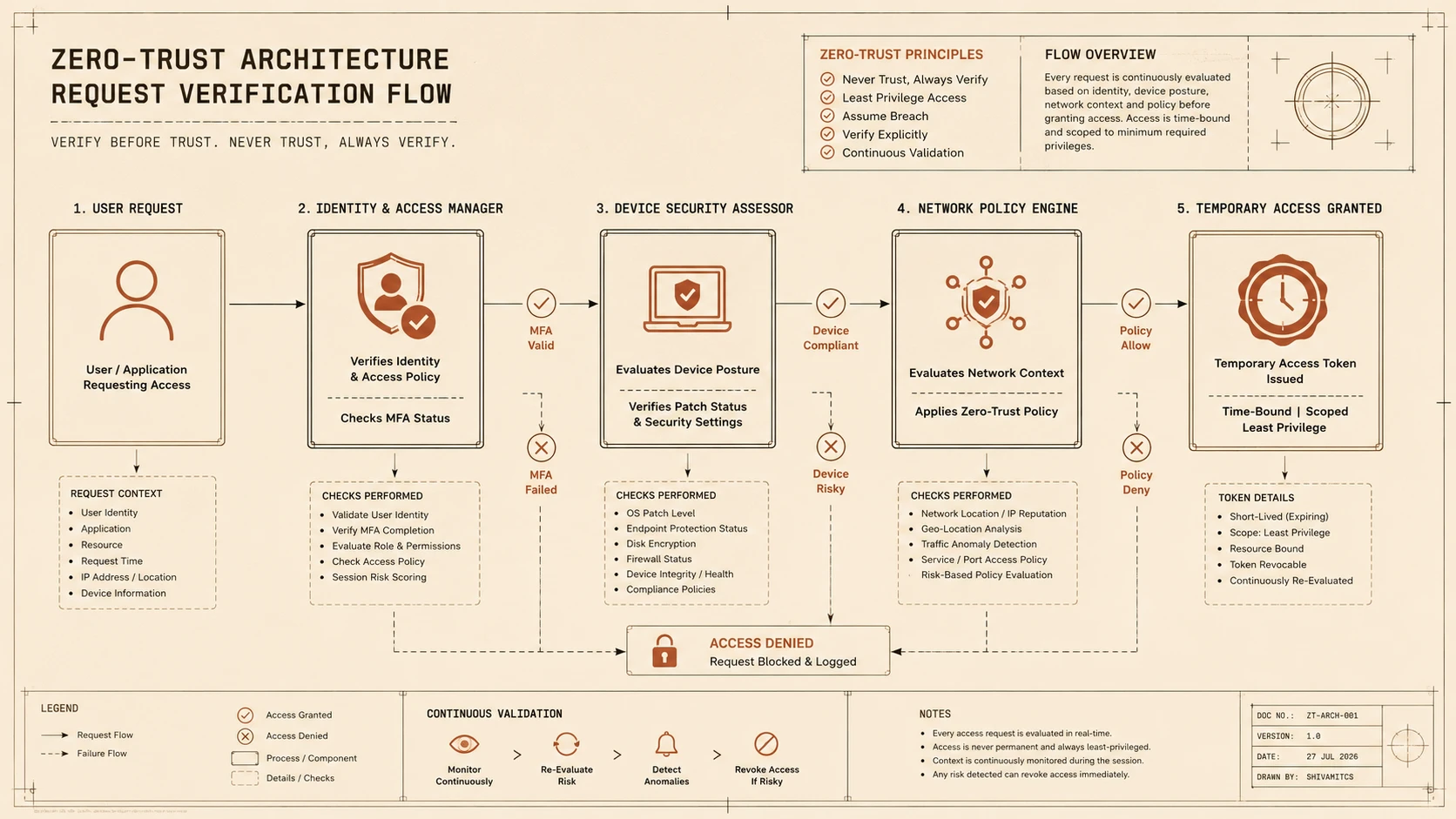
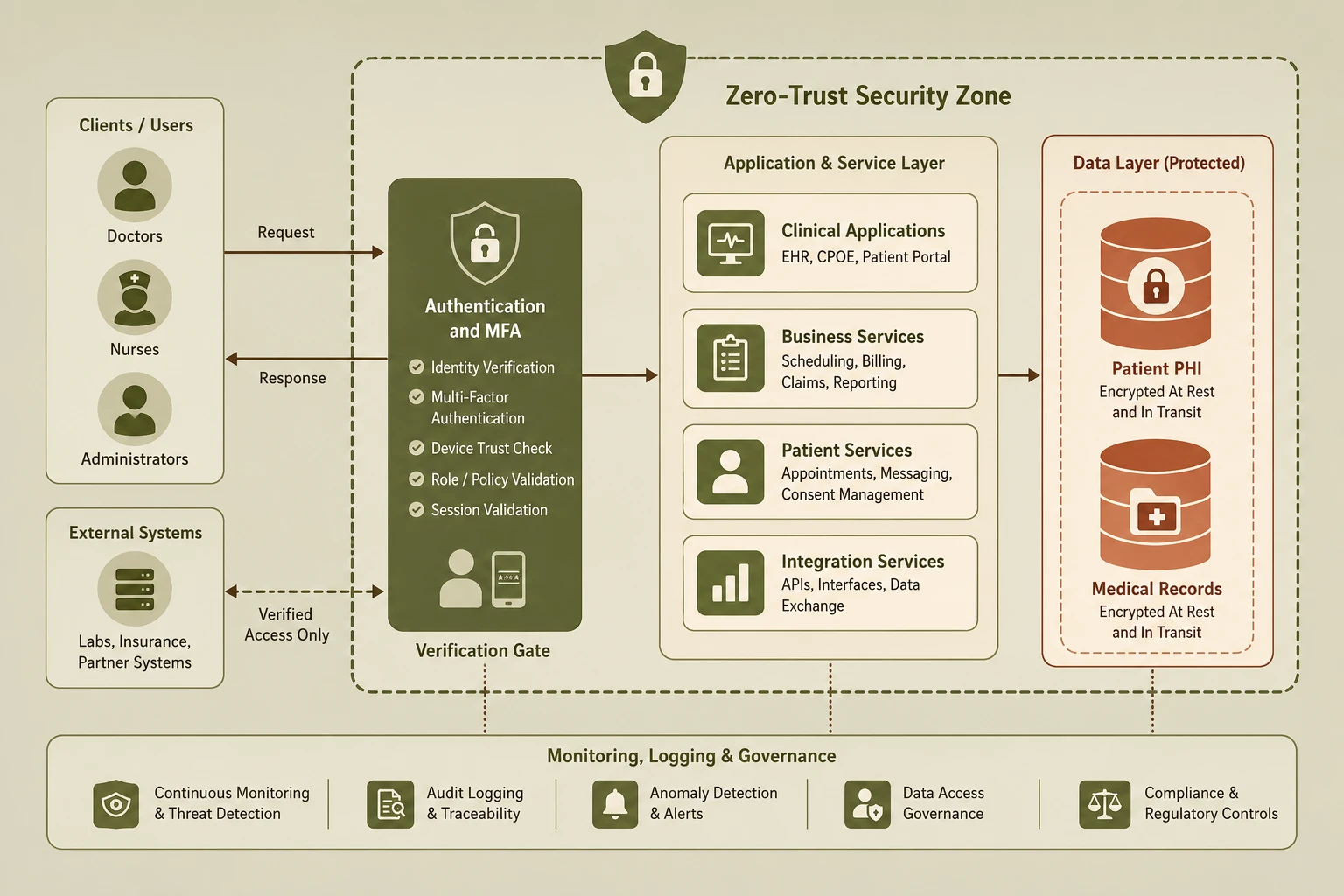
System architecture diagram and conceptual workflow layout for The Zero-Trust Security Wave.
Compromised or non-compliant devices may receive restricted access even when user credentials are valid.
Microsegmentation
Rather than exposing entire internal networks, Zero Trust encourages segmentation of workloads and services.
Potential advantages include:
- ◆Reduced lateral movement
- ◆Smaller attack domains
- ◆Improved workload isolation
- ◆Better policy enforcement
Segmentation allows organizations to apply security controls closer to protected resources.
Continuous Monitoring
Security verification does not end after login.
Organizations increasingly monitor:
- ◆Authentication events
- ◆User behavior
- ◆Endpoint posture
- ◆Network activity
- ◆Application access
- ◆Security alerts
Continuous visibility enables earlier detection of suspicious activity.
Enterprise Use Cases
| Scenario | Benefit |
|---|---|
| Hybrid Workforce | Secure access regardless of location |
| Cloud Applications | Identity-based access control |
| SaaS Platforms | Consistent authentication policies |
| Financial Services | Stronger regulatory compliance support |
| Healthcare Systems | Granular protection of sensitive data |
| Manufacturing | Segmented operational environments |
Organizations with distributed users and cloud infrastructure often realize the greatest benefits from Zero Trust initiatives.
Performance Considerations
Security improvements should not unnecessarily reduce user productivity.
Organizations should evaluate:
- ◆Authentication latency
- ◆Policy evaluation performance
- ◆Identity provider scalability
- ◆Session management
- ◆Endpoint verification time
- ◆User experience during access requests
Efficient policy engines help balance security with operational usability.
Security Considerations
Zero Trust strengthens enterprise security through:
- ◆Continuous authentication
- ◆Strong identity verification
- ◆Multi-factor authentication
- ◆Least privilege authorization
- ◆Endpoint validation
- ◆Comprehensive logging
- ◆Policy-driven access control
However, Zero Trust is not a single product or technology. It represents an architectural approach that combines multiple security capabilities into a coordinated strategy.
Scalability
Zero Trust supports enterprise growth by:
- ◆Centralizing identity policies
- ◆Supporting hybrid infrastructure
- ◆Securing remote employees
- ◆Enabling cloud-native applications
- ◆Standardizing access governance
- ◆Integrating with existing security platforms
These characteristics help organizations modernize security without depending entirely on traditional network boundaries.
Best Practices
Organizations adopting Zero Trust should:
- ◆Inventory users, applications, and devices.
- ◆Implement strong Multi-Factor Authentication.
- ◆Apply least privilege access policies.
- ◆Segment critical workloads.
- ◆Continuously monitor authentication events.
- ◆Validate endpoint compliance.
- ◆Review access policies regularly.
- ◆Expand implementation incrementally rather than attempting organization-wide deployment in a single phase.
Incremental adoption reduces operational disruption while allowing security teams to refine policies over time.
Common Mistakes
Organizations should avoid:
- ◆Treating Zero Trust as a standalone security product.
- ◆Assuming network location determines trustworthiness.
- ◆Granting excessive permissions after authentication.
- ◆Ignoring endpoint security.
- ◆Deploying complex policies without user experience testing.
- ◆Attempting immediate organization-wide transformation without phased planning.
Successful Zero Trust initiatives depend on governance, identity management, and continuous operational improvement.
Technology Comparison
| Capability | Traditional Perimeter Security | Zero Trust Architecture |
|---|---|---|
| Primary Trust Model | Internal network trust | Continuous verification |
| Authentication | Often session-based | Continuous evaluation |
| Access Control | Network-centric | Identity and policy-centric |
| Device Validation | Limited | Continuous posture assessment |
| Lateral Movement Protection | Moderate | Reduced through segmentation |
| Cloud Readiness | Limited | Designed for distributed environments |
Zero Trust shifts enterprise security from location-based assumptions to identity-driven verification.
Adoption Strategy
Organizations should approach Zero Trust through phased implementation.
A practical roadmap includes:
- 1.Assess identity infrastructure.
- 2.Deploy Multi-Factor Authentication.
- 3.Inventory enterprise assets.
- 4.Implement least privilege access.
- 5.Introduce conditional access policies.
- 6.Segment high-value applications.
- 7.Expand monitoring, analytics, and policy refinement across additional workloads.
A gradual approach minimizes disruption while allowing organizations to validate security improvements at each stage.
Limitations
As of February 2022, organizations should recognize several considerations.
Current observations include:
- ◆Zero Trust requires coordinated identity, endpoint, networking, and monitoring capabilities.
- ◆Legacy applications may require modernization before full policy integration.
- ◆Policy complexity can increase operational overhead if governance processes are weak.
- ◆Organizational change management is often as important as technology selection.
Zero Trust should therefore be viewed as a long-term architectural strategy rather than a one-time deployment project.
Looking Ahead
As of February 2022, Zero Trust has become one of the defining trends in enterprise cybersecurity. Growing cloud adoption, hybrid work, identity-centric security, and increasingly sophisticated cyber threats continue driving organizations away from traditional perimeter-focused models toward continuous verification and policy-based access control.
For enterprise architects, security leaders, and engineering managers, the strategic objective is not simply implementing new security technologies but redesigning access models around identity, device trust, least privilege, and continuous monitoring. Organizations that adopt Zero Trust incrementally, integrate security into their operational processes, and continuously refine access policies will be better positioned to protect modern distributed enterprise environments.