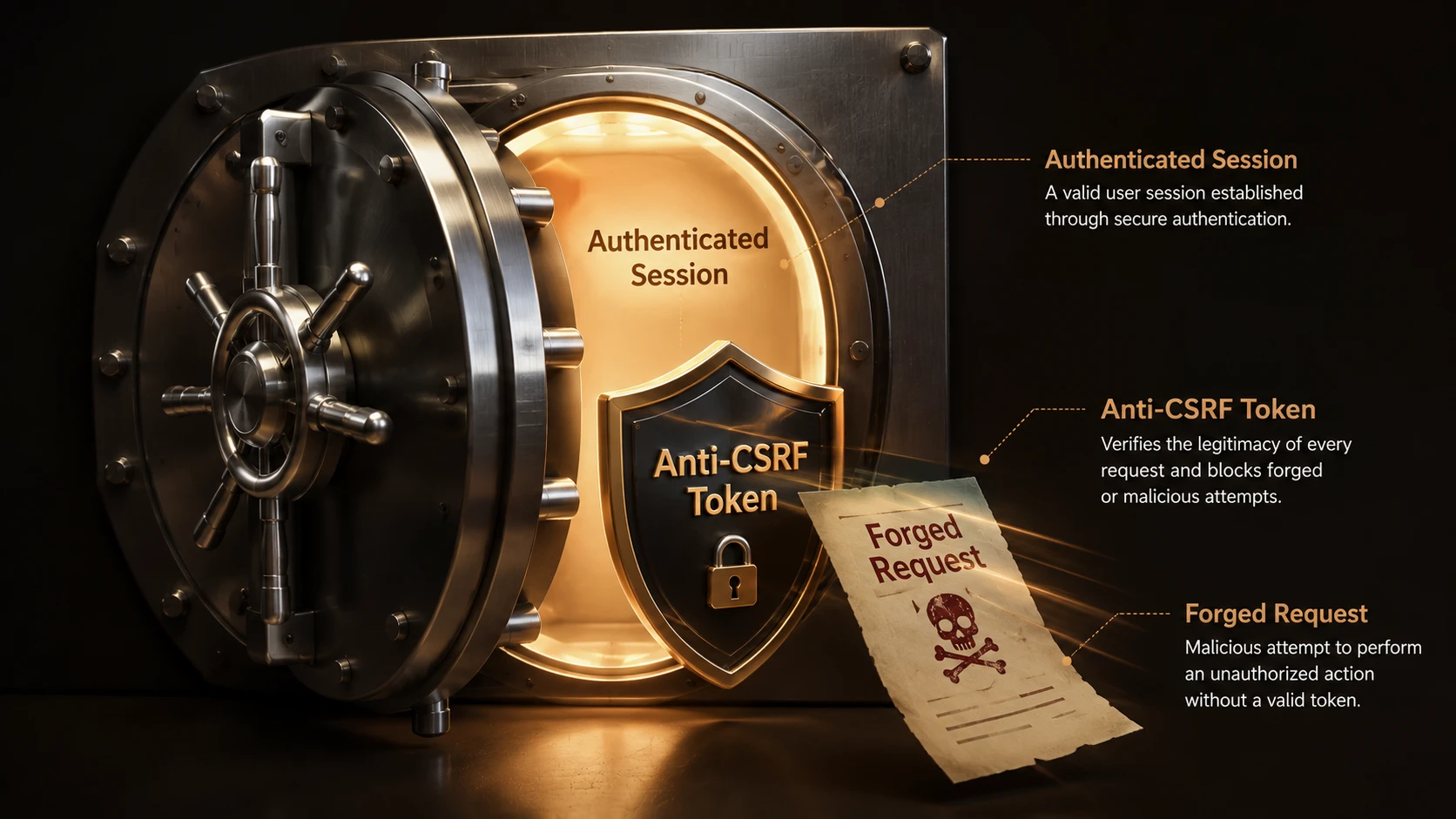
Introduction
Web application security has become a strategic concern for enterprises as browser-based applications continue replacing traditional desktop software. Authentication mechanisms, session management, and persistent browser cookies have greatly improved user convenience, but they also introduce new attack vectors that exploit the trust relationship between browsers and authenticated web applications.
Cross-Site Request Forgery (CSRF) is one such attack. Unlike attacks that exploit software vulnerabilities directly, CSRF abuses authenticated user sessions to execute unintended requests against trusted applications.
From the perspective of June 2013, protecting against CSRF has become an essential requirement for enterprise applications handling financial transactions, administrative operations, account management, and sensitive business data.
Industry Background
Modern web applications increasingly rely on session-based authentication. After users successfully authenticate, browsers automatically include session cookies with every request sent to the application.
This behavior simplifies authentication but creates an important security challenge.
Enterprise applications commonly provide:
- ◆Online banking.
- ◆Customer relationship management.
- ◆Administrative portals.
- ◆Enterprise resource planning.
- ◆Employee self-service systems.
- ◆E-commerce platforms.
If these applications accept state-changing requests solely because a valid session cookie is present, attackers may attempt to exploit authenticated users through malicious web pages.
The Business Problem
CSRF attacks exploit browser behavior rather than application authentication mechanisms.
A typical attack occurs when:
- ◆A user logs into a trusted application.
- ◆The authenticated session remains active.
- ◆The user visits a malicious website.
- ◆The malicious page submits requests to the trusted application.
- ◆The browser automatically includes authentication cookies.
If the target application cannot distinguish legitimate requests from forged ones, unauthorized actions may be performed using the victim's authenticated session.
Potential consequences include:
- ◆Unauthorized account changes.
- ◆Financial transactions.
- ◆Password modifications.
- ◆Administrative actions.
- ◆Data manipulation.
Understanding the Technology
CSRF is fundamentally a trust validation problem.
Browsers automatically attach cookies to requests destined for matching domains. Attackers exploit this behavior by convincing authenticated users to initiate requests without their knowledge.
Common attack mechanisms include:
- ◆Hidden HTML forms.
- ◆Automatically submitted POST requests.
- ◆Image requests.
- ◆Embedded frames.
- ◆Malicious hyperlinks.
The attack succeeds when applications rely solely on session cookies to authorize requests.
Core Architecture
A simplified CSRF interaction is illustrated below.
| Component | Responsibility |
|---|---|
| User Browser | Sends authenticated requests |
| Session Cookie | Identifies authenticated session |
| Trusted Web Application | Processes user requests |
| Malicious Website | Generates forged requests |
| Server Validation | Determines request legitimacy |
Effective CSRF protection requires additional validation beyond session authentication.
Key Features of CSRF Mitigation
Synchronizer Token Pattern
Applications generate unpredictable anti-CSRF tokens associated with authenticated user sessions.
Every state-changing request must include the expected token before processing proceeds.
Double-Submit Cookie
A random value is stored both as a cookie and within the submitted request. The server validates that both values match.
Because attackers cannot reliably generate matching values within a forged request, unauthorized requests are rejected.
Per-Request Validation
Critical operations validate anti-forgery information before modifying application state.
Session Binding
Tokens are associated with authenticated sessions, preventing reuse across unrelated users.
Server-Side Verification
Validation occurs entirely on the server rather than relying on client-side controls.
How It Works
A simplified synchronizer token workflow appears below.
User Authentication
        |
Session Created
        |
Generate CSRF Token
        |
Embed Token in Form
        |
User Submits Request
        |
Server Validates Token
        |
Request Accepted or Rejected
For the double-submit cookie approach:
Server Generates Random Token
        |
Cookie Stores Token
        |
Form Sends Same Token
        |
Server Compares Both Values
        |
Valid Request Proceeds
Both techniques introduce an additional validation step that attackers cannot easily reproduce.
Enterprise Use Cases
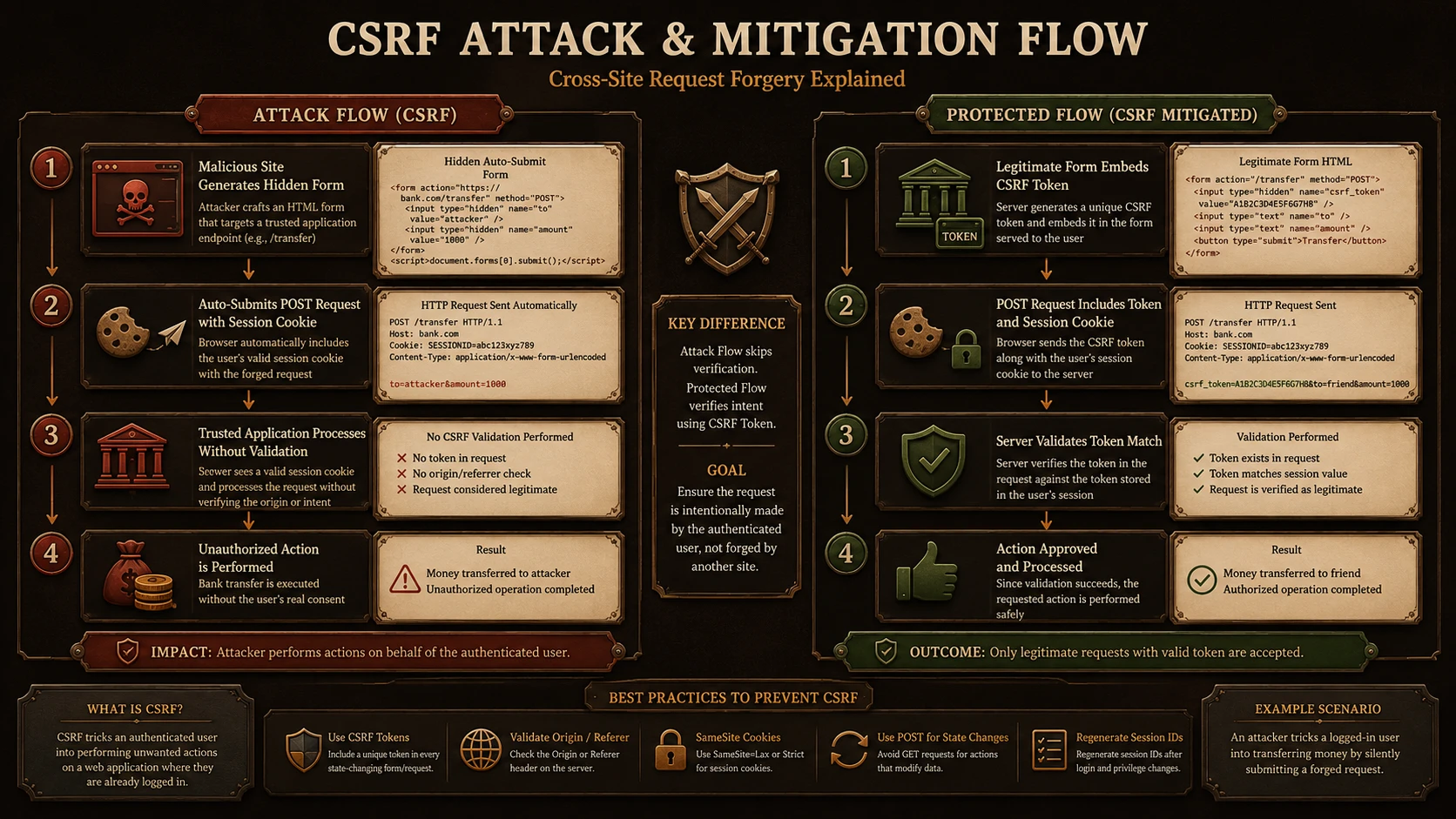
System architecture diagram and conceptual workflow layout for Cross-Site Request Forgery (CSRF).
CSRF protection is essential for numerous enterprise systems.
Internet Banking
Financial transactions require validation beyond session cookies.
Enterprise Administration
Administrative consoles should protect user management, permission changes, and configuration updates.
E-Commerce Platforms
Order placement, payment processing, and account management benefit from anti-CSRF validation.
Healthcare Systems
Patient record modifications should require verified user requests.
Human Resources Applications
Employee information updates and payroll administration require protection against unauthorized actions.
Performance Considerations
CSRF protection introduces minimal performance overhead.
Important considerations include:
- ◆Efficient token generation.
- ◆Secure random value creation.
- ◆Session management.
- ◆Token storage strategy.
- ◆Validation efficiency.
The computational cost of validating tokens is typically insignificant compared with the security benefits provided.
Security Considerations
Organizations should implement multiple defensive measures.
Recommended practices include:
- ◆Anti-CSRF tokens.
- ◆HTTPS communication.
- ◆Secure session management.
- ◆Proper cookie configuration.
- ◆Session expiration.
- ◆Input validation.
- ◆Principle of least privilege.
Security controls should complement one another rather than relying on a single defensive mechanism.
Scalability
Anti-CSRF mechanisms scale effectively across enterprise applications.
Scalable implementation considerations include:
- ◆Centralized session management.
- ◆Consistent token generation.
- ◆Framework-level validation.
- ◆Reusable security middleware.
- ◆Automated security testing.
Centralizing CSRF protection reduces implementation errors across multiple applications.
Best Practices
Organizations should:
- ◆Protect every state-changing request.
- ◆Generate cryptographically strong random tokens.
- ◆Validate tokens on the server.
- ◆Regenerate sessions after authentication.
- ◆Protect administrative interfaces.
- ◆Test applications against common CSRF attack scenarios.
- ◆Incorporate security validation into development standards.
Consistent implementation across all applications reduces organizational security risk.
Common Mistakes
| Mistake | Security Impact |
|---|---|
| Relying only on session cookies | Vulnerable to CSRF attacks |
| Predictable token generation | Easier attack exploitation |
| Missing validation on administrative functions | Privilege abuse |
| Protecting only selected forms | Incomplete security coverage |
| Client-side validation only | Server remains vulnerable |
| Ignoring session security | Increased attack surface |
Avoiding these mistakes significantly strengthens enterprise application security.
Technology Comparison
| Mitigation Technique | Advantages | Considerations |
|---|---|---|
| Synchronizer Token Pattern | Strong server-controlled validation | Requires server-side token management |
| Double-Submit Cookie | Simpler implementation in some architectures | Requires careful cookie handling |
| Referer Header Validation | Additional verification layer | Header availability may vary |
| Session Cookie Only | Simplest implementation | Does not prevent CSRF |
Both synchronizer tokens and double-submit cookies provide substantially stronger protection than relying solely on authenticated sessions.
Adoption Strategy
Organizations should integrate CSRF protection into their secure development lifecycle.
Recommended roadmap:
- 1.Identify all state-changing operations.
- 2.Select a consistent anti-CSRF strategy.
- 3.Standardize framework-level implementation.
- 4.Perform security testing.
- 5.Educate development teams.
- 6.Include CSRF validation in code reviews and deployment verification.
Building security controls into development frameworks improves consistency while reducing implementation effort.
Limitations
Although anti-CSRF mechanisms are highly effective, organizations should recognize several considerations.
- ◆Every state-changing request must be protected consistently.
- ◆Session management remains a critical security dependency.
- ◆Token validation must occur server-side.
- ◆Legacy applications may require architectural modifications.
- ◆Security testing should verify protection across all user workflows.
CSRF protection should be considered one layer within a broader application security strategy.
Looking Ahead
From the perspective of June 2013, Cross-Site Request Forgery remains a practical threat for enterprise web applications that depend on browser-based authentication. As organizations continue building increasingly sophisticated web platforms, implementing robust anti-CSRF defenses becomes an essential component of secure application architecture.
Frameworks are beginning to simplify the implementation of synchronizer tokens and related protections, encouraging more consistent adoption across enterprise development teams. Organizations that standardize these defensive patterns alongside secure session management, transport security, and rigorous testing will be better positioned to protect users and business-critical systems against browser-based request forgery attacks.