Introduction
Enterprise IT infrastructure is becoming increasingly dynamic. Virtualization, cloud computing, and large-scale Linux deployments have made manual server administration both expensive and error-prone. Organizations are seeking ways to standardize infrastructure provisioning, automate configuration management, and reduce operational risk.
Several automation platforms have emerged to address these challenges. Puppet has established itself as a mature configuration management platform, Chef has gained traction through its infrastructure-as-code philosophy, and Ansible has recently entered the market with a simplified, agentless approach.
From the perspective of June 2012, these technologies represent different approaches to solving the same operational challenge: managing infrastructure consistently at scale.
Industry Background
Enterprise infrastructure has evolved significantly over the past decade. Physical servers are increasingly replaced by virtual machines, applications are distributed across multiple environments, and deployment frequency continues to increase.
Traditional system administration often involves:
- ◆Manual server configuration.
- ◆Shell scripting.
- ◆Configuration drift.
- ◆Inconsistent environments.
- ◆Lengthy deployment procedures.
- ◆Human error during maintenance.
Configuration management platforms aim to automate these repetitive tasks while improving consistency across development, testing, and production environments.
Organizations adopting DevOps practices increasingly recognize infrastructure as software that can be version-controlled, tested, and deployed using repeatable processes.
The Business Problem
Managing hundreds or thousands of servers manually introduces significant operational challenges.
Common enterprise concerns include:
- ◆Configuration inconsistency.
- ◆Slow server provisioning.
- ◆Difficult compliance auditing.
- ◆Complex software upgrades.
- ◆Environment drift.
- ◆Limited operational visibility.
- ◆High administrative costs.
Automation platforms seek to define infrastructure declaratively so that systems can be reproduced reliably regardless of scale.
Understanding the Technology
Configuration management systems automate infrastructure by defining the desired system state.
Typical managed resources include:
- ◆Software packages.
- ◆Operating system services.
- ◆Configuration files.
- ◆User accounts.
- ◆Network settings.
- ◆Scheduled tasks.
- ◆Security policies.
Rather than documenting manual procedures, administrators describe the intended configuration, allowing automation tools to apply changes consistently.
Although Puppet, Chef, and Ansible share this objective, each approaches implementation differently.
Core Architecture
The three platforms differ in their architectural models.
| Platform | Primary Architecture | Communication Model |
|---|---|---|
| Puppet | Central server with managed agents | Agent-based |
| Chef | Central server with managed nodes | Agent-based |
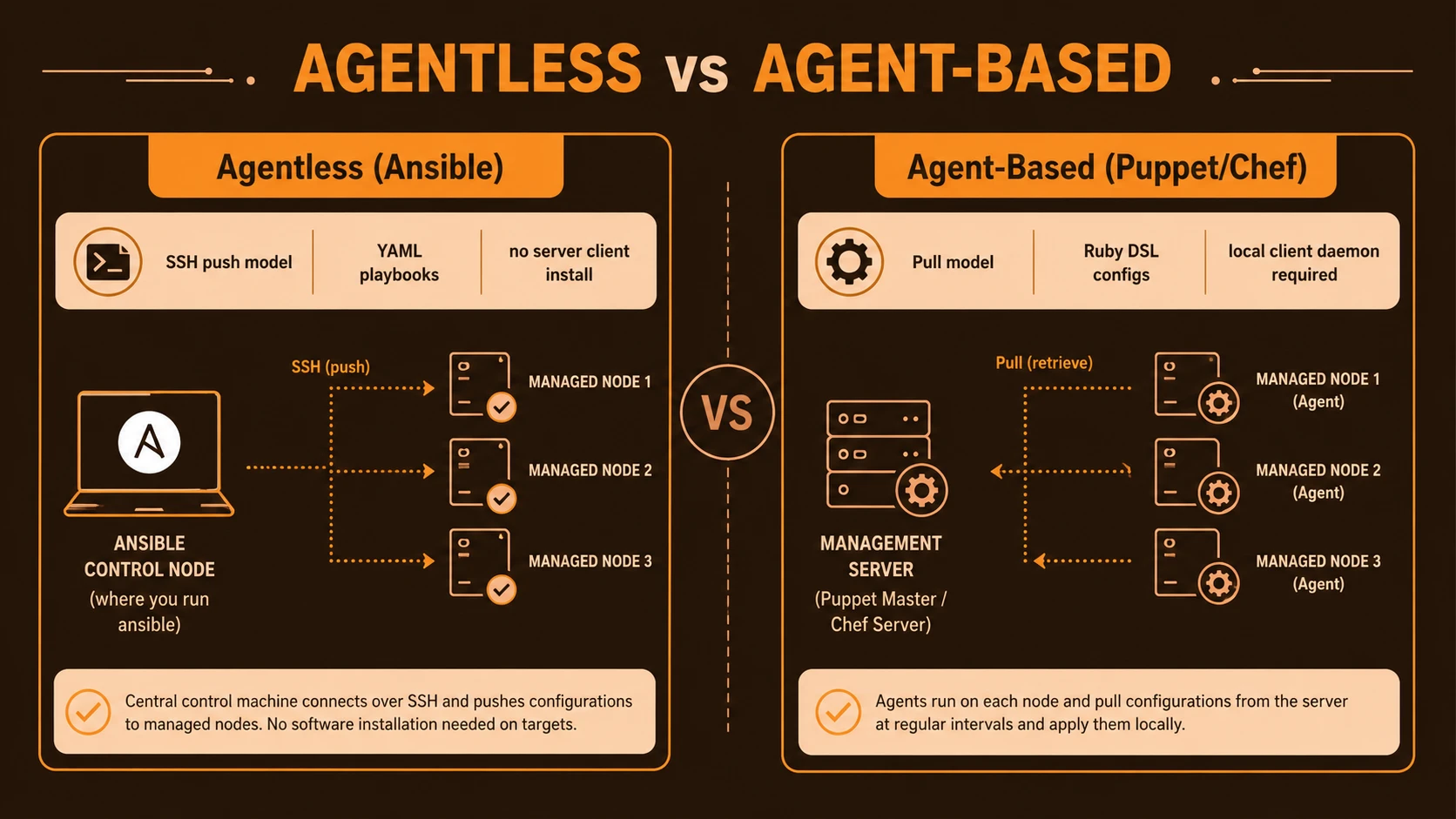
| Ansible | Control node executing remote tasks | Agentless over SSH |
Puppet and Chef rely on software agents installed on managed systems that periodically communicate with central management servers.
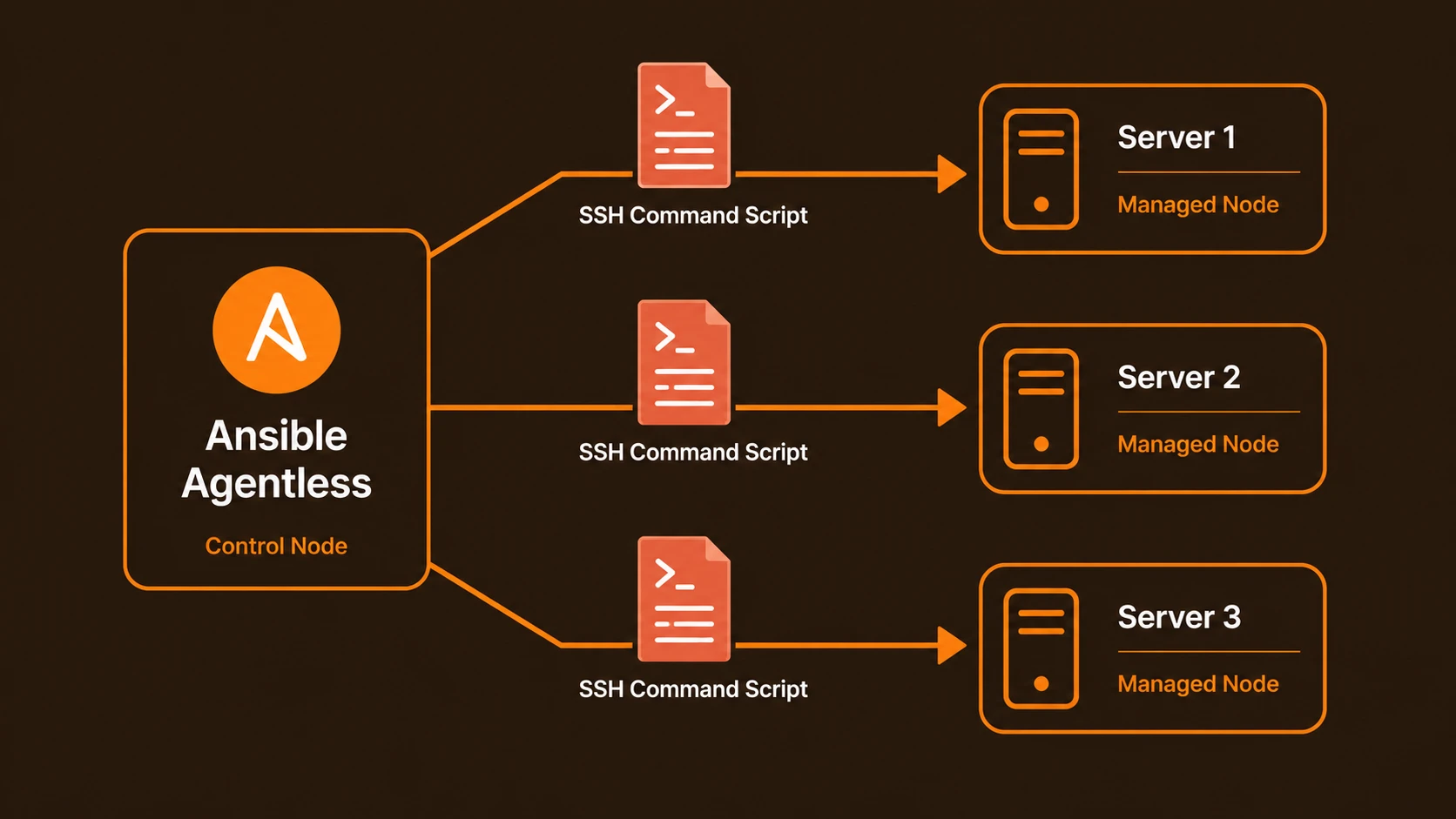
Ansible instead executes tasks remotely over SSH without requiring persistent agents on target hosts, simplifying deployment in many environments.
Key Features
Puppet
Puppet emphasizes declarative configuration management using manifests that describe the desired infrastructure state.
Key capabilities include:
- ◆Declarative configuration language.
- ◆Centralized policy enforcement.
- ◆Automated drift correction.
- ◆Mature enterprise ecosystem.
Chef
Chef approaches infrastructure through executable recipes written using Ruby.
Capabilities include:
- ◆Infrastructure as code.
- ◆Reusable cookbooks.
- ◆Flexible automation workflows.
- ◆Strong developer customization.
Ansible
As one of the newest entrants, Ansible focuses on operational simplicity.
Core characteristics include:
- ◆Agentless architecture.
- ◆SSH-based communication.
- ◆YAML playbooks.
- ◆Simplified deployment model.
- ◆Minimal infrastructure requirements.
How It Works
A simplified automation workflow is similar across all three platforms.
Administrator
      |
Infrastructure Definition
      |
Automation Engine
      |
Target Servers
      |
Configuration Validation
      |
Operational Infrastructure
Each platform evaluates system state and applies changes necessary to achieve the desired configuration.
Enterprise Use Cases
Infrastructure automation supports numerous enterprise scenarios.
Standardized Server Provisioning
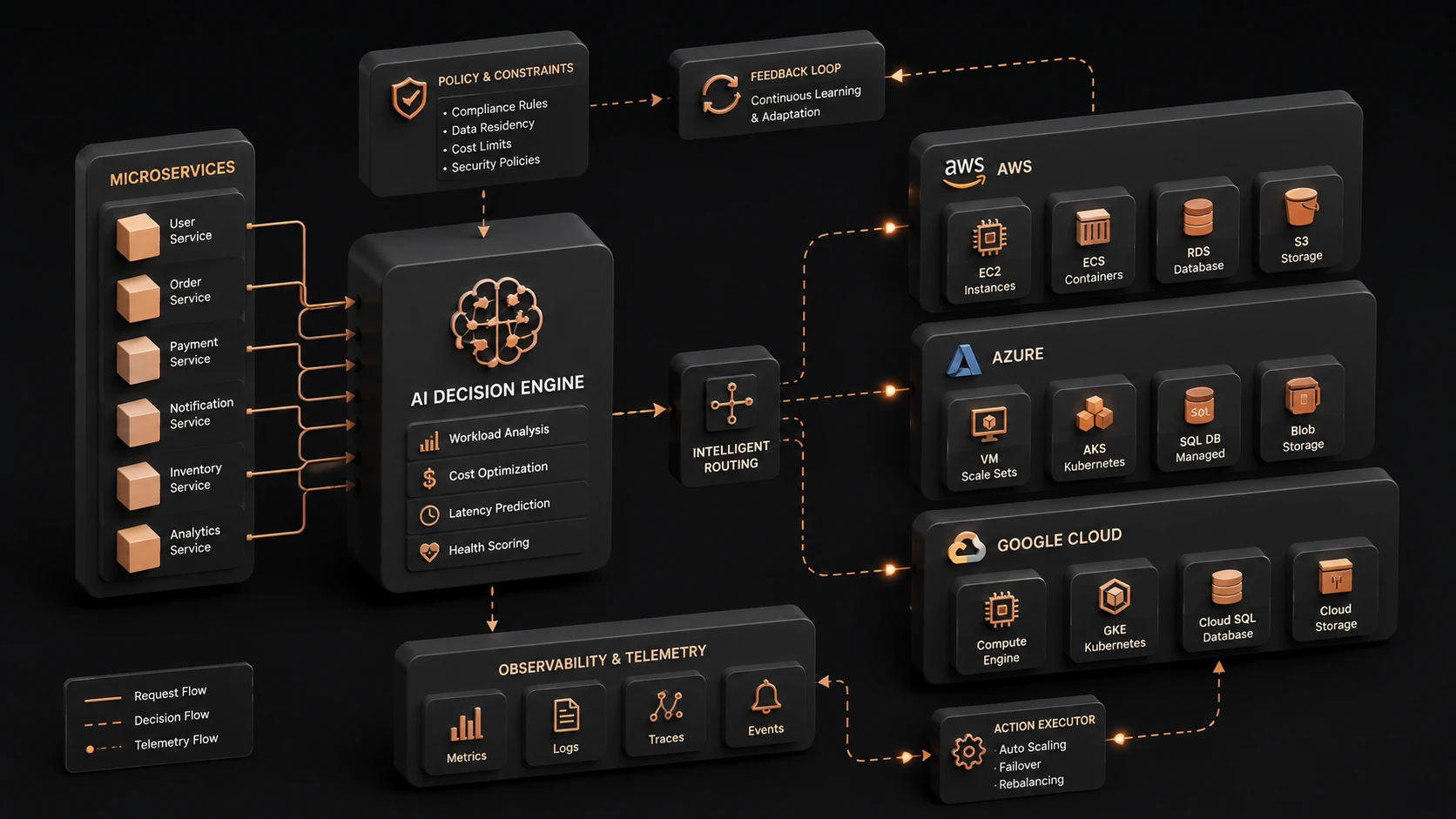
System architecture diagram and conceptual workflow layout for Infrastructure Automation.
Organizations can deploy Linux servers with identical configurations regardless of deployment location.
Application Deployment
Automation simplifies installation of web servers, middleware, databases, and supporting components.
Compliance Enforcement
Configuration management enables standardized security policies across production environments.
Disaster Recovery
Automated infrastructure definitions improve the ability to recreate failed systems consistently.
Cloud Provisioning
As cloud adoption increases, automation becomes essential for deploying repeatable virtual infrastructure.
Performance Considerations
Automation performance depends on infrastructure size, execution model, and network connectivity.
Important factors include:
- ◆Number of managed nodes.
- ◆Agent communication frequency.
- ◆Parallel execution capabilities.
- ◆Repository organization.
- ◆Change complexity.
Agent-based platforms may provide continuous configuration enforcement, while agentless approaches can reduce background resource consumption.
Security Considerations
Infrastructure automation platforms require elevated administrative privileges and therefore must be deployed carefully.
Recommended practices include:
- ◆Secure authentication.
- ◆Encrypted communications.
- ◆Role-based administrative access.
- ◆Version-controlled configuration files.
- ◆Audit logging.
- ◆Principle of least privilege.
Organizations should also protect automation credentials with the same rigor applied to production administrative accounts.
Scalability
All three platforms are designed to support enterprise-scale infrastructure, although implementation approaches differ.
Scalability considerations include:
- ◆Central management server capacity.
- ◆Network topology.
- ◆Repository organization.
- ◆Configuration modularity.
- ◆Team collaboration.
Well-structured automation code becomes increasingly valuable as infrastructure expands.
Best Practices
Organizations adopting infrastructure automation should:
- ◆Store configurations in version control.
- ◆Develop reusable modules.
- ◆Test automation before production deployment.
- ◆Separate development and production environments.
- ◆Document infrastructure standards.
- ◆Automate repetitive administrative tasks.
- ◆Review configuration changes through peer processes.
Treating infrastructure definitions as software improves long-term maintainability.
Common Mistakes
| Mistake | Operational Impact |
|---|---|
| Automating undocumented infrastructure | Inconsistent deployments |
| Hardcoding environment values | Reduced portability |
| Large monolithic configurations | Difficult maintenance |
| Skipping testing | Production failures |
| Poor version control practices | Configuration rollback challenges |
| Excessive manual changes | Configuration drift |
Avoiding these issues improves reliability and operational consistency.
Technology Comparison
| Feature | Ansible | Puppet | Chef |
|---|---|---|---|
| Management Agent | No | Yes | Yes |
| Primary Language | YAML | Puppet DSL | Ruby |
| Communication | SSH | Agent-based | Agent-based |
| Deployment Complexity | Low | Moderate | Moderate |
| Flexibility | High | High | Very High |
| Learning Curve | Moderate | Moderate | Higher for teams unfamiliar with Ruby |
Each platform offers strengths depending on organizational requirements, existing technical expertise, and operational preferences.
Adoption Strategy
Organizations evaluating automation platforms should begin by identifying repetitive administrative processes suitable for automation.
Recommended approach:
- 1.Standardize operating system configurations.
- 2.Automate software installation.
- 3.Introduce version control for infrastructure definitions.
- 4.Pilot automation in development environments.
- 5.Expand gradually into production systems.
- 6.Establish governance for configuration changes.
Incremental adoption reduces operational risk while allowing teams to build automation expertise.
Limitations
Despite their advantages, automation platforms present several considerations.
- ◆Initial implementation requires planning.
- ◆Existing manual processes may require redesign.
- ◆Teams must develop automation expertise.
- ◆Legacy infrastructure may require customization.
- ◆Poorly organized automation code can become difficult to maintain.
Selecting an automation platform should align with organizational skills, infrastructure size, and long-term operational objectives.
Looking Ahead
From the perspective of June 2012, infrastructure automation is transitioning from an operational convenience to a strategic enterprise capability. Puppet and Chef have demonstrated that configuration management can significantly improve deployment consistency, while Ansible introduces an alternative model focused on operational simplicity through its agentless architecture.
As enterprise data centers continue expanding and cloud computing gains wider adoption, organizations are likely to invest more heavily in infrastructure automation, standardized deployment processes, and repeatable operational practices. Whether through agent-based or agentless approaches, automation is increasingly becoming an essential component of modern enterprise infrastructure management.