Introduction
Modern web browsers have evolved into sophisticated application runtimes capable of executing complex enterprise software, multimedia applications, cloud productivity suites, engineering tools, and real-time collaboration platforms. As websites continue increasing in complexity, browser engines must efficiently manage JavaScript execution, CSS computation, page layout, rendering, networking, and graphics acceleration while maintaining responsiveness across increasingly diverse hardware.
Mozilla has long pursued improvements to Firefox through standards compliance, JavaScript optimization, and rendering engine enhancements. However, modern multicore processors provide opportunities that traditional browser architectures cannot fully exploit when significant portions of rendering remain sequential.
Firefox Quantum represents one of Mozilla's most ambitious engineering initiatives. Rather than replacing Gecko entirely, Mozilla has incorporated technologies developed within the experimental Servo browser project. Most notably, Quantum CSS—derived from Servo and implemented using the Rust programming language—introduces highly parallel stylesheet processing while demonstrating the practical benefits of memory-safe systems programming.
From the perspective of November 2017, Firefox Quantum marks the beginning of a new architectural direction for browser engineering.
Industry Background
Web applications increasingly resemble native desktop software.
Organizations now deploy:
- ◆Software-as-a-Service platforms.
- ◆Enterprise dashboards.
- ◆Customer portals.
- ◆Cloud administration consoles.
- ◆Financial trading applications.
- ◆Business intelligence systems.
- ◆Collaborative productivity suites.
Modern browsers must efficiently execute:
- ◆JavaScript engines.
- ◆CSS layout calculations.
- ◆Graphics rendering.
- ◆Network communication.
- ◆DOM manipulation.
- ◆GPU acceleration.
With multicore processors now common across desktops and laptops, browser engines are evolving to utilize parallel hardware more effectively.
The Business Problem
As browser workloads grow larger, traditional rendering pipelines encounter several limitations.
Organizations frequently experience:
- ◆Slow page rendering.
- ◆Complex stylesheet computation.
- ◆Limited CPU parallelism.
- ◆High memory consumption.
- ◆Interface responsiveness challenges.
- ◆Large application rendering costs.
- ◆Increasing browser maintenance complexity.
Improving browser responsiveness now depends not only on faster JavaScript execution but also on more efficient rendering architecture.
Firefox Quantum addresses these challenges through selective integration of Servo technologies.
Understanding the Technology
Firefox Quantum combines the mature Gecko browser engine with modern technologies developed through Mozilla's Servo research project.
Major architectural improvements include:
- ◆Quantum CSS.
- ◆Parallel stylesheet processing.
- ◆Rust-based engine components.
- ◆Improved rendering efficiency.
- ◆Better multicore processor utilization.
- ◆Optimized graphics pipeline.
- ◆Faster page responsiveness.
Rather than rewriting the browser entirely, Mozilla has modernized critical subsystems while preserving compatibility with existing web standards.
Core Architecture
A simplified Firefox Quantum architecture appears below.
| Component | Responsibility |
|---|---|
| Browser User Interface | User interaction |
| Gecko Engine | HTML parsing and rendering |
| Quantum CSS | Parallel stylesheet computation |
| Rust Components | Memory-safe systems programming |
| JavaScript Engine | Script execution |
| Graphics Layer | Rendering and compositing |
Servo technologies complement Gecko by accelerating portions of the rendering pipeline while maintaining browser compatibility.
Key Features
Quantum CSS
Quantum CSS is the most visible architectural contribution from Servo.
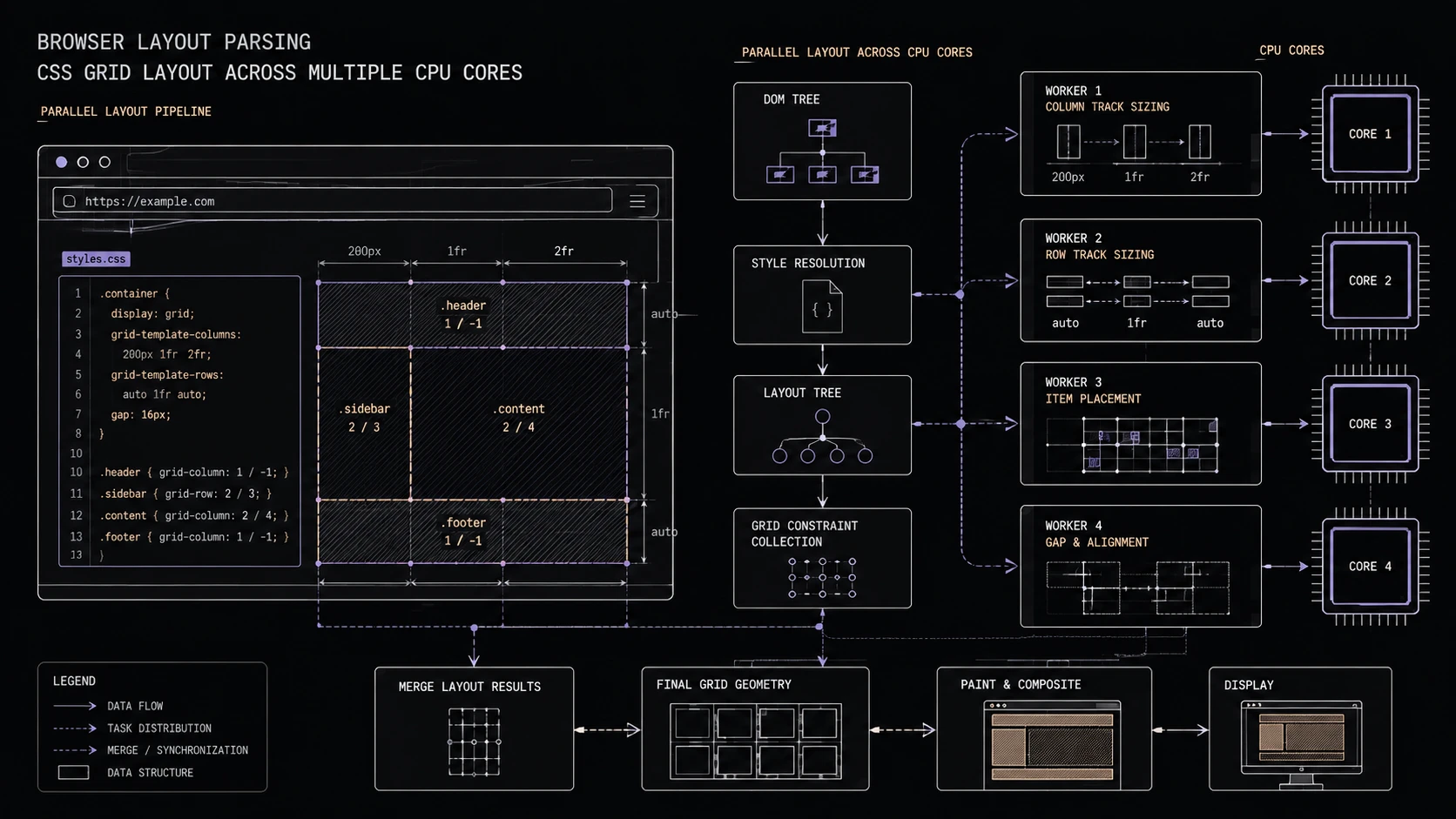
Rather than evaluating CSS rules sequentially wherever possible, Quantum CSS is designed to utilize multiple processor cores during stylesheet matching and computation.
This improves rendering efficiency for modern web applications containing large and complex style hierarchies.
Rust Integration
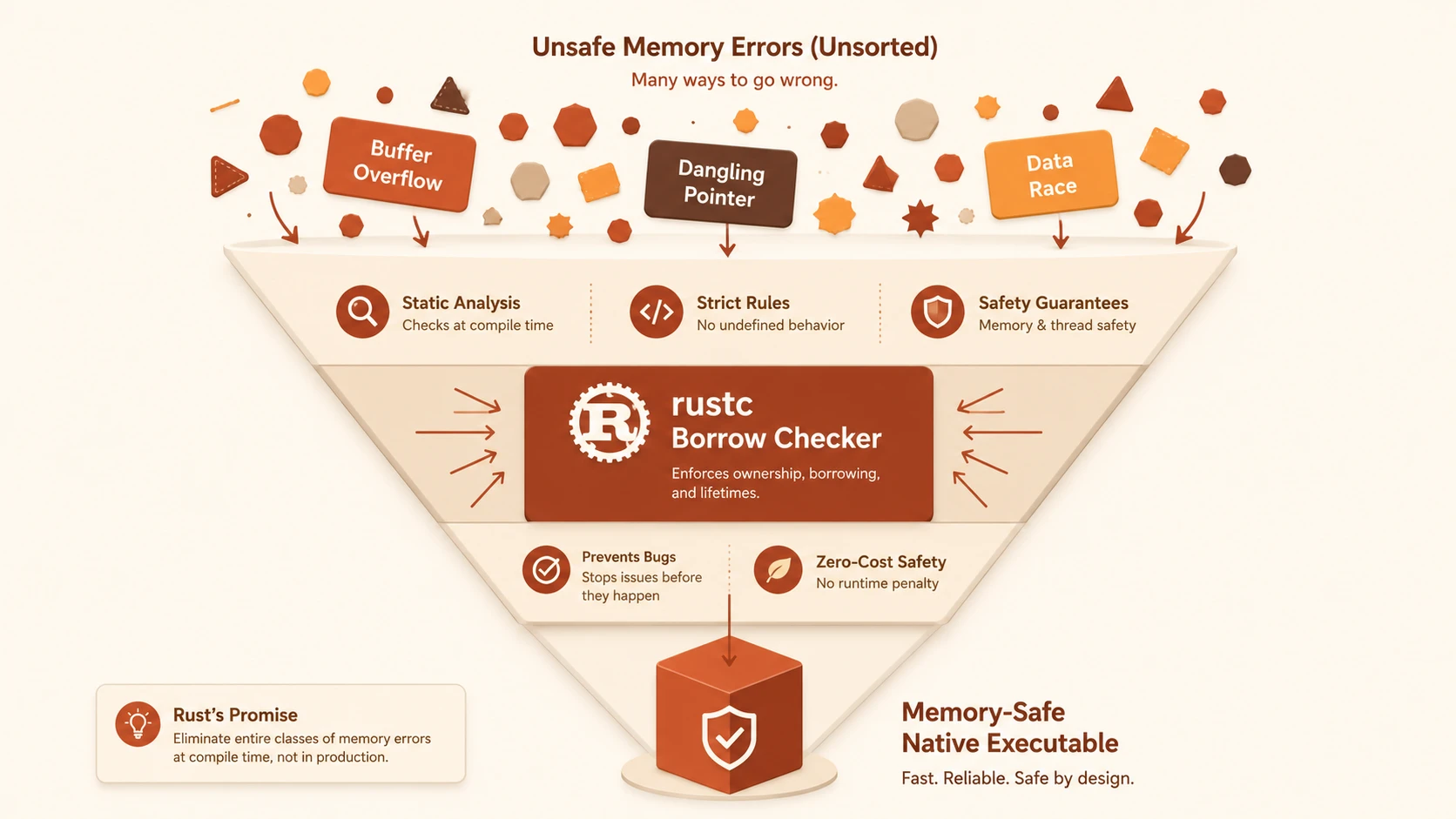
Servo is implemented using Rust, a systems programming language emphasizing memory safety and concurrency.
By integrating Rust components into Firefox, Mozilla demonstrates how modern language design can improve reliability while enabling highly parallel execution.
Better Multicore Utilization
Firefox Quantum is engineered to make better use of contemporary multicore processors.
Instead of concentrating rendering work within limited execution paths, critical operations can increasingly benefit from available hardware resources.
Improved Responsiveness
Rendering optimizations contribute to faster interface updates and improved browsing responsiveness.
These improvements become particularly valuable when users interact with complex web applications.
Graphics Pipeline Optimizations
Mozilla continues refining graphics rendering and compositing to improve visual performance during page interaction and scrolling.
Modern Browser Architecture
Firefox Quantum reflects a broader architectural strategy focused on modular browser components, parallel execution, and long-term maintainability.
How It Works
A simplified rendering workflow appears below.
HTML Document
        |
DOM Construction
        |
Quantum CSS
        |
Parallel Style Calculation
        |
Layout Engine
        |
Graphics Rendering
        |
Displayed Web Page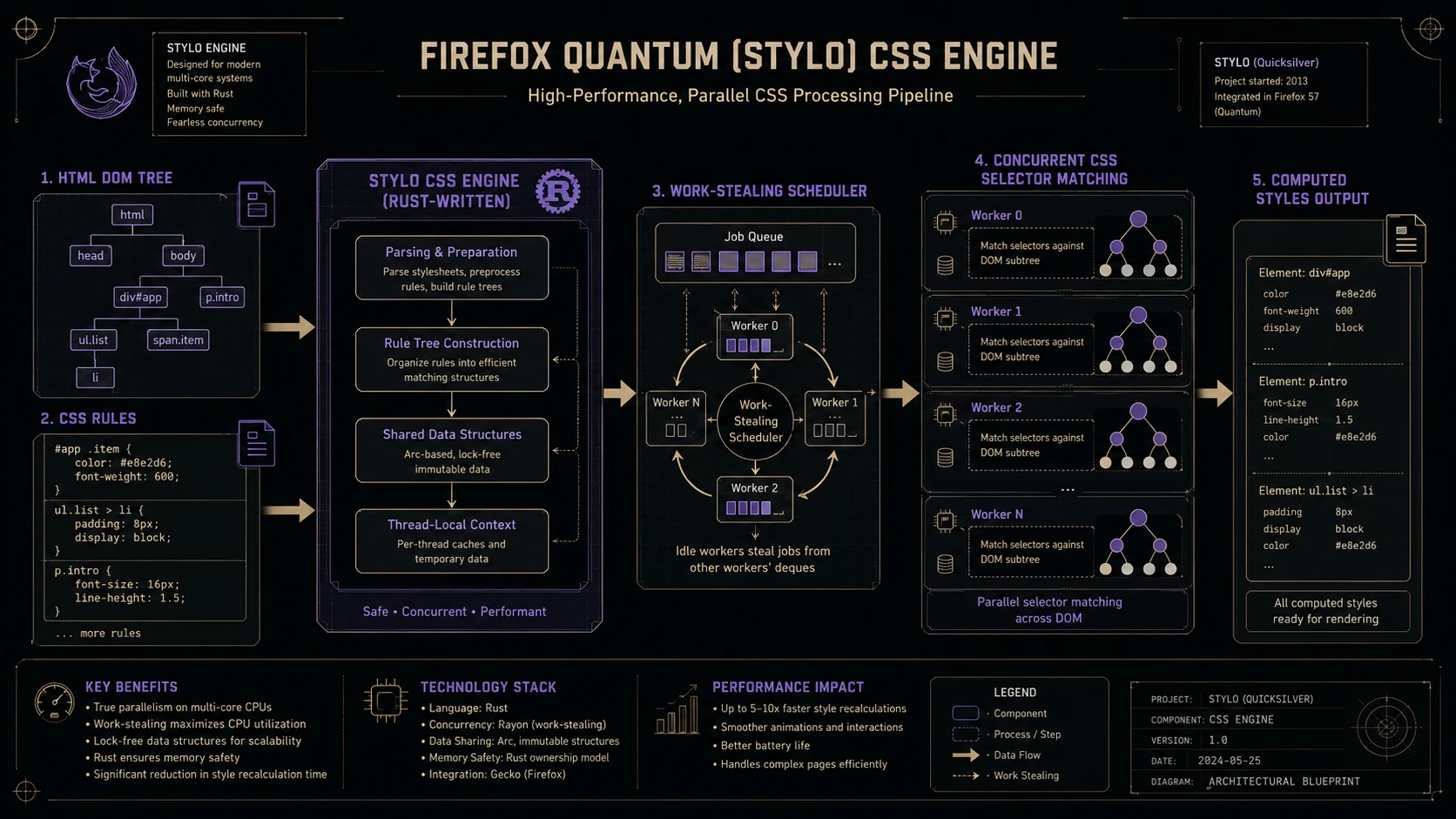
System architecture diagram and conceptual workflow layout for Firefox Quantum.
Quantum CSS performs stylesheet computation before layout and rendering continue through Gecko's existing browser pipeline.
Enterprise Use Cases
Software-as-a-Service Platforms
Large enterprise applications containing complex user interfaces benefit from faster rendering.
Business Dashboards
Interactive reporting systems displaying numerous visual components can improve interface responsiveness.
Cloud Administration Consoles
Infrastructure management portals containing extensive styling benefit from parallel CSS evaluation.
Enterprise Productivity Applications
Large browser-based office applications require efficient rendering during continuous user interaction.
Internal Business Systems
Organizations standardizing on Firefox benefit from improved browsing performance without modifying existing applications.
Performance Considerations
Firefox Quantum focuses on improving rendering efficiency rather than changing web application behavior.
Organizations should evaluate:
- ◆Page rendering speed.
- ◆CSS processing.
- ◆CPU utilization.
- ◆Memory consumption.
- ◆Browser responsiveness.
- ◆Graphics performance.
Performance gains depend upon application characteristics, stylesheet complexity, and available processor resources.
Security Considerations
Firefox Quantum continues Mozilla's emphasis on secure browser architecture.
Organizations should continue implementing:
- ◆HTTPS deployment.
- ◆Secure authentication.
- ◆Content Security Policy.
- ◆Browser update management.
- ◆Secure web application design.
- ◆Enterprise endpoint protection.
Rust's memory safety characteristics contribute to more robust systems programming, although overall browser security remains a comprehensive engineering effort.
Scalability
Firefox Quantum introduces several improvements supporting increasingly demanding web applications.
Advantages include:
- ◆Better multicore utilization.
- ◆Parallel CSS processing.
- ◆Improved rendering responsiveness.
- ◆Modern systems programming techniques.
- ◆Enhanced browser architecture.
These capabilities position Firefox for increasingly sophisticated enterprise web workloads.
Best Practices
Organizations evaluating Firefox Quantum should:
- ◆Benchmark representative enterprise applications.
- ◆Validate browser compatibility.
- ◆Measure rendering performance.
- ◆Test internal business applications.
- ◆Continue standards-based web development.
- ◆Monitor enterprise deployment policies.
- ◆Keep browser versions updated.
Incremental browser deployment allows organizations to evaluate measurable performance improvements.
Common Mistakes
| Mistake | Business Impact |
|---|---|
| Assuming Servo completely replaces Gecko | Architectural misunderstanding |
| Expecting every website to benefit equally | Unrealistic performance expectations |
| Ignoring browser compatibility testing | Deployment risk |
| Treating Rust as a browser runtime | Misunderstanding implementation architecture |
| Focusing only on JavaScript benchmarks | Incomplete performance evaluation |
| Neglecting enterprise browser management | Operational inconsistency |
Successful evaluation requires understanding how Quantum integrates selected Servo technologies rather than replacing Firefox's entire architecture.
Technology Comparison
| Characteristic | Previous Firefox Releases | Firefox Quantum |
|---|---|---|
| Rendering Architecture | Traditional Gecko pipeline | Gecko enhanced with Quantum technologies |
| CSS Processing | Primarily sequential | Quantum CSS with parallel processing |
| Systems Programming | Primarily C++ | C++ with integrated Rust components |
| Multicore Utilization | Limited in CSS processing | Improved parallel execution |
| Browser Responsiveness | Mature | Further optimized |
Firefox Quantum modernizes browser internals while maintaining compatibility with existing web standards.
Adoption Strategy
Organizations should evaluate Firefox Quantum through structured deployment.
- 1.Test enterprise web applications.
- 2.Benchmark rendering performance.
- 3.Validate browser extensions.
- 4.Review enterprise management policies.
- 5.Compare performance against existing browser deployments.
- 6.Expand organizational rollout following successful validation.
This phased approach minimizes operational risk while allowing organizations to measure real-world improvements.
Limitations
As of November 2017, organizations should recognize several considerations.
- ◆Performance improvements vary by workload.
- ◆Existing browser extensions should be validated.
- ◆Enterprise deployment policies may require updates.
- ◆Browser optimization continues evolving.
- ◆Benefits depend on application complexity and hardware configuration.
These considerations should be incorporated into enterprise browser modernization planning.
Looking Ahead
From the perspective of November 2017, Firefox Quantum represents one of the most important browser architecture advancements in recent years. By integrating Servo-derived technologies such as Quantum CSS while leveraging Rust for critical engine components, Mozilla has demonstrated a practical path toward safer, more parallel, and more responsive browser implementations.
Rather than introducing new web standards, Firefox Quantum improves how existing standards are executed, enabling enterprise applications to benefit from modern hardware without requiring application changes. As browser workloads continue increasing and multicore processors become the norm, Quantum's architectural direction provides a compelling foundation for the next generation of high-performance web browsers.