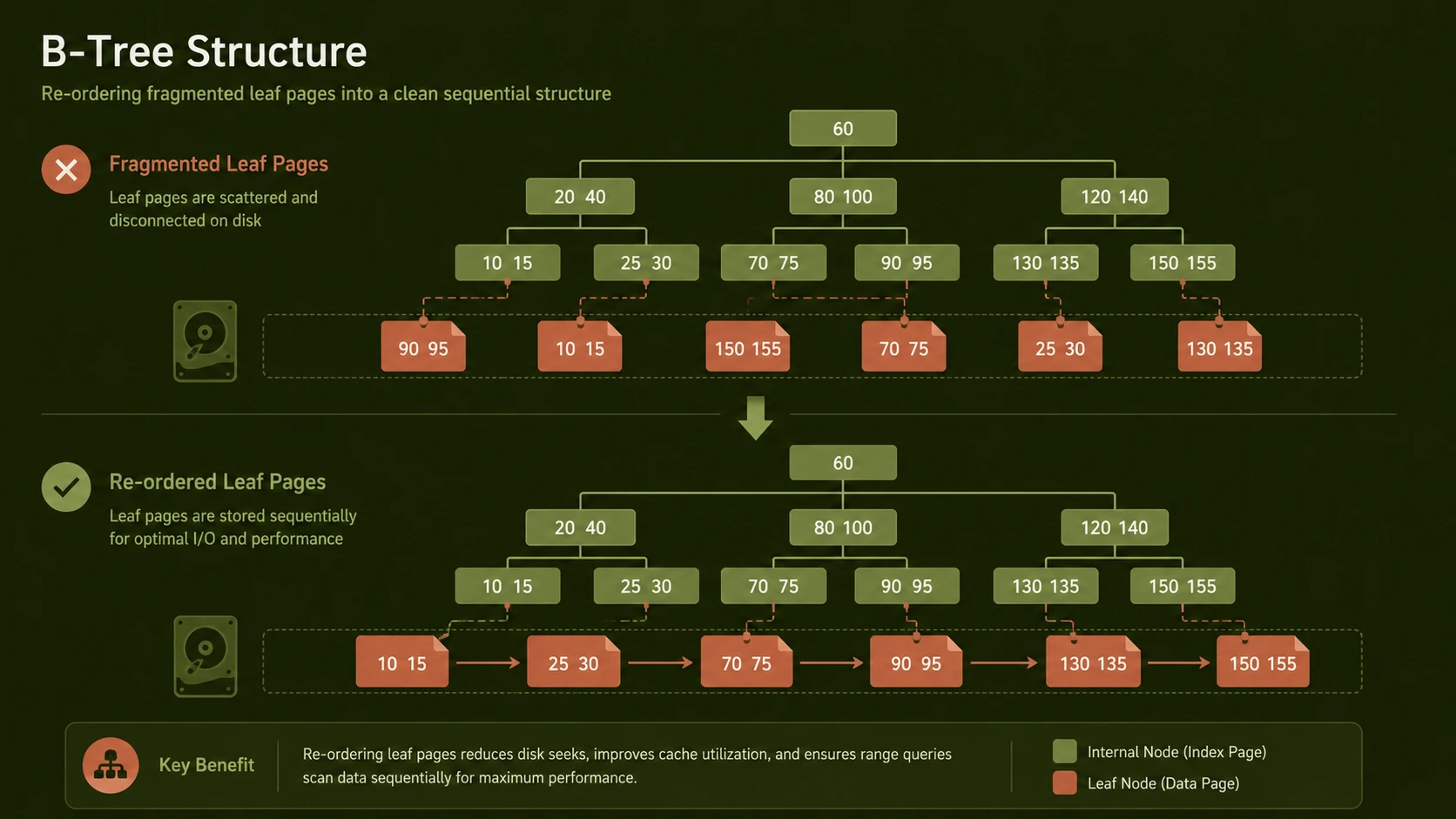
Introduction
Enterprise databases are expected to support increasingly demanding workloads while maintaining predictable response times and high availability. Customer relationship management systems, financial applications, business intelligence platforms, e-commerce solutions, and Software as a Service (SaaS) applications all depend on efficient index structures to locate and retrieve data quickly.
Although SQL Server's query optimizer automatically chooses efficient execution plans, its effectiveness depends heavily upon the quality of the underlying indexes. As databases experience continuous INSERT, UPDATE, and DELETE operations, index pages gradually become fragmented, increasing the amount of work required to satisfy queries.
Fragmentation is often misunderstood. Many administrators rebuild indexes on fixed schedules without first determining whether maintenance is necessary, while others ignore fragmentation entirely until performance problems become visible. Both approaches can lead to unnecessary resource consumption or degraded query performance.
Understanding how SQL Server stores indexes as balanced B-Tree structures, how fragmentation develops, and how maintenance operations affect production systems is essential for enterprise database administrators and architects.
Industry Background
Relational database systems rely heavily on indexing to accelerate data retrieval. Rather than scanning every row in a table, SQL Server navigates B-Tree structures to locate qualifying records efficiently.
As enterprise applications grow, database indexes experience continuous modification. New rows are inserted, existing values change, and records are removed. Over time these operations alter the physical organization of index pages.
SQL Server includes built-in tools for measuring fragmentation and maintenance operations that reorganize or rebuild indexes. Effective database administration depends on understanding when these operations provide measurable benefit.
The Business Problem
Poorly maintained indexes may contribute to:
- ◆Slower query execution
- ◆Increased logical and physical I/O
- ◆Longer report generation
- ◆Higher storage utilization
- ◆Reduced cache efficiency
- ◆Longer maintenance windows
- ◆Greater CPU utilization during data access
At the same time, excessive maintenance introduces its own costs, including additional logging, resource consumption, and operational disruption.
The objective is not to eliminate fragmentation entirely, but to manage it appropriately according to workload characteristics.
Understanding SQL Server B-Tree Indexes
Most SQL Server indexes are organized as balanced tree (B-Tree) structures.
A B-Tree organizes data into multiple levels.
Typical levels include:
- ◆Root page
- ◆Intermediate pages
- ◆Leaf pages
The root page directs navigation toward intermediate pages, which ultimately locate the leaf pages containing index entries or table data depending on index type.
This balanced structure allows SQL Server to locate information efficiently regardless of table size.
Core Architecture
| Component | Responsibility |
|---|---|
| Root Page | Entry point into the index |
| Intermediate Pages | Navigate toward leaf pages |
| Leaf Pages | Store indexed data or row locators |
| Query Optimizer | Chooses index access methods |
| Storage Engine | Reads and writes index pages |
| Maintenance Operations | Reorganize or rebuild indexes |
Together these components provide efficient navigation while supporting ongoing data modification.
What Is Index Fragmentation?
Fragmentation describes how efficiently index pages are organized.
As records are inserted or updated, SQL Server may split pages to accommodate new values. These page splits can cause logically adjacent pages to become physically separated within storage.
Fragmentation generally falls into two categories:
- ◆Logical fragmentation
- ◆Internal fragmentation
Understanding the distinction helps determine appropriate maintenance strategies.
Logical Fragmentation
Logical fragmentation occurs when the logical ordering of pages no longer matches their physical storage order.
As a result:
- ◆Sequential scans require additional page reads.
- ◆Read-ahead operations become less efficient.
- ◆Storage access patterns become less predictable.
Large range scans often experience the greatest impact.
Internal Fragmentation
Internal fragmentation refers to unused space within index pages.
Causes include:
- ◆Page splits
- ◆Deleted rows
- ◆Variable-length data modifications
Excessive unused space increases the number of pages SQL Server must read during query execution.
How Fragmentation Develops
Several workload characteristics contribute to fragmentation.
Common causes include:
- ◆Random inserts
- ◆Frequent updates to indexed columns
- ◆Large delete operations
- ◆Variable-length character data
- ◆Page splits
Highly transactional systems generally experience fragmentation more rapidly than append-only workloads.
Diagnosing Fragmentation
Effective maintenance begins with accurate measurement rather than assumptions.
Database administrators should evaluate:
- ◆Fragmentation percentage
- ◆Page count
- ◆Index size
- ◆Workload characteristics
- ◆Query performance
SQL Server provides dynamic management views that report fragmentation statistics for individual indexes.
Maintenance decisions should consider both fragmentation levels and index size rather than relying on a single metric.
Reorganize vs. Rebuild
-- SQL Server script to identify index fragmentation and dynamically reorganize or rebuild B-Trees
SELECT
    dbschemas.[name] as SchemaName,
    dbtables.[name] as TableName,
    dbindexes.[name] as IndexName,
    indexstats.avg_fragmentation_in_percent
FROM sys.dm_db_index_physical_stats(DB_ID(), NULL, NULL, NULL, 'DETAILED') indexstats
INNER JOIN sys.indexes dbindexes ON dbindexes.[object_id] = indexstats.[object_id]
    AND dbindexes.index_id = indexstats.index_id
INNER JOIN sys.tables dbtables ON dbtables.[object_id] = indexstats.[object_id]
INNER JOIN sys.schemas dbschemas ON dbtables.[schema_id] = dbschemas.[schema_id]
WHERE indexstats.avg_fragmentation_in_percent > 10.0;

-- Rebuild index (if fragmentation > 30%)
ALTER INDEX ALL ON Sales.Orders REBUILD;
SQL Server provides two primary maintenance operations.
Index Reorganize
Reorganize performs an online defragmentation process that reorders existing leaf pages.
Characteristics include:
- ◆Incremental operation
- ◆Lower resource utilization
- ◆Maintains index availability
- ◆Generally suitable for moderate fragmentation
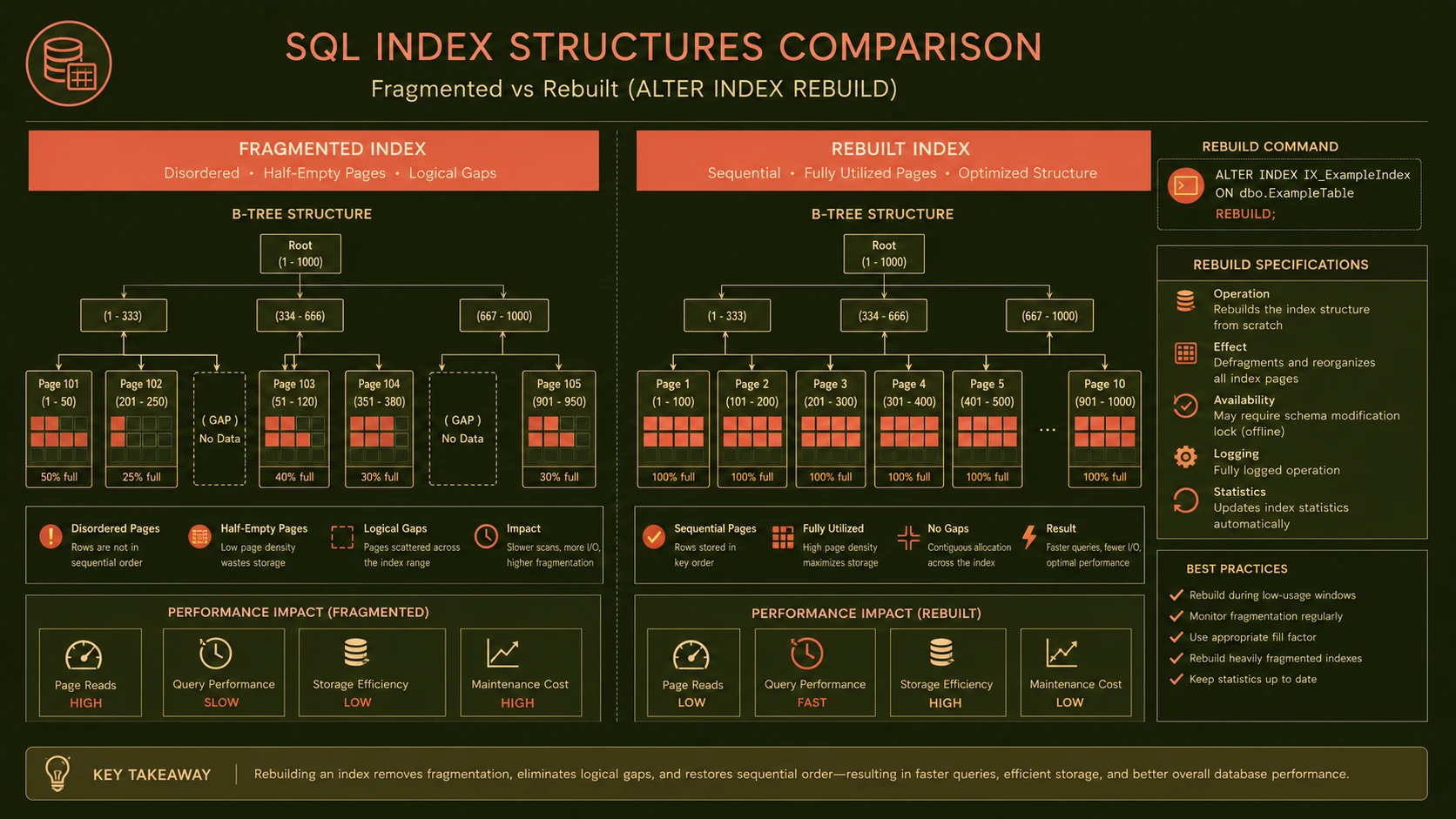
System architecture diagram and conceptual workflow layout for Database Index Fragmentation.
Index Rebuild
Rebuild creates a new copy of the index.
Benefits include:
- ◆Removes logical fragmentation
- ◆Reclaims free space
- ◆Recreates B-Tree structure
- ◆Updates index statistics as part of the rebuild process
Because rebuilding is more resource intensive, it should be scheduled carefully within maintenance windows.
Fill Factor Considerations
SQL Server allows indexes to reserve free space through the fill factor setting.
Lower fill factors leave room for future inserts, potentially reducing page splits.
However, excessive free space may increase storage requirements and reduce cache efficiency.
Selecting an appropriate fill factor depends upon workload characteristics rather than a universal recommendation.
Statistics and Query Optimization
Although indexes and statistics are related, they serve different purposes.
Statistics help the query optimizer estimate row counts and select efficient execution plans.
Index rebuilding refreshes associated statistics, while index reorganization does not automatically provide the same benefit.
Administrators should consider both index maintenance and statistics maintenance as complementary activities.
Enterprise Use Cases
| Scenario | Benefit |
|---|---|
| OLTP Systems | Maintain predictable query performance |
| Data Warehouses | Improve large index scans |
| Financial Databases | Reduce storage access overhead |
| SaaS Platforms | Support sustained transactional workloads |
| Reporting Systems | Improve analytical query efficiency |
| Enterprise ERP | Maintain balanced index structures |
Different workloads require different maintenance strategies based on usage patterns and operational requirements.
Performance Considerations
Index maintenance should balance performance improvements against operational costs.
Important considerations include:
- ◆Database size
- ◆Maintenance windows
- ◆Transaction log growth
- ◆CPU utilization
- ◆I/O bandwidth
- ◆Concurrent user activity
Maintenance should be measured using production-like workloads rather than fixed schedules alone.
Security Considerations
Index maintenance primarily affects performance rather than application security.
Nevertheless, organizations should:
- ◆Restrict administrative permissions.
- ◆Audit maintenance activities.
- ◆Protect backup procedures.
- ◆Schedule maintenance within approved operational processes.
Administrative controls remain an important aspect of enterprise database governance.
Scalability
As databases continue growing, automated maintenance becomes increasingly important.
Scalable maintenance strategies typically include:
- ◆Regular fragmentation analysis
- ◆Selective index maintenance
- ◆Automated maintenance jobs
- ◆Monitoring index growth
- ◆Reviewing execution plans after major schema changes
Automation should be driven by measured database conditions rather than rigid schedules whenever possible.
Best Practices
Enterprise database teams should:
- ◆Measure fragmentation before performing maintenance.
- ◆Focus on frequently used indexes.
- ◆Distinguish between reorganize and rebuild operations.
- ◆Monitor transaction log growth during rebuilds.
- ◆Schedule maintenance during low-activity periods.
- ◆Review fill factor settings periodically.
- ◆Maintain index statistics.
- ◆Validate performance improvements after maintenance.
Consistent monitoring often provides greater value than indiscriminate maintenance.
Common Mistakes
Database administrators frequently encounter several maintenance issues.
Common mistakes include:
- ◆Rebuilding every index regardless of fragmentation.
- ◆Ignoring workload characteristics.
- ◆Confusing statistics maintenance with fragmentation removal.
- ◆Performing maintenance during peak business hours.
- ◆Neglecting transaction log capacity.
- ◆Assuming fragmentation alone explains every performance problem.
Successful optimization requires comprehensive performance analysis rather than relying solely on maintenance tasks.
Technology Comparison
| Capability | Index Reorganize | Index Rebuild |
|---|---|---|
| Resource Usage | Lower | Higher |
| Removes Logical Fragmentation | Yes | Yes |
| Reclaims Free Space | Limited | Yes |
| Recreates B-Tree Structure | No | Yes |
| Updates Statistics | No | Yes |
| Suitable for Heavy Fragmentation | Limited | Yes |
Selecting the appropriate operation depends upon measured fragmentation levels, maintenance windows, and operational objectives.
Adoption Strategy
Organizations should implement index maintenance as part of a broader database performance strategy.
A practical approach includes:
- 1.Identify critical production databases.
- 2.Monitor fragmentation regularly.
- 3.Classify indexes by usage and size.
- 4.Reorganize moderately fragmented indexes where appropriate.
- 5.Schedule rebuilds for heavily fragmented indexes during maintenance windows.
- 6.Review statistics and execution plans after maintenance.
- 7.Continuously evaluate workload trends and maintenance effectiveness.
Data-driven maintenance provides better long-term results than fixed maintenance routines.
Limitations
Although index maintenance improves storage organization, it is not a universal performance solution.
Current considerations include:
- ◆Some workloads experience minimal benefit from frequent rebuilding.
- ◆Large rebuild operations consume substantial system resources.
- ◆Poor query design cannot be corrected through index maintenance alone.
- ◆Schema design and indexing strategy remain fundamental performance factors.
Administrators should evaluate index maintenance within the broader context of database optimization.
Looking Ahead
As of November 2014, SQL Server continues to provide a mature set of tools for monitoring and maintaining index health. Enterprise environments supporting large transactional and analytical workloads should view fragmentation analysis as an ongoing operational responsibility rather than a periodic housekeeping task.
Effective database administration depends on understanding workload behavior, measuring fragmentation accurately, selecting appropriate maintenance operations, and balancing performance improvements with operational cost. Organizations that incorporate these principles into regular database maintenance can improve query efficiency while maintaining stable and predictable SQL Server performance as databases continue to grow.