Introduction
Redis has established itself as one of the fastest in-memory data stores available for modern web applications. Originally adopted as a high-performance key-value store, Redis has steadily evolved into a versatile data structure server supporting strings, hashes, lists, sets, sorted sets, publish/subscribe messaging, transactions, persistence, replication, and increasingly sophisticated application architectures.
As web applications continue to demand lower latency and higher throughput, developers often encounter situations where multiple Redis commands must be executed together. Traditionally, these operations require several client-server round trips, increasing network latency while introducing opportunities for race conditions between commands.
Redis 2.6 introduces server-side Lua scripting, a major architectural enhancement that allows developers to execute multiple Redis operations within a single atomic script. Rather than sending numerous commands across the network, applications can now move business logic closer to the data.
For architects building high-performance web platforms, real-time systems, caching layers, and scalable distributed applications, Lua scripting represents an important capability that extends Redis beyond simple data storage.
Industry Background
The widespread adoption of distributed web applications has placed increasing pressure on backend infrastructure. Applications frequently execute many small operations against caching systems to implement counters, leaderboards, queues, rate limiting, session management, and recommendation engines.
Although Redis offers extremely fast command execution, network communication can become a limiting factor when several commands must execute together.
Prior to Redis 2.6, developers commonly addressed this problem using:
- ◆Client-side transactions
- ◆WATCH and MULTI/EXEC
- ◆Application-side locking
- ◆Multiple sequential Redis commands
- ◆Custom retry logic
These approaches solve many problems but often increase application complexity.
Lua scripting provides an alternative by allowing related operations to execute entirely inside the Redis server.
The Business Problem
Enterprise applications frequently require multiple Redis commands to behave as a single logical operation.
Examples include:
- ◆Incrementing counters while updating timestamps
- ◆Maintaining leaderboards
- ◆Implementing distributed locks
- ◆Executing inventory checks
- ◆Updating multiple data structures
- ◆Rate limiting users
- ◆Session validation
Without server-side execution, applications typically perform numerous network calls.
Common challenges include:
- ◆Increased network latency
- ◆Race conditions
- ◆Complex retry logic
- ◆Larger application codebases
- ◆Reduced consistency under concurrent load
Redis 2.6 addresses these issues through embedded scripting.
Understanding Lua Scripting
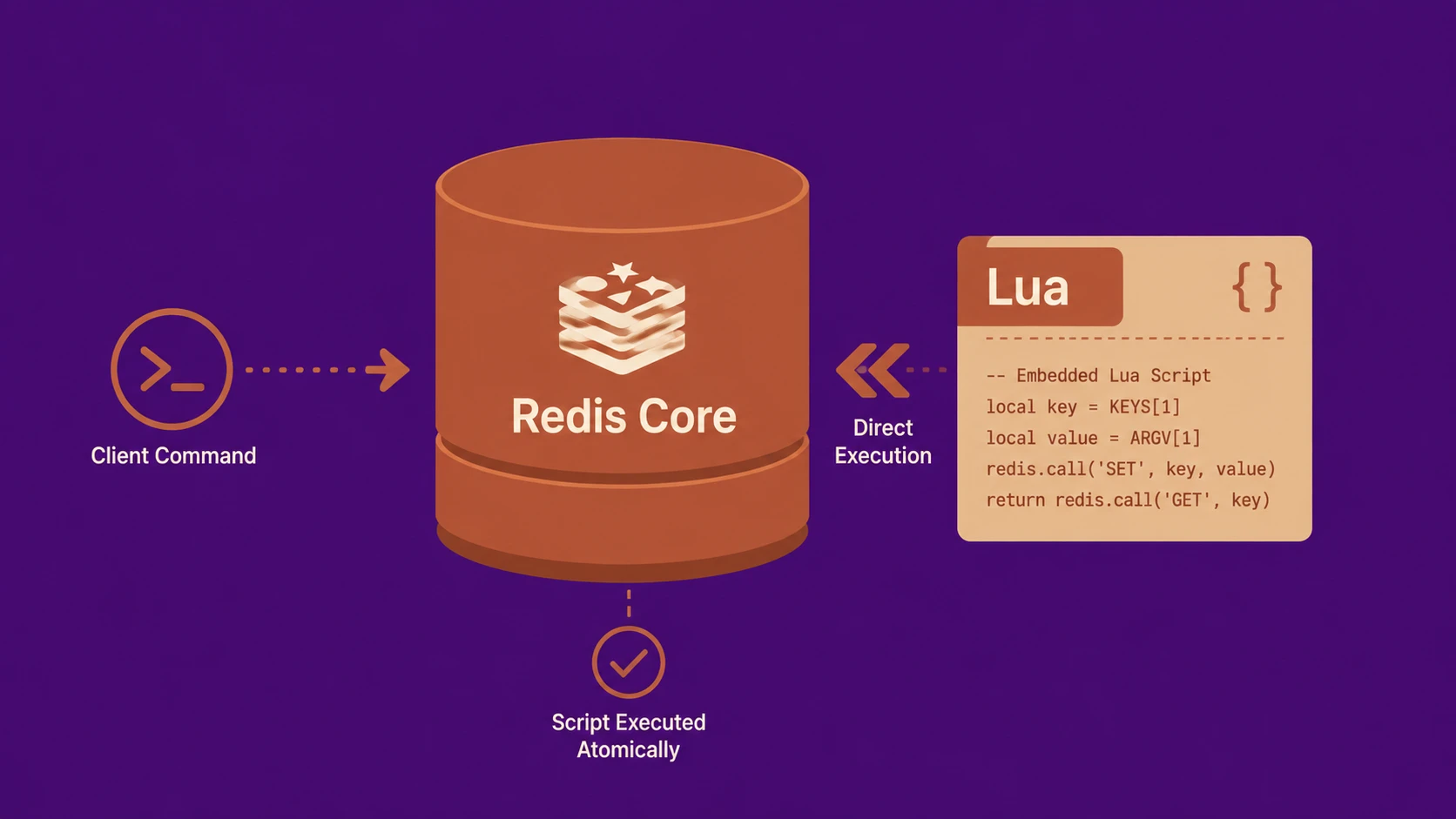
Redis 2.6 embeds the Lua programming language directly within the server.
Applications submit Lua scripts to Redis for execution rather than issuing multiple individual commands.
The server executes the script as a single atomic operation.
This model provides several important advantages:
- ◆Fewer network round trips
- ◆Atomic execution
- ◆Centralized business logic
- ◆Improved consistency
- ◆Higher throughput for complex operations
The scripting environment exposes Redis commands through a Lua interface, allowing scripts to read and modify Redis data structures.
Core Architecture
Lua scripting extends the Redis execution engine while preserving the simplicity of the existing command model.
| Component | Responsibility |
|---|---|
| Redis Client | Sends Lua scripts |
| Lua Interpreter | Executes server-side logic |
| Redis Command API | Allows scripts to access Redis data |
| In-Memory Data Store | Stores application data |
| Atomic Execution Engine | Guarantees uninterrupted script execution |
Scripts execute inside the Redis server process, eliminating repeated communication between clients and the server for related operations.
New Scripting Commands
Redis 2.6 introduces several commands that manage server-side scripting.
| Command | Purpose |
|---|---|
| EVAL | Execute a Lua script |
| EVALSHA | Execute a previously cached script by SHA1 hash |
| SCRIPT LOAD | Store a script in the server cache |
| SCRIPT EXISTS | Verify whether a script has been cached |
| SCRIPT FLUSH | Remove cached scripts |
| SCRIPT KILL | Stop a running script under supported conditions |
Together, these commands provide a practical mechanism for deploying reusable business logic while minimizing script transmission overhead.
How Lua Scripts Work
-- Redis server-side atomic Lua script to throttle API requests
local key = KEYS[1]
local limit = tonumber(ARGV[1])
local expiry = tonumber(ARGV[2])

local current = tonumber(redis.call('get', key) or "0")
if current + 1 > limit then
    return 0
else
    redis.call("INCRBY", key, 1)
    if current == 0 then
        redis.call("EXPIRE", key, expiry)
    end
    return 1
end
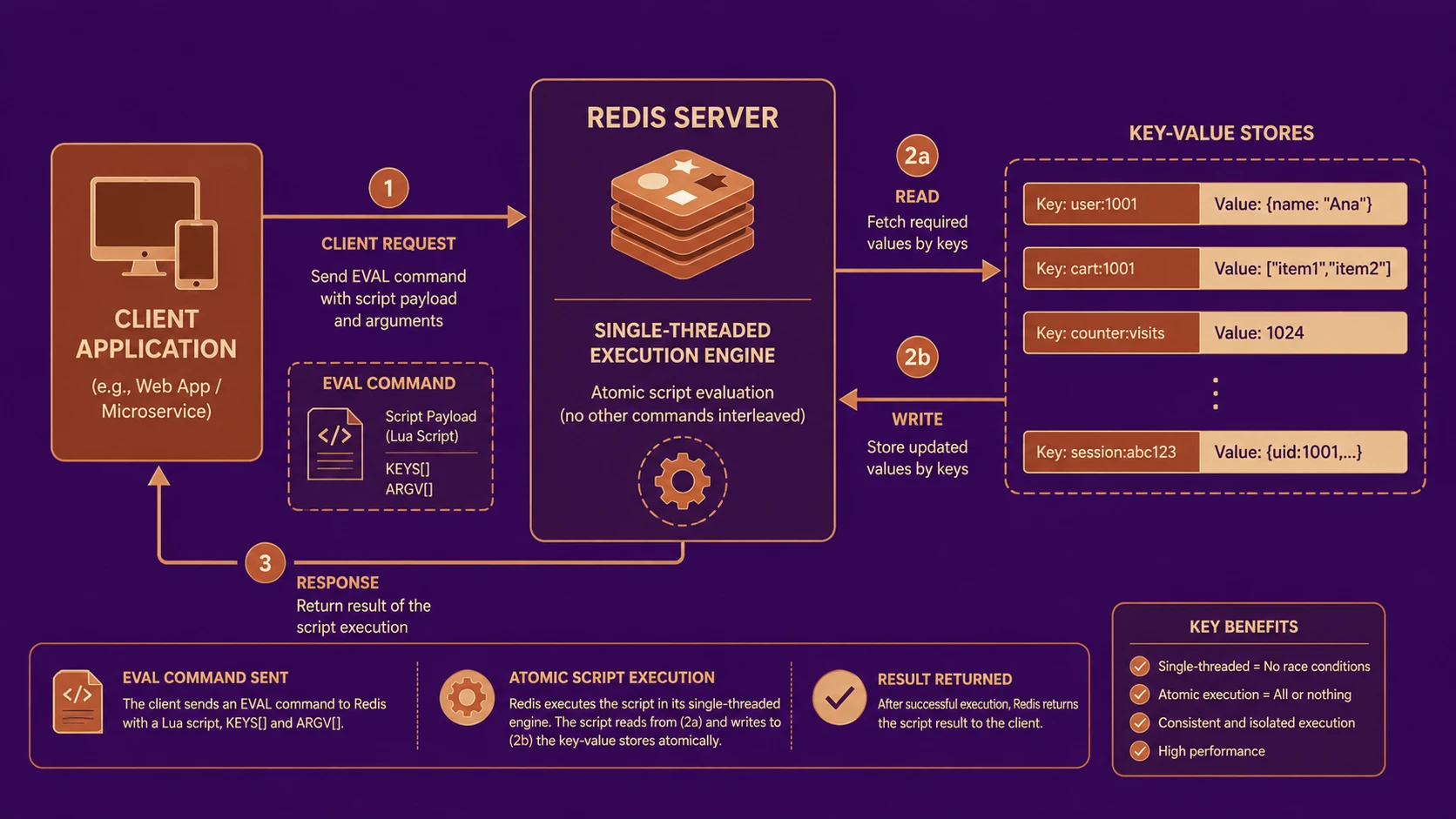
A typical execution flow consists of:
- 1.The application submits a Lua script.
- 2.Redis invokes the embedded Lua interpreter.
- 3.The script executes Redis commands internally.
- 4.Results are collected.
- 5.A single response is returned to the client.
Because execution occurs entirely within Redis, intermediate results never traverse the network.
Atomic Execution
One of the most significant characteristics of Lua scripting is atomicity.
While a Lua script is executing, Redis processes no other client commands.
This behavior ensures:
- ◆Consistent reads
- ◆Consistent writes
- ◆Elimination of race conditions
- ◆Predictable execution
Developers no longer need to coordinate several independent commands through complex synchronization logic for many common scenarios.
Reducing Network Overhead
Consider an application updating multiple keys during a user login.
Without scripting:
System architecture diagram and conceptual workflow layout for Redis 2.6: Lua Scripting, Server-Side Scripts, and Commands.
- ◆Retrieve session
- ◆Validate expiration
- ◆Update activity timestamp
- ◆Increment login counter
- ◆Store audit information
Each operation requires communication between the application and Redis.
Using Lua scripting, these operations execute within one server request, reducing latency and improving overall throughput.
For geographically distributed applications or high-frequency workloads, reducing network round trips can significantly improve responsiveness.
Enterprise Use Cases
Redis scripting enables several enterprise scenarios.
| Scenario | Benefit |
|---|---|
| Rate limiting | Atomic request counting |
| Session management | Consistent updates |
| Leaderboards | Coordinated ranking updates |
| Distributed locking | Reduced race conditions |
| Shopping carts | Atomic inventory validation |
| Analytics counters | Efficient aggregation |
| Queue processing | Simplified coordination |
| Gaming platforms | Consistent score management |
These workloads often benefit from executing multiple Redis commands together.
Performance Considerations
Lua scripting reduces communication overhead but should still be designed carefully.
Performance recommendations include:
- ◆Keep scripts concise.
- ◆Avoid unnecessary loops.
- ◆Minimize expensive operations.
- ◆Cache reusable scripts using EVALSHA.
- ◆Benchmark production workloads.
Although server-side execution removes network latency, excessively complex scripts may increase execution time for other clients because Redis processes commands sequentially.
Security Considerations
Redis scripting executes inside the Redis server and therefore should be treated as trusted application logic.
Organizations should:
- ◆Restrict Redis access to trusted clients.
- ◆Validate script inputs.
- ◆Avoid exposing administrative Redis endpoints publicly.
- ◆Review scripts before deployment.
- ◆Monitor long-running scripts.
Operational governance remains important because poorly designed scripts can affect overall server responsiveness.
Scalability
Redis continues to rely primarily on an event-driven architecture that processes commands sequentially.
Lua scripting complements this design by reducing client-server communication while maintaining predictable execution.
Scalability advantages include:
- ◆Reduced network traffic
- ◆Lower client complexity
- ◆Fewer synchronization problems
- ◆More efficient resource utilization
However, architects should remember that lengthy scripts occupy the server during execution and may delay subsequent client requests.
Best Practices
Organizations adopting Redis scripting should establish clear development standards.
Recommended practices include:
- ◆Keep scripts deterministic.
- ◆Design scripts for small, focused tasks.
- ◆Cache scripts using SHA identifiers.
- ◆Validate all input parameters.
- ◆Benchmark scripts under expected production loads.
- ◆Document script behavior.
- ◆Version shared scripts within source control.
- ◆Test failure scenarios.
Well-designed scripts remain easier to maintain and review over time.
Common Mistakes
Early adopters should avoid several implementation pitfalls.
Common mistakes include:
- ◆Writing excessively large scripts
- ◆Treating Lua as a replacement for application logic
- ◆Ignoring execution time
- ◆Performing unnecessary computations inside Redis
- ◆Failing to cache frequently used scripts
- ◆Assuming scripting improves every workload
Server-side scripting should complement application architecture rather than replace thoughtful system design.
Technology Comparison
| Capability | Traditional Redis Commands | Redis 2.6 Lua Scripting |
|---|---|---|
| Multiple Client Requests | Required | Single request |
| Network Round Trips | Multiple | One |
| Atomic Multi-Step Logic | Limited to transactions and command sequencing | Native |
| Business Logic Location | Application | Redis Server |
| Race Condition Reduction | Manual coordination | Built into execution model |
| Script Reuse | Not applicable | Supported through cached scripts |
Lua scripting extends existing Redis capabilities rather than replacing transactions or standard commands.
Adoption Strategy
Organizations should adopt scripting incrementally.
A practical strategy includes:
- 1.Identify workflows requiring multiple Redis commands.
- 2.Measure network overhead.
- 3.Prototype Lua implementations.
- 4.Benchmark latency improvements.
- 5.Cache production scripts using SHA hashes.
- 6.Monitor execution times during deployment.
This measured approach allows teams to evaluate the operational impact before expanding scripting across additional services.
Limitations
Although Lua scripting provides substantial flexibility, several considerations remain.
Current limitations include:
- ◆Scripts execute synchronously.
- ◆Long-running scripts can delay other client operations.
- ◆Complex business logic may still belong within the application layer.
- ◆Developers must become familiar with Lua syntax and the Redis scripting API.
Architects should carefully balance server-side execution against overall system maintainability.
Looking Ahead
Redis 2.6 marks an important milestone in the platform's evolution. By introducing embedded Lua scripting, Redis expands beyond a high-performance data structure server into a programmable data platform capable of executing coordinated operations directly where data resides.
As of September 2012, organizations building scalable web applications, real-time analytics platforms, online services, and distributed systems should evaluate Lua scripting for workloads that require atomic multi-command operations. When applied thoughtfully, server-side scripting has the potential to reduce latency, simplify application code, and improve consistency while preserving the performance characteristics that have made Redis an increasingly important component of modern application architectures.