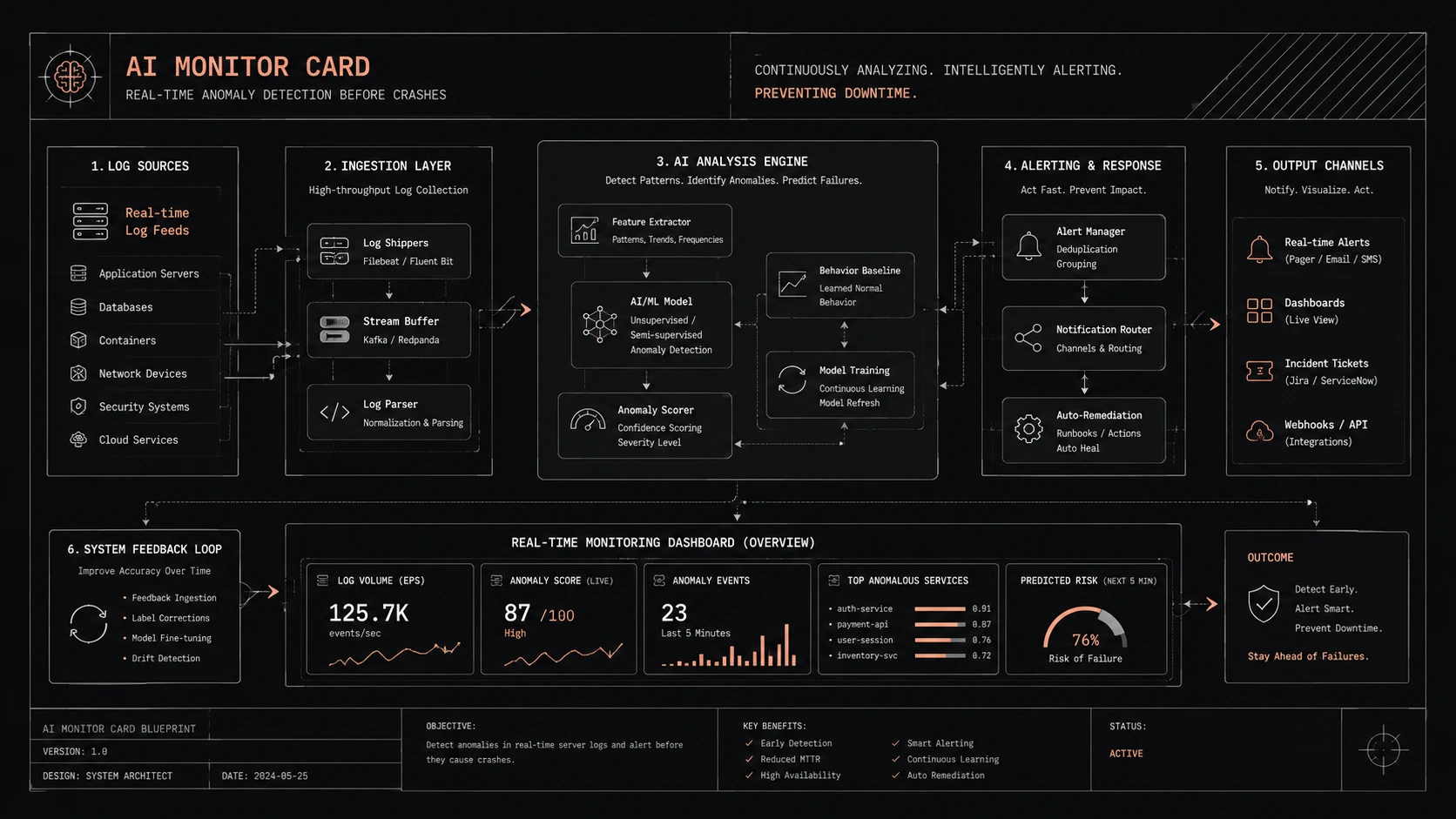
Introduction
Enterprise software has become significantly more complex over the past decade. Applications are no longer deployed as monolithic services running on a handful of virtual machines. Instead, modern organizations operate hundreds or thousands of microservices across Kubernetes clusters, serverless platforms, cloud databases, API gateways, edge infrastructure, SaaS platforms, and AI-powered services.
This architectural evolution has dramatically increased operational complexity. A single customer transaction may traverse dozens of independent services before completing successfully. Traditional monitoring systems that simply report CPU utilization or server availability can no longer provide sufficient visibility into these distributed environments.
Observability has emerged as the modern operational discipline for understanding the internal state of complex systems through telemetry data including logs, metrics, traces, events, and application profiles. At the same time, Artificial Intelligence for IT Operations (AIOps) is transforming operational management by applying machine learning, statistical analysis, and automation to detect anomalies, correlate incidents, predict failures, and recommend remediation.
Together, Observability and AIOps are enabling organizations to shift from reactive incident response toward predictive and increasingly autonomous operations.
As of May 2024, these capabilities have become strategic priorities for enterprises seeking higher system reliability, faster incident resolution, and improved operational efficiency.
Industry Background
Several technology trends continue accelerating adoption:
- ◆Cloud-native architectures
- ◆Kubernetes platforms
- ◆Microservices
- ◆Distributed tracing
- ◆Artificial Intelligence
- ◆Platform Engineering
- ◆Site Reliability Engineering (SRE)
- ◆Hybrid and multi-cloud deployments
Organizations increasingly require operational platforms capable of understanding highly dynamic distributed systems rather than isolated infrastructure components.
The Business Problem
Modern enterprise environments commonly experience:
- ◆Alert fatigue
- ◆Fragmented operational visibility
- ◆Long incident resolution times
- ◆Increasing operational complexity
- ◆Difficult root cause analysis
- ◆Unpredictable system behavior
- ◆Large volumes of telemetry data
Operations teams require intelligent systems capable of transforming raw telemetry into actionable operational insights.
Understanding Observability
// OpenTelemetry Tracer initialization for distributed tracing observability
const { NodeTracerProvider } = require('@opentelemetry/node');
const { SimpleSpanProcessor } = require('@opentelemetry/tracing');
const { JaegerExporter } = require('@opentelemetry/exporter-jaeger');

const provider = new NodeTracerProvider();
provider.addSpanProcessor(
  new SimpleSpanProcessor(new JaegerExporter({ serviceName: 'billing-service' }))
);
provider.register();
Observability extends beyond traditional infrastructure monitoring by providing comprehensive visibility into application behavior.
Rather than asking predefined monitoring questions, observability enables engineers to investigate unknown system behavior using multiple telemetry sources.
Core telemetry pillars include:
- ◆Metrics
- ◆Logs
- ◆Distributed traces
- ◆Events
- ◆Application profiles
Together these data sources enable engineers to understand system performance, dependencies, and operational health.
Understanding AIOps
AIOps applies artificial intelligence and machine learning techniques to operational data.
Rather than manually reviewing thousands of alerts, AIOps platforms analyze telemetry to:
- ◆Detect anomalies
- ◆Correlate events
- ◆Identify probable root causes
- ◆Predict failures
- ◆Recommend remediation
- ◆Automate operational workflows
The objective is to improve operational efficiency while reducing manual investigation effort.
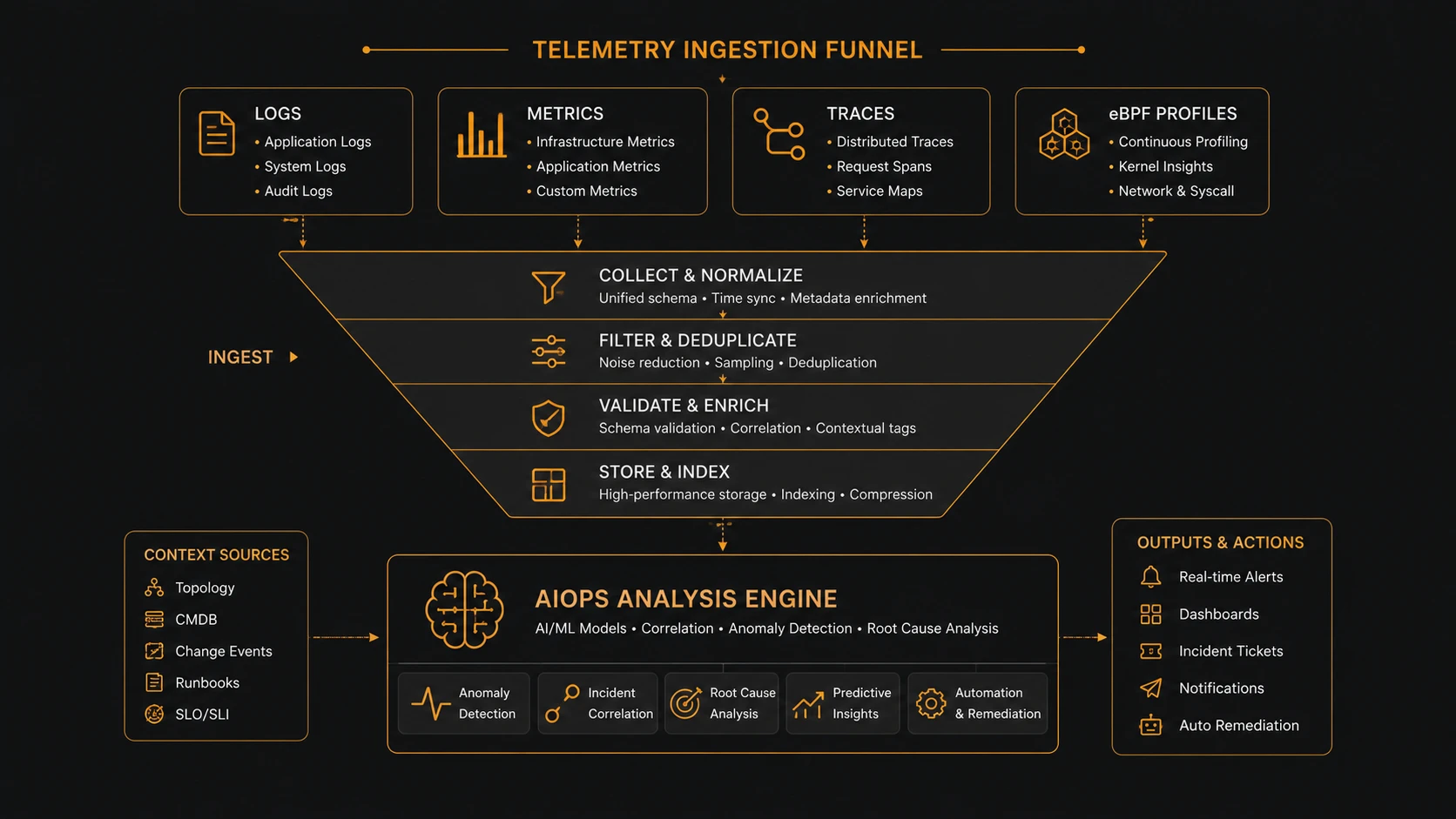
Core Architecture
| Component | Responsibility |
|---|---|
| Applications | Generate operational telemetry |
| Telemetry Collectors | Collect logs, metrics, traces, and events |
| Observability Platform | Stores, indexes, and analyzes telemetry |
| AIOps Engine | Detects anomalies and predicts incidents |
| Automation Platform | Executes remediation workflows |
| Notification System | Alerts operations teams |
| Dashboard & Analytics | Visualizes operational health |
This architecture transforms operational data into actionable intelligence while supporting both human operators and automated workflows.
The Three Pillars of Observability
Although observability continues evolving, three telemetry categories remain foundational.
Metrics
Metrics provide quantitative measurements such as:
- ◆CPU utilization
- ◆Memory usage
- ◆Request latency
- ◆Error rates
- ◆Throughput
Metrics are well suited for dashboards, capacity planning, and trend analysis.
Logs
Logs record detailed operational events generated by applications and infrastructure.
Typical information includes:
- ◆Errors
- ◆Warnings
- ◆Audit events
- ◆Security activity
- ◆Business transactions
Structured logging improves searchability and automated analysis.
Distributed Tracing
Distributed tracing follows requests across multiple services.
Tracing enables engineering teams to understand:
- ◆Request flow
- ◆Service dependencies
- ◆Latency bottlenecks
- ◆Failed interactions
Tracing is particularly valuable in microservice environments where business transactions span numerous independent components.
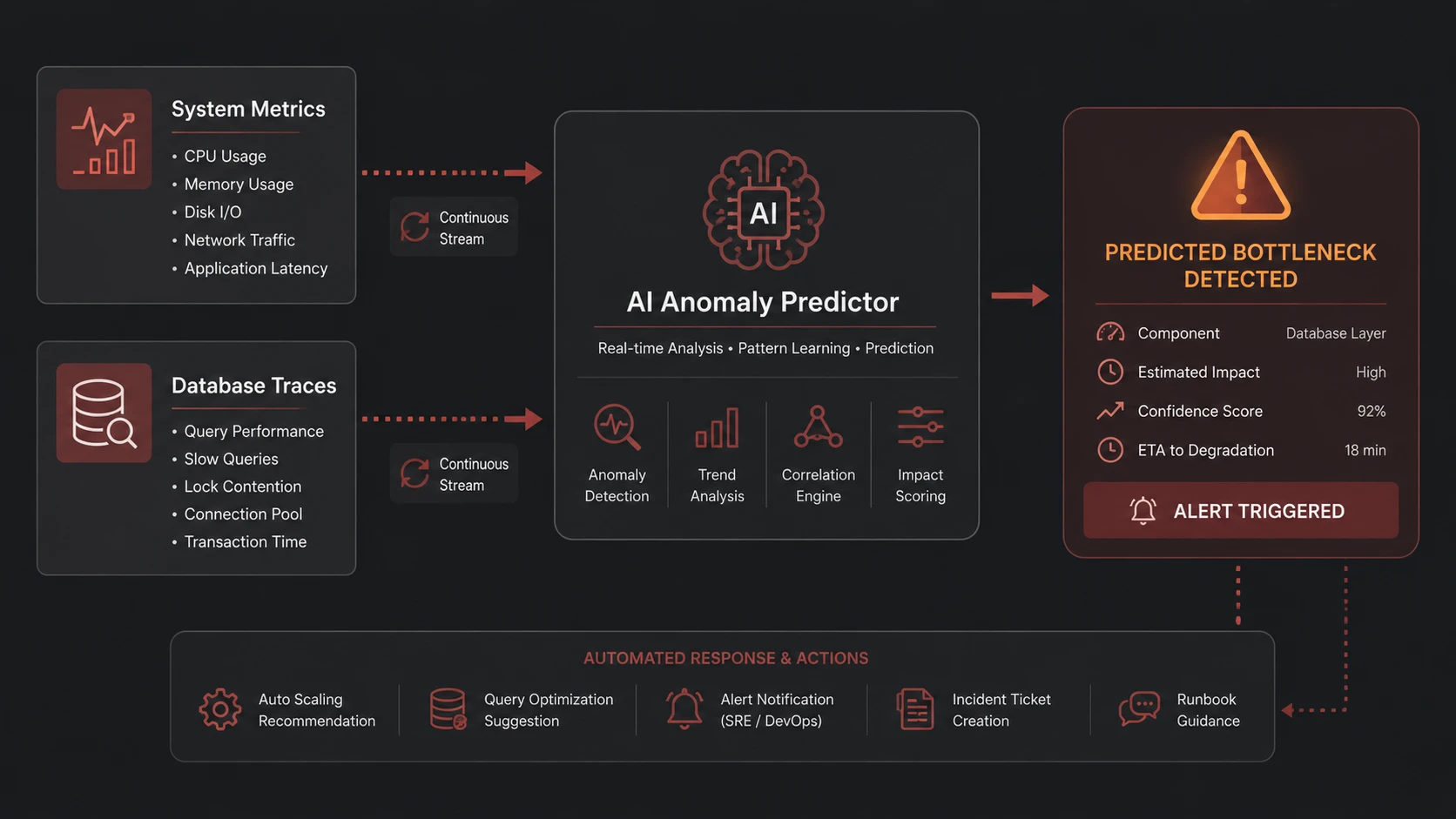
AI-Powered Anomaly Detection
Static alert thresholds often generate excessive operational noise.
AIOps platforms increasingly analyze historical telemetry to identify unusual behavior.
Potential capabilities include:
- ◆Seasonal pattern recognition
- ◆Capacity forecasting
- ◆Performance degradation detection
- ◆Resource anomaly identification
- ◆Infrastructure health prediction
These capabilities allow operations teams to identify emerging problems before they become service outages.
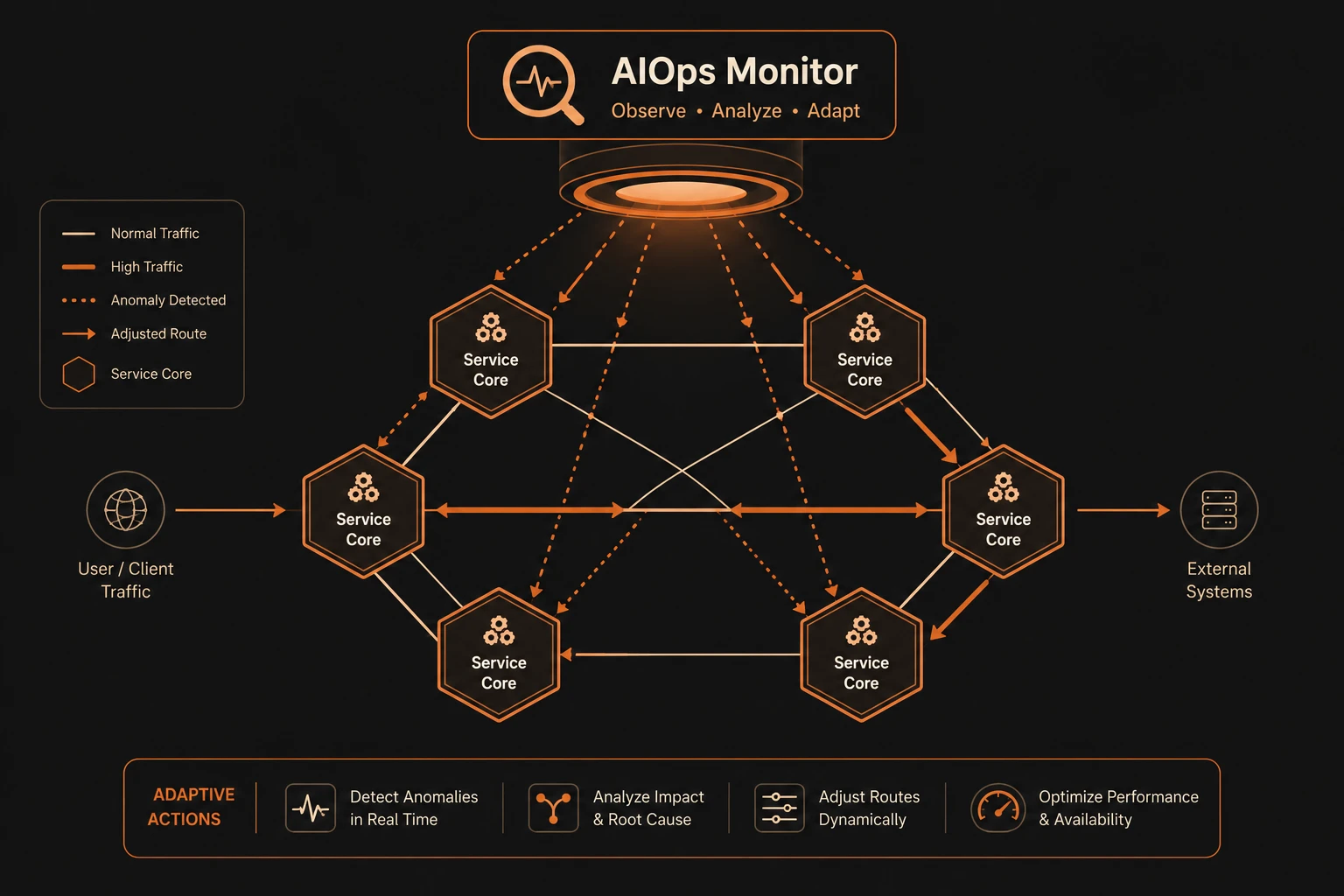
Event Correlation
Large enterprise environments may generate thousands of alerts during a single infrastructure issue.
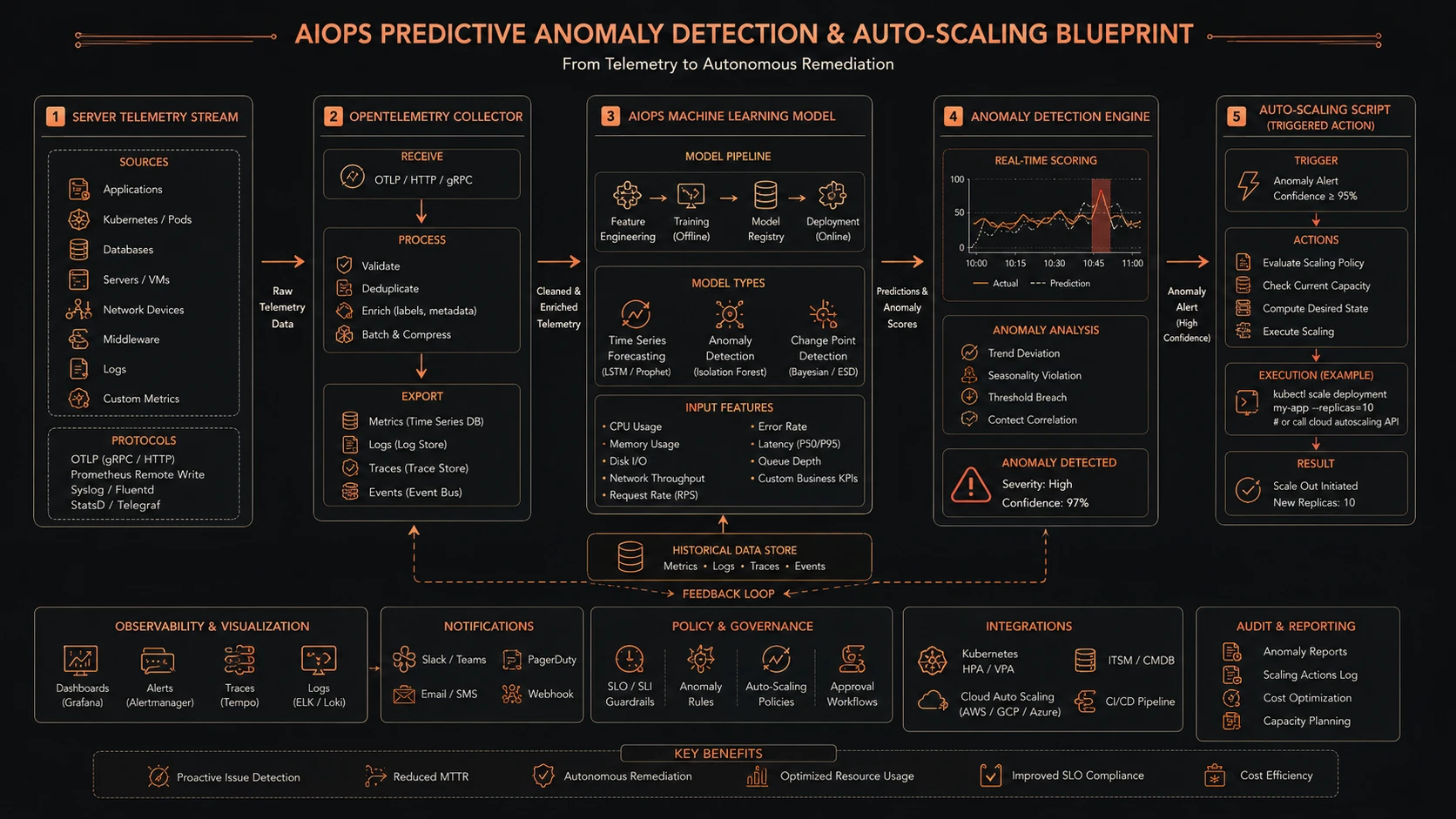
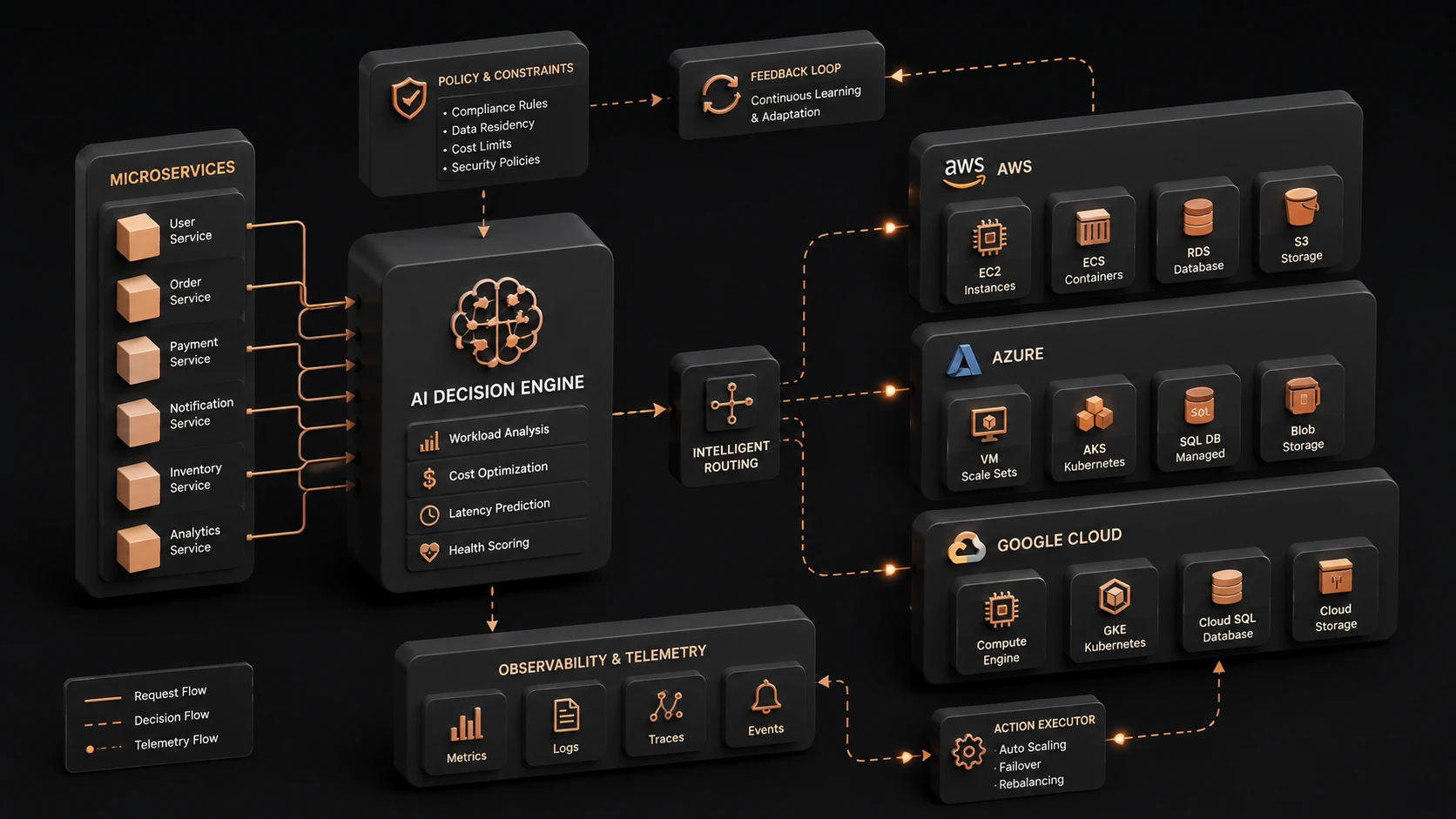
System architecture diagram and conceptual workflow layout for Observability & AIOps.
AIOps platforms correlate related events by analyzing:
- ◆Service topology
- ◆Historical incidents
- ◆Dependency relationships
- ◆Infrastructure changes
- ◆Operational timelines
Event correlation reduces duplicate alerts while helping engineers focus on the most likely root cause.
Predictive Operations
One of the most promising applications of AIOps involves predictive operational management.
Rather than reacting after failures occur, organizations increasingly analyze trends to anticipate:
- ◆Capacity exhaustion
- ◆Storage limitations
- ◆Infrastructure degradation
- ◆Performance bottlenecks
- ◆Network anomalies
Predictive analytics supports proactive maintenance and resource planning.
Automation and Self-Healing
Many operational activities can be automated once confidence levels become sufficiently high.
Examples include:
- ◆Restarting failed services
- ◆Scaling workloads
- ◆Clearing temporary resource constraints
- ◆Rotating infrastructure
- ◆Executing predefined recovery workflows
Organizations should maintain governance and approval mechanisms for high-impact automated actions.
Enterprise Use Cases
| Scenario | Benefit |
|---|---|
| Cloud Platforms | End-to-end operational visibility |
| Financial Services | Faster incident detection |
| Healthcare Systems | Improved service availability |
| E-commerce Platforms | Predictive traffic management |
| Manufacturing | Infrastructure reliability |
| SaaS Providers | Reduced Mean Time to Resolution (MTTR) |
Organizations operating distributed cloud-native environments benefit significantly from combining observability with intelligent operational automation.
Performance Considerations
Engineering teams should evaluate:
- ◆Telemetry ingestion rate
- ◆Query performance
- ◆Dashboard responsiveness
- ◆Trace collection overhead
- ◆Alert processing latency
- ◆Storage efficiency
Observability platforms should provide comprehensive visibility while minimizing operational overhead.
Security Considerations
Operational telemetry often contains sensitive business information.
Organizations should continue implementing:
- ◆Identity and access management
- ◆Role-based access control
- ◆Encryption in transit and at rest
- ◆Audit logging
- ◆Data retention policies
- ◆Secure telemetry collection
- ◆Privacy-aware observability practices
Operational visibility should align with enterprise security and compliance requirements.
Scalability
Observability platforms must scale alongside enterprise growth.
Modern architectures support scalability through:
- ◆Distributed telemetry collection
- ◆Horizontal storage scaling
- ◆Stream processing
- ◆Automated data lifecycle management
- ◆Cloud-native deployment models
Scalable observability ensures operational insight remains effective as infrastructure expands.
Best Practices
Organizations implementing Observability and AIOps should:
- ◆Instrument applications during development rather than after deployment.
- ◆Standardize logging, metrics, and tracing across services.
- ◆Define meaningful Service Level Indicators (SLIs) and Service Level Objectives (SLOs).
- ◆Continuously improve telemetry quality.
- ◆Introduce AI-assisted anomaly detection incrementally.
- ◆Validate automated remediation before production deployment.
- ◆Measure operational improvements using incident response metrics.
- ◆Maintain cross-functional collaboration among development, operations, security, and platform teams.
A disciplined observability strategy enables reliable automation while preserving operational trust.
Common Mistakes
Organizations should avoid:
- ◆Collecting excessive telemetry without clear operational objectives.
- ◆Treating observability as equivalent to infrastructure monitoring.
- ◆Ignoring distributed tracing in microservice architectures.
- ◆Deploying automated remediation without governance.
- ◆Measuring success solely by the number of dashboards created.
- ◆Expecting AI to replace experienced operations engineers.
Observability succeeds when telemetry, engineering processes, and operational expertise work together.
Technology Comparison
| Capability | Traditional Monitoring | Observability with AIOps |
|---|---|---|
| Operational Visibility | Infrastructure focused | End-to-end distributed systems |
| Alerting | Static thresholds | Intelligent anomaly detection |
| Root Cause Analysis | Manual investigation | AI-assisted correlation |
| Incident Response | Reactive | Predictive and automated |
| Data Sources | Primarily metrics | Logs, metrics, traces, events, and profiles |
| Automation | Limited | Intelligent remediation workflows |
Observability expands monitoring into a comprehensive operational intelligence platform capable of supporting increasingly autonomous enterprise operations.
Adoption Strategy
Organizations should modernize incrementally.
A recommended roadmap includes:
- 1.Standardize telemetry instrumentation.
- 2.Deploy centralized observability platforms.
- 3.Implement distributed tracing across critical services.
- 4.Define SLIs and SLOs.
- 5.Introduce AI-assisted anomaly detection.
- 6.Automate low-risk operational workflows.
- 7.Continuously refine predictive models and operational governance.
An incremental approach allows organizations to improve operational maturity while building confidence in automation.
Limitations
As of May 2024, organizations should recognize several considerations.
Current observations include:
- ◆High-quality telemetry remains essential for effective AI analysis.
- ◆AIOps platforms require ongoing tuning and operational validation.
- ◆Human expertise continues to be critical for complex incidents and strategic decision-making.
- ◆Successful implementation depends on engineering culture, observability maturity, and well-defined operational processes rather than AI technology alone.
Organizations should therefore approach Observability and AIOps as complementary capabilities that enhance, rather than replace, experienced operations teams.
Looking Ahead
As of May 2024, Observability and AIOps are becoming foundational capabilities for operating modern cloud-native enterprises. By combining comprehensive telemetry collection, intelligent analytics, predictive insights, and automated remediation, organizations can move beyond reactive monitoring toward resilient, data-driven operations.
For enterprise architects, Site Reliability Engineers, platform engineering teams, and technology leaders, the strategic objective is to create operational platforms that continuously learn from system behavior while empowering engineers with actionable intelligence. Organizations that invest in standardized instrumentation, strong governance, AI-assisted analytics, and incremental automation will be well positioned to operate increasingly complex digital ecosystems with greater reliability, efficiency, and confidence.