Introduction
Enterprise databases have evolved from simple transactional storage engines into the foundation of modern business applications. Customer relationship management systems, financial platforms, analytics solutions, e-commerce applications, and cloud services all depend on database systems capable of handling increasingly complex workloads while maintaining reliability and consistency.
PostgreSQL has steadily established itself as one of the most capable open source relational database management systems by combining SQL standards compliance with advanced features such as Multi-Version Concurrency Control (MVCC), extensibility, replication, sophisticated indexing, and transactional integrity.
The release of PostgreSQL 9.6 represents another important milestone. Rather than introducing sweeping SQL language changes, this version focuses heavily on execution engine improvements, most notably parallel query execution, allowing multiple CPU cores to participate in processing suitable queries.
From the perspective of August 2016, PostgreSQL 9.6 demonstrates a clear emphasis on improving analytical performance while continuing to strengthen enterprise scalability.
Industry Background
Organizations continue collecting larger volumes of operational and analytical data.
Enterprise workloads increasingly include:
- ◆Online Transaction Processing (OLTP).
- ◆Business Intelligence.
- ◆Data Warehousing.
- ◆Financial reporting.
- ◆Customer analytics.
- ◆Log analysis.
- ◆Operational dashboards.
Modern servers commonly include multiple processor cores and substantial memory capacity. However, many database workloads have historically executed individual queries using only a single CPU core.
As datasets continue expanding, parallel execution becomes an increasingly important optimization strategy.
The Business Problem
Large enterprise databases commonly encounter several operational challenges.
Organizations frequently experience:
- ◆Slow analytical queries.
- ◆CPU underutilization.
- ◆Long report generation times.
- ◆Increasing data volumes.
- ◆Resource contention.
- ◆Infrastructure scaling costs.
- ◆Complex read-intensive workloads.
Adding hardware alone does not always improve performance if query execution cannot effectively utilize available processor resources.
PostgreSQL 9.6 addresses this challenge through parallel query execution.
Understanding the Technology
PostgreSQL is an ACID-compliant relational database management system supporting advanced SQL functionality and extensibility.
Version 9.6 introduces several notable improvements.
Major enhancements include:
- ◆Parallel sequential scans.
- ◆Parallel query execution.
- ◆Parallel aggregation.
- ◆Improved replication capabilities.
- ◆Better query planner decisions.
- ◆Enhanced scalability.
These improvements allow appropriate queries to distribute work across multiple worker processes, reducing execution time for many analytical operations.
Core Architecture
A simplified PostgreSQL 9.6 architecture appears below.
| Component | Responsibility |
|---|---|
| Client Applications | Submit SQL queries |
| PostgreSQL Server | Coordinates query execution |
| Query Planner | Builds execution plans |
| Parallel Workers | Execute eligible query operations |
| Storage Engine | Manages persistent data |
| Write-Ahead Log (WAL) | Ensures durability and recovery |
The query planner determines whether parallel execution is beneficial based on workload characteristics and available system resources.
Key Features
Parallel Query Execution
The headline feature of PostgreSQL 9.6 is parallel query execution.
For eligible workloads, PostgreSQL can distribute portions of a query across multiple worker processes, allowing modern multicore processors to execute database operations more efficiently.
This capability is particularly valuable for large analytical queries involving significant data scans.
Parallel Sequential Scans
Sequential table scans can be divided among multiple workers.
Instead of one process scanning an entire table, multiple workers cooperate by processing different portions of the dataset simultaneously.
Parallel Aggregation
Aggregation operations such as counting or summarizing large datasets can benefit from distributed execution before results are combined.
Query Planner Enhancements
The PostgreSQL planner continues improving its ability to determine efficient execution strategies based on statistics and workload characteristics.
Parallel execution is selected only when expected to improve performance.
Replication Improvements
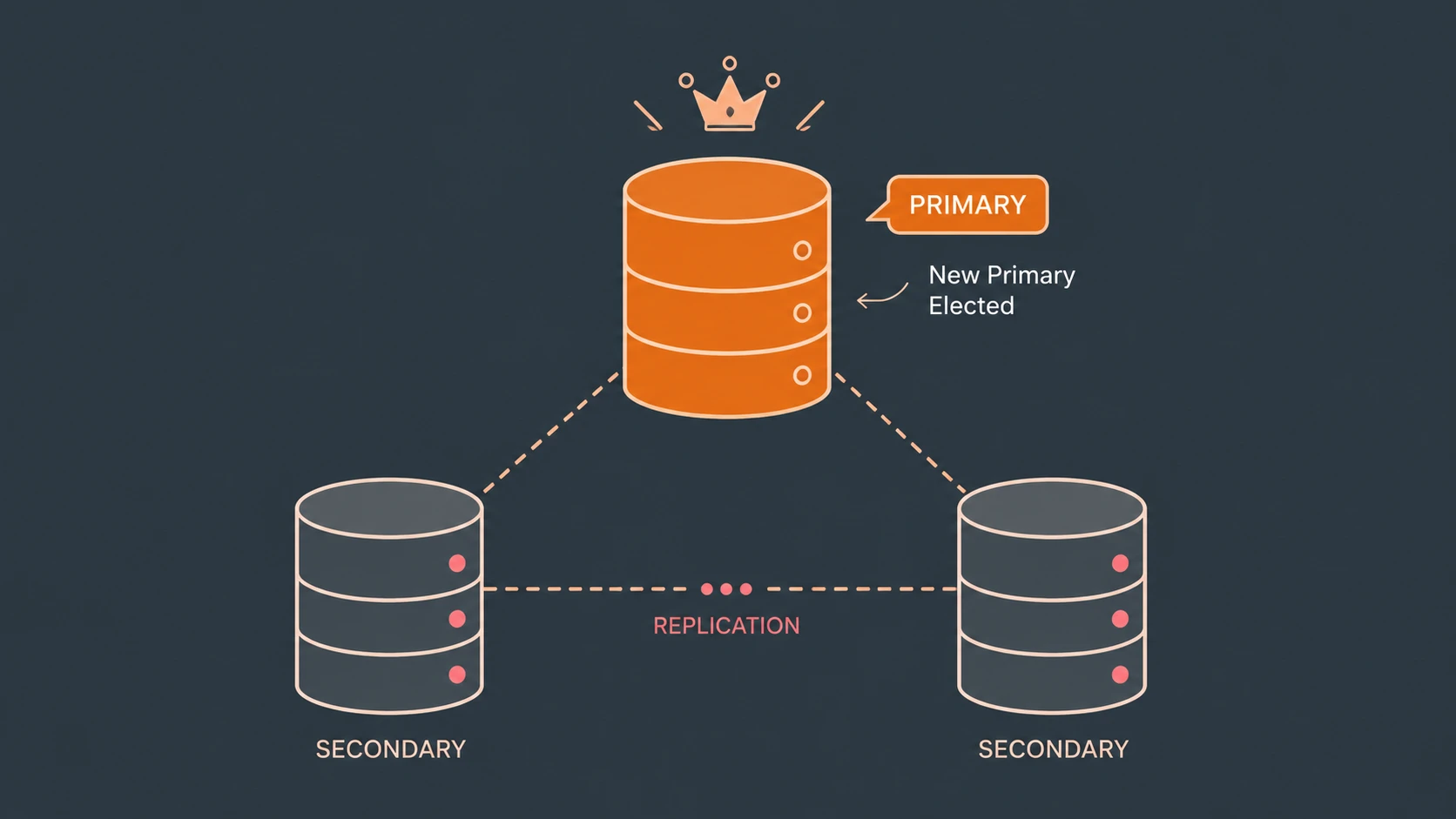
PostgreSQL 9.6 also introduces enhancements to streaming replication, improving scalability for read-heavy environments and disaster recovery planning.
Mature SQL Support
Organizations continue benefiting from PostgreSQL's advanced SQL capabilities, transactional consistency, indexing options, extensibility, and standards compliance.
How It Works
A simplified execution workflow appears below.
SQL Query
      |
Query Planner
      |
Parallel Execution Decision
      |
Coordinator Process
      |
Multiple Worker Processes
      |
Result Aggregation
      |
Client Response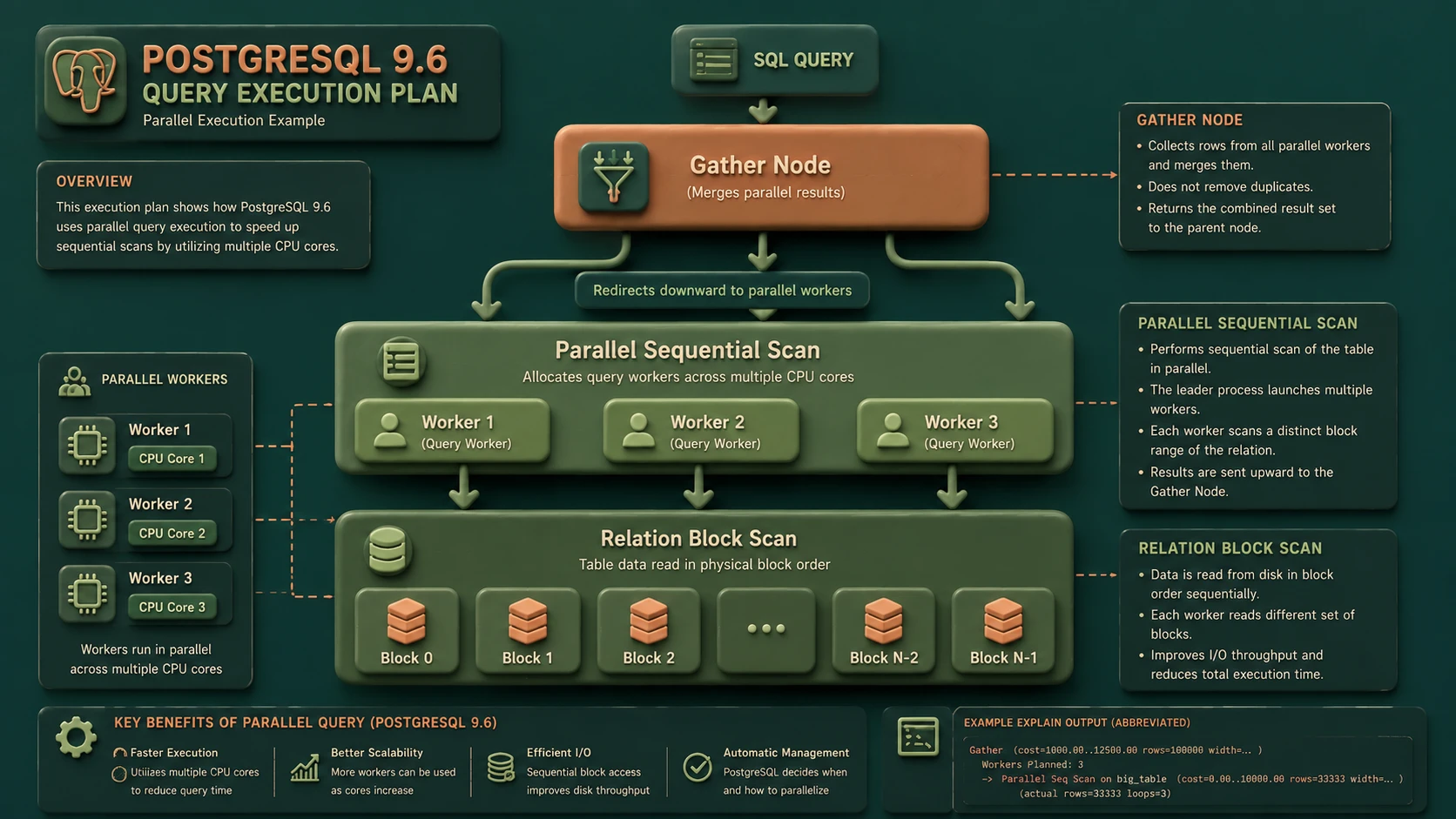
System architecture diagram and conceptual workflow layout for PostgreSQL 9.6: Parallel Query Execution and Scale-Out Architecture.
Parallel execution occurs transparently when the optimizer determines that distributing work across multiple workers will improve performance.
Enterprise Use Cases
Business Intelligence
Large reporting queries processing millions of records benefit from parallel execution.
Data Warehousing
Analytical workloads involving large table scans become more efficient on multicore hardware.
Financial Reporting
Complex aggregation queries may complete faster through parallel processing.
Customer Analytics
Organizations performing behavioral analysis across large datasets benefit from improved query throughput.
Read-Heavy Applications
Replication enhancements support scalable read infrastructure while preserving transactional integrity.
Performance Considerations
PostgreSQL 9.6 focuses heavily on improving query execution efficiency.
Important considerations include:
- ◆Number of CPU cores.
- ◆Query complexity.
- ◆Table size.
- ◆Parallel worker configuration.
- ◆Memory availability.
- ◆Storage subsystem performance.
Not every SQL statement benefits equally from parallel execution. Smaller transactional queries may continue executing efficiently without multiple workers.
Security Considerations
Performance improvements should complement established database security practices.
Organizations should continue implementing:
- ◆Role-based access control.
- ◆Authentication.
- ◆Encryption for network communication.
- ◆Audit logging.
- ◆Backup protection.
- ◆Principle of least privilege.
Database security remains independent of execution engine optimizations.
Scalability
PostgreSQL 9.6 strengthens scalability in several important areas.
Advantages include:
- ◆Better multicore utilization.
- ◆Faster analytical queries.
- ◆Improved replication.
- ◆Efficient read scaling.
- ◆Mature concurrency control.
These capabilities position PostgreSQL for increasingly demanding enterprise workloads.
Best Practices
Organizations evaluating PostgreSQL 9.6 should:
- ◆Benchmark representative production workloads.
- ◆Analyze execution plans regularly.
- ◆Configure parallel worker settings appropriately.
- ◆Maintain accurate database statistics.
- ◆Optimize indexes before relying solely on parallel execution.
- ◆Monitor CPU utilization.
- ◆Continue routine maintenance operations such as VACUUM and ANALYZE.
Performance improvements are most effective when combined with sound database administration practices.
Common Mistakes
| Mistake | Business Impact |
|---|---|
| Assuming every query benefits from parallel execution | Unrealistic performance expectations |
| Ignoring execution plans | Missed optimization opportunities |
| Poor indexing strategy | Slower query performance |
| Outdated database statistics | Inefficient query planning |
| Underestimating storage performance | Limited scalability |
| Skipping performance benchmarking | Inaccurate capacity planning |
Successful optimization requires careful analysis of workload characteristics rather than relying solely on new database features.
Technology Comparison
| Characteristic | PostgreSQL 9.5 | PostgreSQL 9.6 |
|---|---|---|
| Parallel Query Execution | Not available | Supported for eligible queries |
| Sequential Scan | Single worker | Parallel sequential scans |
| Aggregation | Single-process execution | Parallel aggregation support |
| Replication | Mature streaming replication | Enhanced replication capabilities |
| Multicore Utilization | Limited for individual queries | Improved workload distribution |
PostgreSQL 9.6 focuses on improving execution efficiency while preserving the database's mature transactional architecture.
Adoption Strategy
Organizations should adopt PostgreSQL 9.6 through a structured migration plan.
- 1.Evaluate application compatibility.
- 2.Benchmark representative production workloads.
- 3.Validate replication configurations.
- 4.Review execution plans after migration.
- 5.Tune parallel worker parameters.
- 6.Expand deployment following operational validation.
This phased approach minimizes migration risk while allowing organizations to quantify measurable performance improvements.
Limitations
As of August 2016, organizations should recognize several considerations.
- ◆Parallel execution applies only to eligible query types.
- ◆Performance improvements depend on workload characteristics.
- ◆Hardware configuration remains an important factor.
- ◆Existing database optimization practices remain essential.
- ◆Careful testing should precede production deployment.
These considerations should be incorporated into enterprise upgrade planning.
Looking Ahead
From the perspective of August 2016, PostgreSQL 9.6 represents one of the most important performance-focused releases in the project's history. By introducing parallel query execution and strengthening multicore processor utilization, PostgreSQL continues evolving from a highly capable transactional database into an increasingly competitive platform for analytical workloads.
Combined with its mature SQL implementation, robust concurrency model, replication capabilities, extensibility, and strong open source community, PostgreSQL 9.6 provides organizations with a compelling database platform for modern enterprise applications. As multicore server hardware becomes increasingly common across data centers, parallel query execution is likely to become an important capability for organizations seeking better performance from existing infrastructure.