Introduction
Enterprise applications are generating more data than ever before. Customer relationship management systems, e-commerce platforms, financial applications, business intelligence solutions, and content management systems must support increasing numbers of users while maintaining reliability and acceptable response times.
For many years, database normalization has been considered a cornerstone of relational database design. Proper normalization minimizes redundancy, preserves data integrity, and simplifies long-term maintenance. Nearly every database design methodology emphasizes normalization during system design.
However, the rapid growth of Internet-scale applications has introduced new performance challenges. Large transactional systems frequently execute complex joins across multiple tables, and as datasets grow into millions of records, query performance becomes an increasingly important concern.
To address these challenges, many organizations are selectively adopting denormalization techniques. Rather than eliminating normalization altogether, architects intentionally duplicate selected data to reduce joins, improve read performance, and simplify frequently executed queries.
As of November 2010, organizations evaluating large-scale web applications must determine where normalization remains appropriate and where denormalization offers measurable business value.
This article examines both approaches, compares their strengths and weaknesses, discusses enterprise architecture implications, and provides practical recommendations for balancing data integrity with application performance.
Understanding Database Normalization
Normalization is the process of organizing relational data to reduce redundancy while maintaining logical consistency.
The primary objectives include:
- ◆Eliminating duplicate data
- ◆Improving data integrity
- ◆Simplifying maintenance
- ◆Reducing update anomalies
- ◆Improving consistency
Most enterprise systems are designed using the first three normal forms.
These forms help ensure that each piece of information is stored only where it logically belongs.
Benefits of Normalization
A normalized database offers several long-term advantages.
Improved Data Integrity
Updates occur in one location rather than across multiple duplicated records.
Reduced Storage Requirements
Because duplicate information is minimized, storage utilization is generally more efficient.
Easier Maintenance
Database administrators can modify business data without updating multiple tables.
Stronger Data Consistency
Normalization helps reduce inconsistencies that may arise when duplicated information becomes outdated.
Flexible Relationships
Relational models naturally support complex business relationships through foreign keys.
A Typical Normalized Schema
Consider a simple order management system.
Customers
-----------
CustomerID
Name
Email

Orders
-----------
OrderID
CustomerID
OrderDate

OrderItems
-----------
OrderItemID
OrderID
ProductID
Quantity

Products
-----------
ProductID
ProductName
Price
Rather than storing customer and product information repeatedly in every order, relationships are maintained through primary and foreign keys.
Understanding Denormalization
Denormalization intentionally introduces controlled redundancy to improve application performance.
Instead of retrieving information through multiple joins, frequently accessed data may be duplicated within selected tables.
Typical goals include:
- ◆Faster queries
- ◆Fewer joins
- ◆Lower query complexity
- ◆Improved reporting performance
- ◆Better scalability for read-heavy workloads
Denormalization is not poor database design. It is a deliberate optimization strategy that should be applied only after careful analysis.
Example of Denormalization
Instead of retrieving customer information through joins, an Orders table may also contain:
Orders
-----------
OrderID
CustomerID
CustomerName
CustomerEmail
OrderDate
This reduces the need for additional joins during reporting, although customer information now exists in multiple locations.
Comparing Normalization and Denormalization
| Feature | Normalization | Denormalization |
|---|---|---|
| Data Redundancy | Minimal | Increased |
| Storage Requirements | Lower | Higher |
| Read Performance | Moderate | Higher for specific queries |
| Update Complexity | Lower | Higher |
| Data Integrity | Strong | Requires additional controls |
| Maintenance | Easier | More Complex |
| Query Complexity | Higher | Lower |
| Scalability | Balanced | Optimized for read-heavy workloads |
Neither approach is universally superior. The appropriate choice depends upon application requirements.
Why Web Applications Are Changing Database Design
Traditional enterprise applications often process predictable workloads.
Modern web applications may experience:
- ◆Millions of page views
- ◆Heavy reporting activity
- ◆Large product catalogs
- ◆Continuous customer transactions
- ◆High search volumes
- ◆Rapid content delivery
Read operations frequently outnumber write operations by a significant margin.
Reducing expensive joins can therefore improve user response times.
Enterprise Architecture Considerations
Database architecture should support business objectives rather than purely academic design principles.
A simplified enterprise architecture might resemble:
Users
   |
Web Servers
   |
Application Layer
   |
Business Services
   |
Relational Database
      |
Normalized Core Tables
      |
Denormalized Reporting Tables
Many enterprise systems combine normalized transactional databases with denormalized structures designed specifically for reporting and analytics.
Enterprise Use Cases
Financial Systems
Banking and accounting applications prioritize data integrity.
Normalization remains the preferred approach because accuracy outweighs marginal performance improvements.
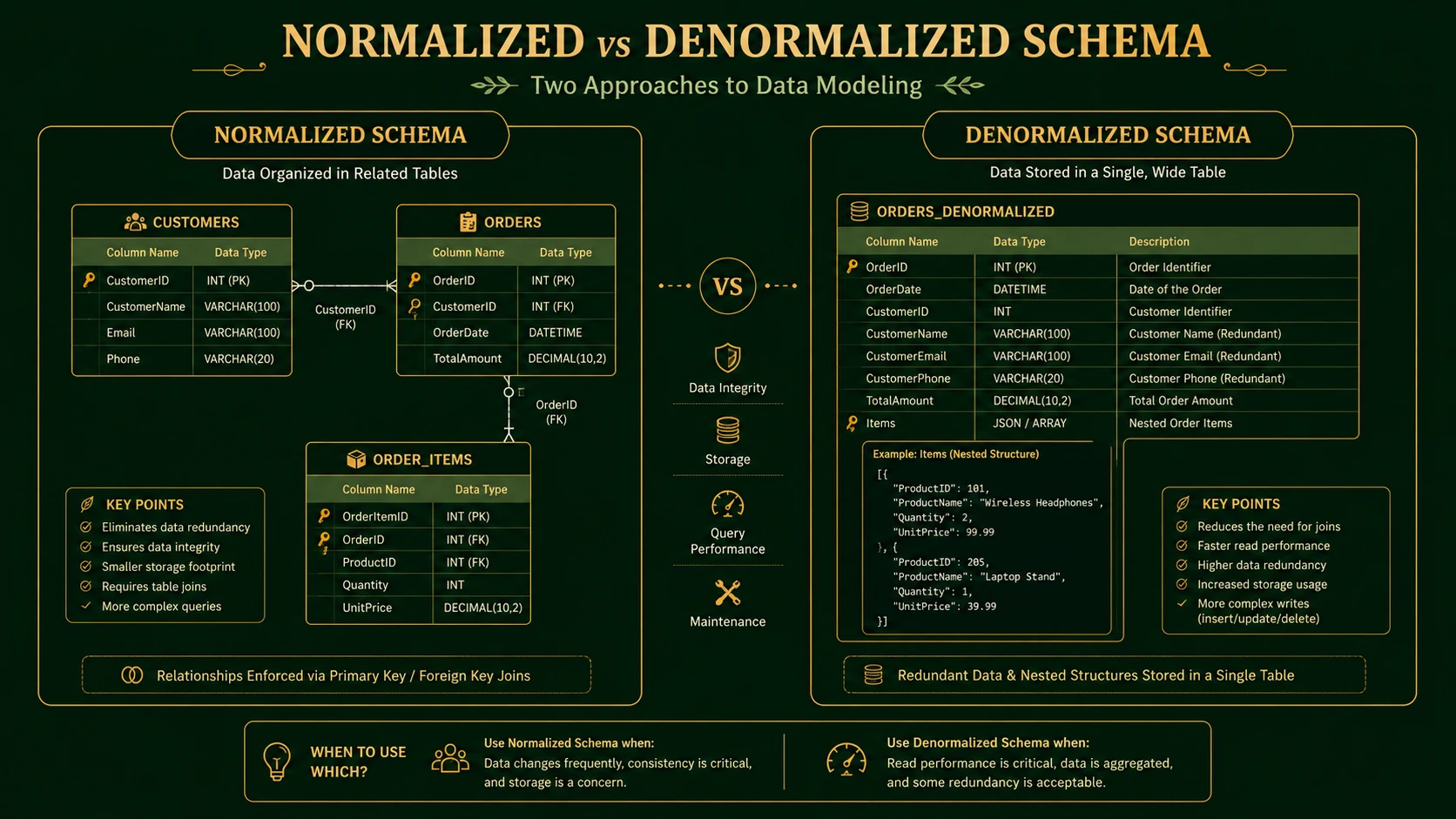
System architecture diagram and conceptual workflow layout for Database Normalization vs. Denormalization for Web-Scale Performance.
E-Commerce Platforms
Product catalogs, search pages, and recommendation engines frequently benefit from denormalized read models.
Business Intelligence
Reporting systems often aggregate data from multiple operational databases.
Denormalized reporting structures simplify analytical queries.
Content Management Systems
Frequently accessed content metadata may be duplicated to reduce database joins during page rendering.
Customer Relationship Management
Operational customer records generally remain normalized, while dashboards and reporting modules may leverage denormalized datasets.
Performance Considerations
Database performance depends upon numerous factors beyond normalization.
Architects should also evaluate:
- ◆Indexing strategies
- ◆Query optimization
- ◆Database caching
- ◆Hardware configuration
- ◆Memory utilization
- ◆Network latency
- ◆Connection pooling
Denormalization should not replace sound database tuning.
Poorly indexed databases remain slow regardless of schema design.
When Normalization Is the Better Choice
Normalization remains preferable when:
- ◆Data consistency is critical.
- ◆Transactions are frequent.
- ◆Business rules change regularly.
- ◆Storage efficiency matters.
- ◆Regulatory compliance requires strong integrity.
Operational systems handling financial transactions, inventory management, and customer records generally benefit from normalized schemas.
When Denormalization Makes Sense
Denormalization becomes attractive when:
- ◆Read operations greatly exceed writes.
- ◆Complex joins dominate workload.
- ◆Reporting performance is critical.
- ◆Query latency directly affects user experience.
- ◆Data changes infrequently.
In these scenarios, carefully managed redundancy can significantly improve application responsiveness.
Best Practices
Organizations should adopt several guiding principles.
- ◆Begin with a normalized design.
- ◆Measure actual performance before optimizing.
- ◆Use indexing effectively.
- ◆Denormalize only where measurable benefits exist.
- ◆Document duplicated data clearly.
- ◆Automate synchronization where possible.
- ◆Review query execution plans regularly.
- ◆Test under realistic production workloads.
- ◆Monitor database performance continuously.
These practices reduce unnecessary complexity while supporting long-term scalability.
Common Mistakes
Several implementation errors frequently affect database projects.
Premature Denormalization
Duplicating data before identifying actual bottlenecks increases maintenance complexity without measurable benefit.
Ignoring Indexes
Many performance issues originate from poor indexing rather than normalization.
Excessive Table Joins
Deep relational structures can negatively affect complex reporting queries if not carefully optimized.
Inconsistent Duplicate Data
Denormalized fields must remain synchronized to avoid reporting inaccuracies.
Designing Only for Current Workloads
Database schemas should anticipate future growth while remaining maintainable.
Adoption Recommendations
Organizations designing enterprise databases should adopt a phased strategy.
Phase 1
- ◆Build a normalized logical data model.
- ◆Validate business rules.
- ◆Establish indexing standards.
Phase 2
- ◆Measure production query performance.
- ◆Identify high-cost queries.
- ◆Review execution plans.
Phase 3
- ◆Introduce selective denormalization where justified.
- ◆Benchmark improvements.
- ◆Validate data consistency.
Phase 4
- ◆Continuously monitor workload patterns.
- ◆Refine optimization strategies.
- ◆Update database documentation.
A disciplined approach ensures that optimization decisions are driven by measurable performance requirements rather than assumptions.
Balancing Integrity and Performance
Normalization and denormalization should not be viewed as competing philosophies but as complementary tools within the enterprise architect's toolkit.
Most successful enterprise systems employ normalization for transactional integrity while selectively introducing denormalized structures to support reporting, search, or high-volume read operations.
The appropriate balance depends upon business priorities, workload characteristics, operational complexity, and long-term maintenance objectives.
Looking Ahead
Enterprise databases continue to evolve as applications process larger datasets and support increasing numbers of concurrent users. While normalized relational models remain the foundation of reliable transactional systems, growing web-scale workloads are encouraging architects to consider selective denormalization as a practical performance optimization technique.
As organizations continue modernizing enterprise applications throughout 2010, database architects should base optimization decisions on measured workload characteristics rather than assumptions. By combining sound relational design with carefully planned denormalization where appropriate, enterprises can build database platforms that deliver both strong data integrity and the performance required by increasingly demanding web applications.