Modern web applications have grown dramatically in both size and complexity. What once consisted primarily of static HTML pages enhanced with small JavaScript snippets has evolved into sophisticated applications supporting collaboration, dashboards, enterprise workflows, real-time communication, and rich user interfaces. As browser capabilities have expanded, JavaScript has become the dominant programming language for client-side web development.
Despite its widespread success, JavaScript presents several challenges for developers building large-scale enterprise applications. Dynamic typing, inconsistent coding practices, and the absence of certain language features commonly found in enterprise programming languages can make large projects increasingly difficult to maintain.
Recognizing these challenges, Google has announced Dart, a new programming language intended for structured web application development. Rather than focusing solely on small browser scripts, Dart is designed to support large codebases, improve developer productivity, and simplify long-term maintenance.
Although Dart has only recently been introduced and its long-term adoption remains uncertain, the announcement has generated considerable discussion throughout the software industry. Enterprise architects should understand both the opportunities and the challenges presented by this emerging technology.
Why Web Development Is Evolving
Enterprise web applications continue increasing in scale and complexity.
Modern business applications commonly include:
- ◆Customer relationship management
- ◆Enterprise resource planning
- ◆Financial dashboards
- ◆Collaboration platforms
- ◆Business intelligence portals
- ◆Project management systems
- ◆Real-time messaging
These applications often contain hundreds of thousands of lines of client-side code.
As applications grow, developers increasingly seek programming languages that provide stronger structure, better tooling, and improved maintainability.
JavaScript's Success
JavaScript has become the standard programming language for browser-based applications.
Its strengths include:
- ◆Universal browser support
- ◆Dynamic programming model
- ◆Large developer community
- ◆Extensive framework ecosystem
- ◆Flexible programming style
These characteristics have contributed significantly to JavaScript's widespread adoption.
However, enterprise teams frequently encounter challenges when managing very large JavaScript projects.
Introducing Dart
Google describes Dart as a language designed specifically for structured web application development.
Key objectives include:
- ◆Improved scalability
- ◆Better developer productivity
- ◆Enhanced tooling
- ◆Structured programming model
- ◆Familiar syntax for developers coming from C-style languages
The language seeks to address challenges encountered in large JavaScript applications while remaining focused on web development.
Design Goals
Although Dart is still in its early stages, its design emphasizes several important principles.
These include:
- ◆Readable syntax
- ◆Object-oriented programming
- ◆Optional static typing
- ◆Better code organization
- ◆Modern development tools
These features are intended to simplify the development of large software projects.
Familiar Object-Oriented Programming
Developers familiar with languages such as Java or C# will recognize many object-oriented concepts within Dart.
These include:
- ◆Classes
- ◆Objects
- ◆Constructors
- ◆Inheritance
- ◆Interfaces
- ◆Libraries
This familiarity may reduce the learning curve for enterprise development teams.
Optional Static Typing
One of Dart's most discussed features is optional static typing.
Developers may choose to specify types where they improve readability and tooling while retaining flexibility in other situations.
Potential benefits include:
- ◆Better code documentation
- ◆Earlier error detection
- ◆Improved tooling support
- ◆Enhanced code navigation
Whether organizations choose extensive or limited type annotations will depend upon project requirements and development standards.
Enterprise Development Considerations
Large enterprise projects often emphasize:
- ◆Maintainability
- ◆Readability
- ◆Team collaboration
- ◆Long-term support
- ◆Automated testing
Google's positioning of Dart suggests that these concerns influenced many of the language's design decisions.
Tooling and Developer Productivity
Productive software development depends not only on language design but also on supporting tools.
Enterprise developers typically expect:
- ◆Code completion
- ◆Refactoring support
- ◆Debugging tools
- ◆Project management features
- ◆Build automation
Strong tooling can significantly improve developer efficiency over the lifetime of a project.
Enterprise Architecture
Regardless of programming language, enterprise web applications should continue following layered architectural principles.
Typical architecture:
Web Browser
      |
Dart Application
      |
HTTP / REST Services
      |
Application Server
      |
Business Services
      |
Enterprise Database
Separating presentation from business logic remains essential regardless of client-side technology.
Comparing JavaScript and Dart
| JavaScript | Dart |
|---|---|
| Established browser language | Newly introduced language |
| Dynamic typing | Optional static typing |
| Universal browser support | Emerging ecosystem |
| Large developer community | Early community growth |
| Mature tooling ecosystem | New development tools |
JavaScript currently remains the dominant web programming language, while Dart represents an alternative approach that is still gaining maturity.
Enterprise Use Cases
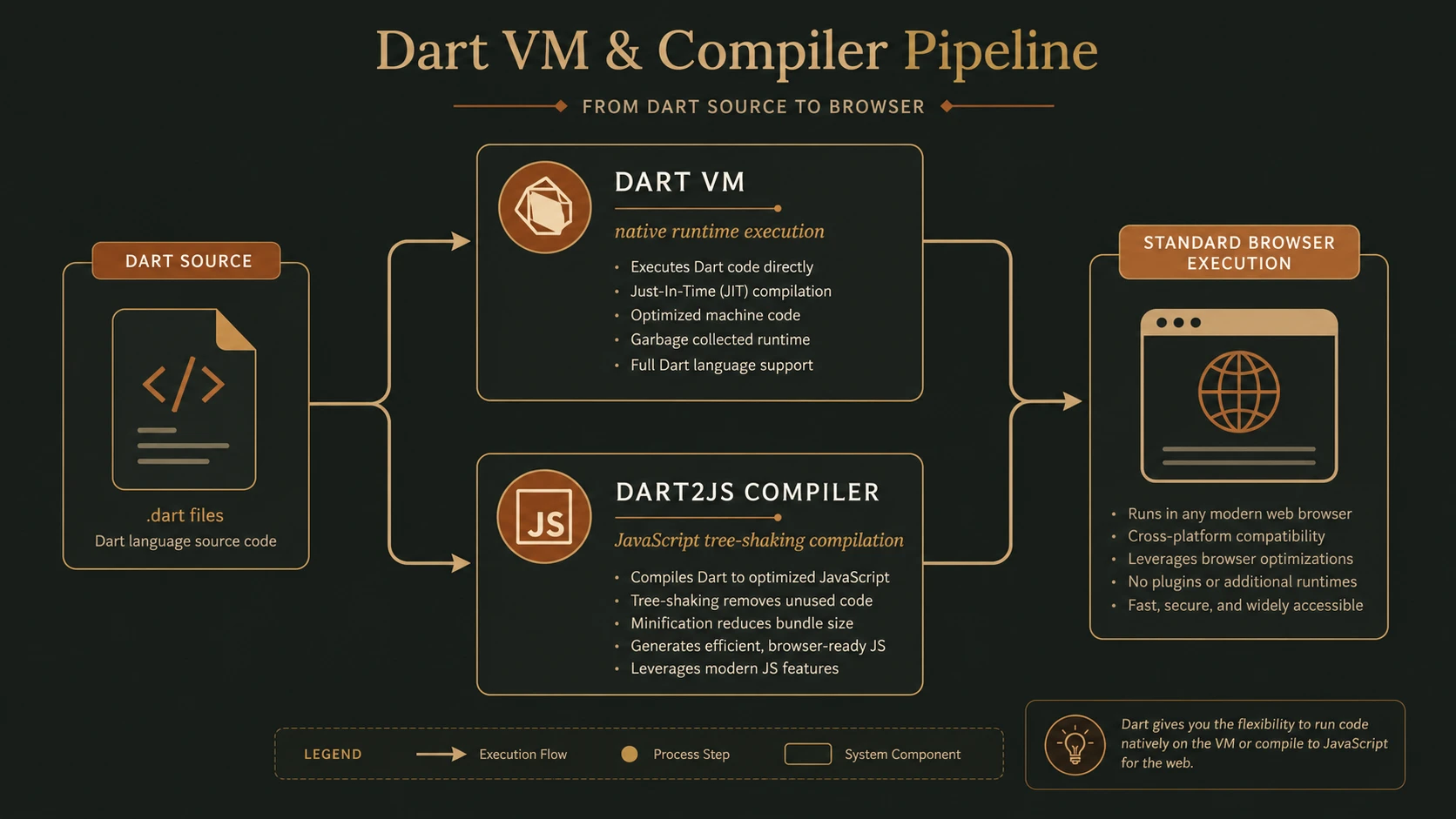
System architecture diagram and conceptual workflow layout for Dart Language: Google's Attempt to Replace JavaScript.
Business Dashboards
Large interactive dashboards may benefit from improved code organization as applications continue growing.
Customer Portals
Structured client-side code can simplify maintenance across long-lived customer-facing applications.
Internal Enterprise Applications
Organizations building extensive browser-based business software may find stronger architectural organization beneficial.
Rich Internet Applications
Applications involving complex client-side behavior may benefit from languages emphasizing scalability and maintainability.
Migration Challenges
Organizations considering Dart should recognize several practical considerations.
Existing JavaScript applications represent significant investments.
Migration decisions should evaluate:
- ◆Training requirements
- ◆Existing libraries
- ◆Browser compatibility
- ◆Development tooling
- ◆Team expertise
Most organizations are unlikely to replace existing applications immediately.
Instead, new projects may provide opportunities for evaluation.
Browser Compatibility
JavaScript currently executes across all major browsers.
As Dart enters the market, organizations should monitor:
- ◆Browser support
- ◆Development workflows
- ◆Tool maturity
- ◆Community adoption
Compatibility remains a critical factor for enterprise web applications.
Performance Considerations
Enterprise applications should continue prioritizing:
- ◆Responsive interfaces
- ◆Efficient rendering
- ◆Network optimization
- ◆Memory usage
- ◆Scalable client-side architecture
Programming language selection represents only one aspect of overall application performance.
Best Practices
Organizations evaluating Dart should consider the following recommendations.
Begin with Pilot Projects
Evaluate the language using small, manageable applications.
Preserve Layered Architecture
Business services should remain independent of client-side implementation.
Invest in Developer Training
Successful adoption depends upon team understanding rather than language capabilities alone.
Monitor Tool Evolution
Development environments will likely continue improving as the ecosystem matures.
Continue Supporting Existing JavaScript Applications
Existing production systems should be evaluated carefully before introducing significant technology changes.
Common Mistakes
Organizations evaluating new programming languages frequently encounter similar challenges.
Assuming Immediate Replacement
New technologies typically require gradual evaluation before enterprise-wide adoption.
Ignoring Existing Investments
Organizations should protect existing applications while exploring new opportunities.
Focusing Only on Language Features
Tooling, documentation, and community support are equally important.
Underestimating Training Requirements
New programming models require time for developers to master.
Neglecting Long-Term Maintainability
Technology choices should align with organizational strategy rather than short-term enthusiasm.
Adoption Recommendations
Enterprise teams interested in Dart should adopt a measured approach.
Recommended roadmap:
- 1.Study the language and development tools.
- 2.Build a proof-of-concept application.
- 3.Evaluate productivity improvements.
- 4.Compare development experience with existing JavaScript projects.
- 5.Review browser deployment options.
- 6.Train interested development teams.
- 7.Expand adoption only where measurable business value is demonstrated.
This incremental strategy allows organizations to explore innovation while minimizing project risk.
Looking Ahead
Google's introduction of Dart reflects the growing demand for programming languages capable of supporting increasingly sophisticated web applications. By emphasizing structure, tooling, and scalability, Dart seeks to address many of the challenges encountered in large JavaScript codebases while providing developers with a familiar object-oriented programming model.
It remains too early in late 2011 to predict whether Dart will achieve widespread industry adoption or how browser vendors and the broader web development community will respond. Nevertheless, enterprise architects should monitor its progress closely. Organizations that understand emerging web technologies and evaluate them thoughtfully will be better positioned to make informed decisions as the next generation of web application development continues to evolve.