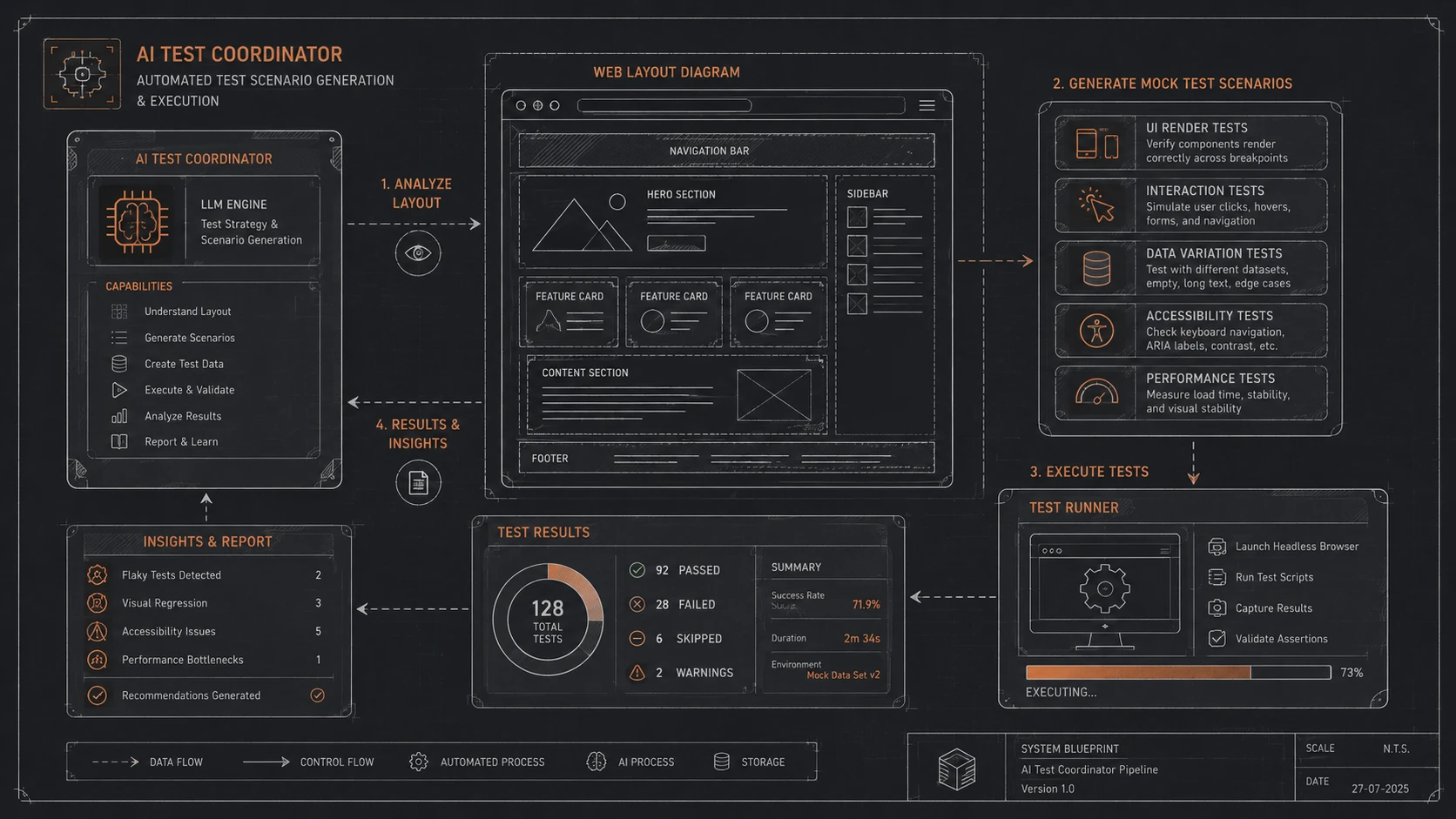
Introduction
Software development has accelerated dramatically over the past decade. Agile methodologies, DevOps practices, Continuous Integration (CI), Continuous Delivery (CD), cloud-native architectures, and microservices have significantly shortened release cycles. While these advancements have improved delivery speed, they have also increased the complexity of software testing.
Traditional Quality Assurance (QA) approaches often rely on manually written test cases, brittle UI automation scripts, extensive regression suites, and repetitive maintenance. As applications evolve, UI changes, API updates, and business rule modifications frequently cause automated tests to fail, requiring considerable engineering effort to restore test stability.
By September 2023, Artificial Intelligence has emerged as one of the most significant innovations in software quality engineering. Modern AI-powered testing platforms assist engineering teams by automatically generating test cases, repairing broken UI locators, predicting high-risk components, analyzing production failures, and optimizing regression execution.
Rather than replacing QA engineers, AI enables quality teams to focus on exploratory testing, business validation, security verification, and customer experience while repetitive testing activities become increasingly automated.
Industry Background
Modern software delivery increasingly depends upon:
- ◆Agile Development
- ◆DevOps
- ◆Continuous Integration
- ◆Continuous Delivery
- ◆Cloud-native Applications
- ◆Microservices
- ◆API-first Development
- ◆Platform Engineering
As deployment frequency increases, organizations require testing processes that scale alongside software delivery.
The Business Problem
Enterprise QA teams frequently encounter:
- ◆Expanding regression suites
- ◆Slow release validation
- ◆Brittle UI automation
- ◆Manual test maintenance
- ◆Incomplete test coverage
- ◆Limited testing resources
- ◆Growing application complexity
Traditional automation alone often struggles to keep pace with rapid software evolution.
Understanding AI-driven QA
AI-driven QA combines machine learning, generative AI, analytics, and automation to improve software testing throughout the development lifecycle.
Primary objectives include:
- ◆Intelligent test generation
- ◆Autonomous test maintenance
- ◆Risk-based testing
- ◆Faster regression validation
- ◆Predictive defect analysis
- ◆Continuous quality improvement
AI complements conventional testing rather than replacing established engineering practices.
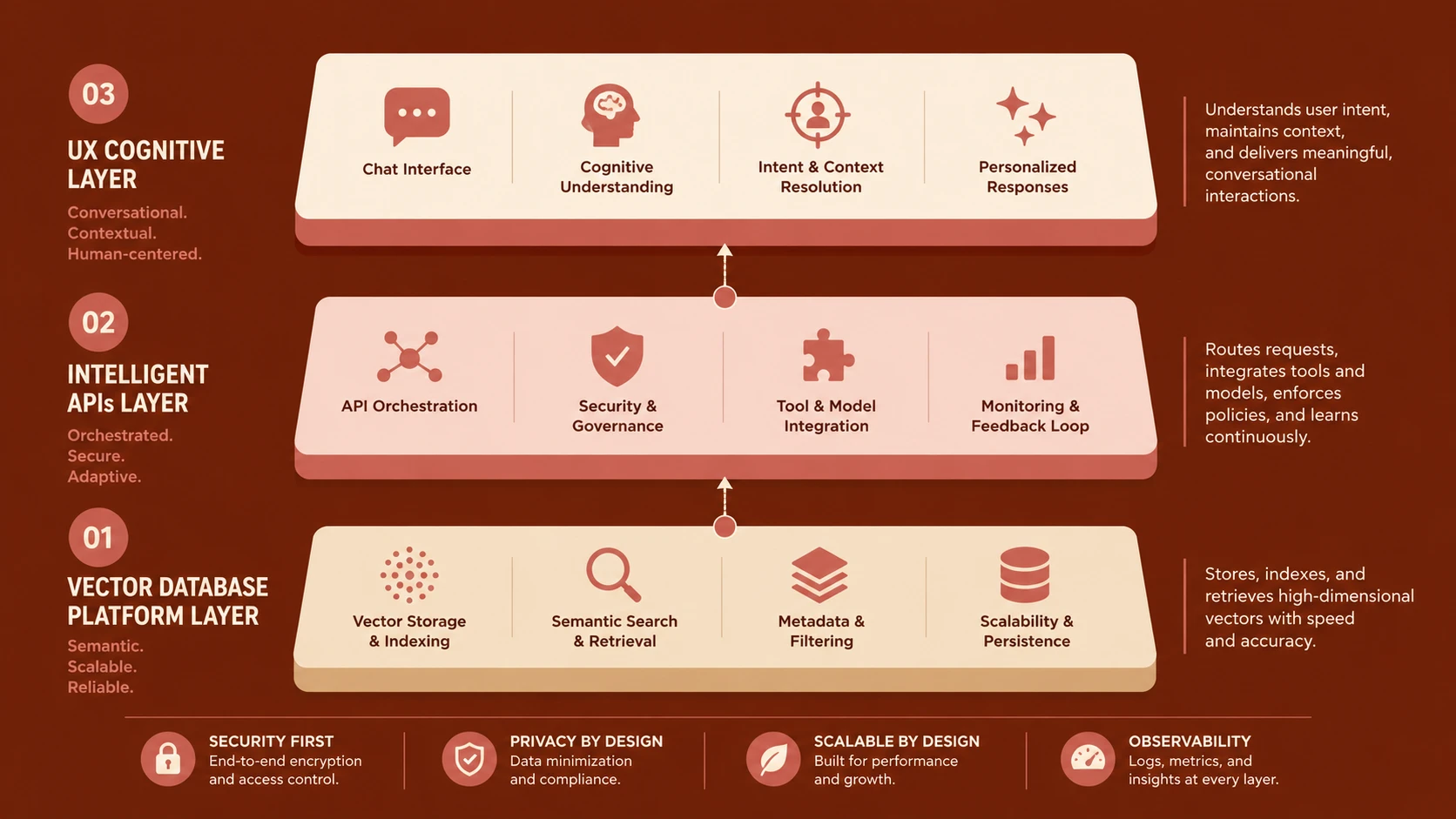
Core Architecture
| Component | Responsibility |
|---|---|
| Source Code Repository | Application source management |
| CI/CD Pipeline | Automated builds and deployments |
| AI Testing Engine | Test generation and optimization |
| Test Automation Framework | Functional test execution |
| Production Monitoring | Runtime quality insights |
| Defect Management System | Issue tracking |
| Analytics Platform | Quality reporting |
| Human QA Engineers | Validation and exploratory testing |
Together these components establish an intelligent quality engineering platform.
How AI-driven QA Works
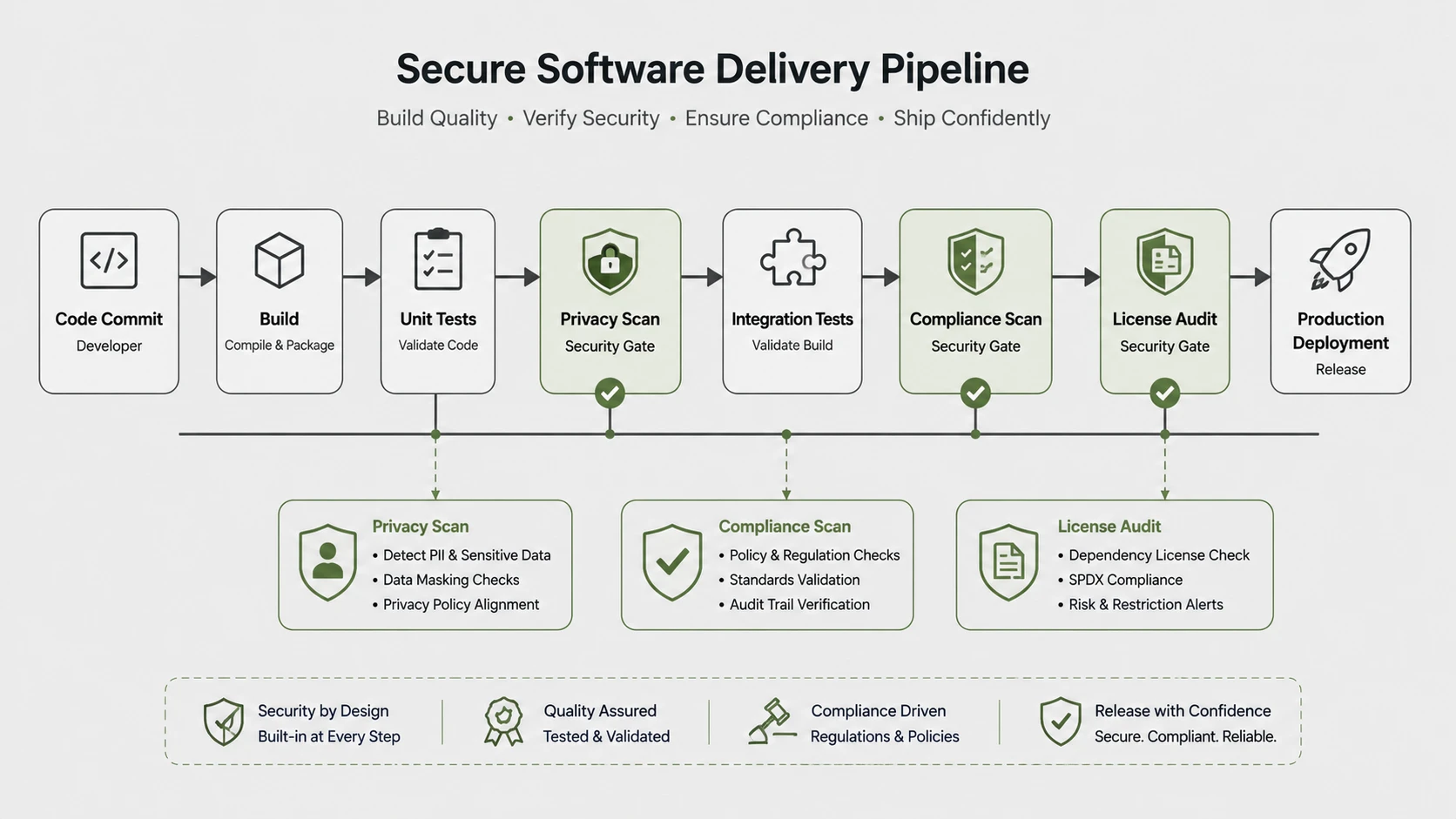
- 1.Developers commit application code.
- 2.CI pipelines trigger automated builds.
- 3.AI analyzes code changes and application behavior.
- 4.Relevant test cases are generated or prioritized.
- 5.Automated functional, API, and integration tests execute.
- 6.AI identifies failures, probable root causes, and unstable tests.
- 7.Engineering teams review results and improve application quality.
This continuous feedback loop accelerates software delivery while maintaining quality.
Intelligent Test Generation
One of the most significant advancements in AI-driven QA is automated test generation.
AI systems analyze:
- ◆User workflows
- ◆Application structure
- ◆Business logic
- ◆API specifications
- ◆Historical defects
- ◆Existing test suites
Based on these inputs, the platform recommends or generates additional automated tests that improve coverage while reducing manual effort.
Self-Healing Test Automation
// Puppeteer/Playwright selector fallback handler illustrating self-healing element search
async function getSelfHealedElement(page, primarySelector, fallbackSelectors) {
  const el = await page.$(primarySelector);
  if (el) return el;

  console.warn(`[QA Engine] Element '${primarySelector}' missing, attempting fallback search...`);
  for (const selector of fallbackSelectors) {
    const fallbackEl = await page.$(selector);
    if (fallbackEl) {
      console.log(`[QA Engine] Successfully self-healed, resolved using: '${selector}'`);
      return fallbackEl;
    }
  }
  throw new Error(`[QA Engine] Element resolution failed on all selectors`);
}
Traditional UI automation frequently breaks when interface elements change.
AI-powered testing platforms increasingly provide self-healing capabilities that:
- ◆Detect UI modifications
- ◆Identify alternative element locators
- ◆Repair automation scripts
- ◆Reduce false failures
- ◆Improve regression stability
This reduces maintenance effort across large automation suites.
Risk-Based Testing
Not every application component requires identical testing effort.
AI models increasingly prioritize testing using factors such as:
- ◆Code change frequency
- ◆Historical defects
- ◆Production incidents
- ◆Component complexity
- ◆Business criticality
Engineering teams can focus resources on the highest-risk areas.
Predictive Defect Analysis
Machine learning models analyze historical engineering data to identify components more likely to contain defects.
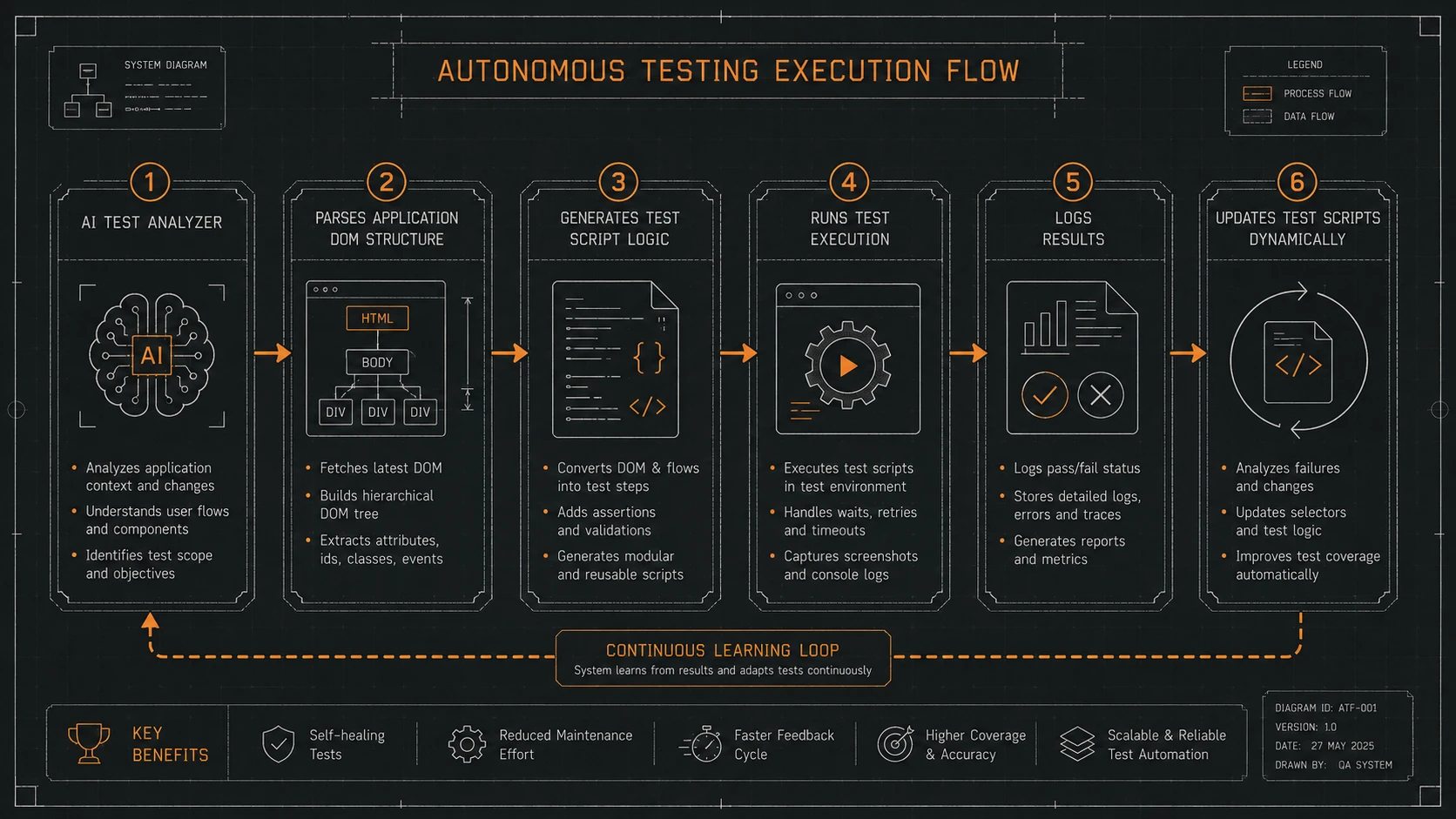
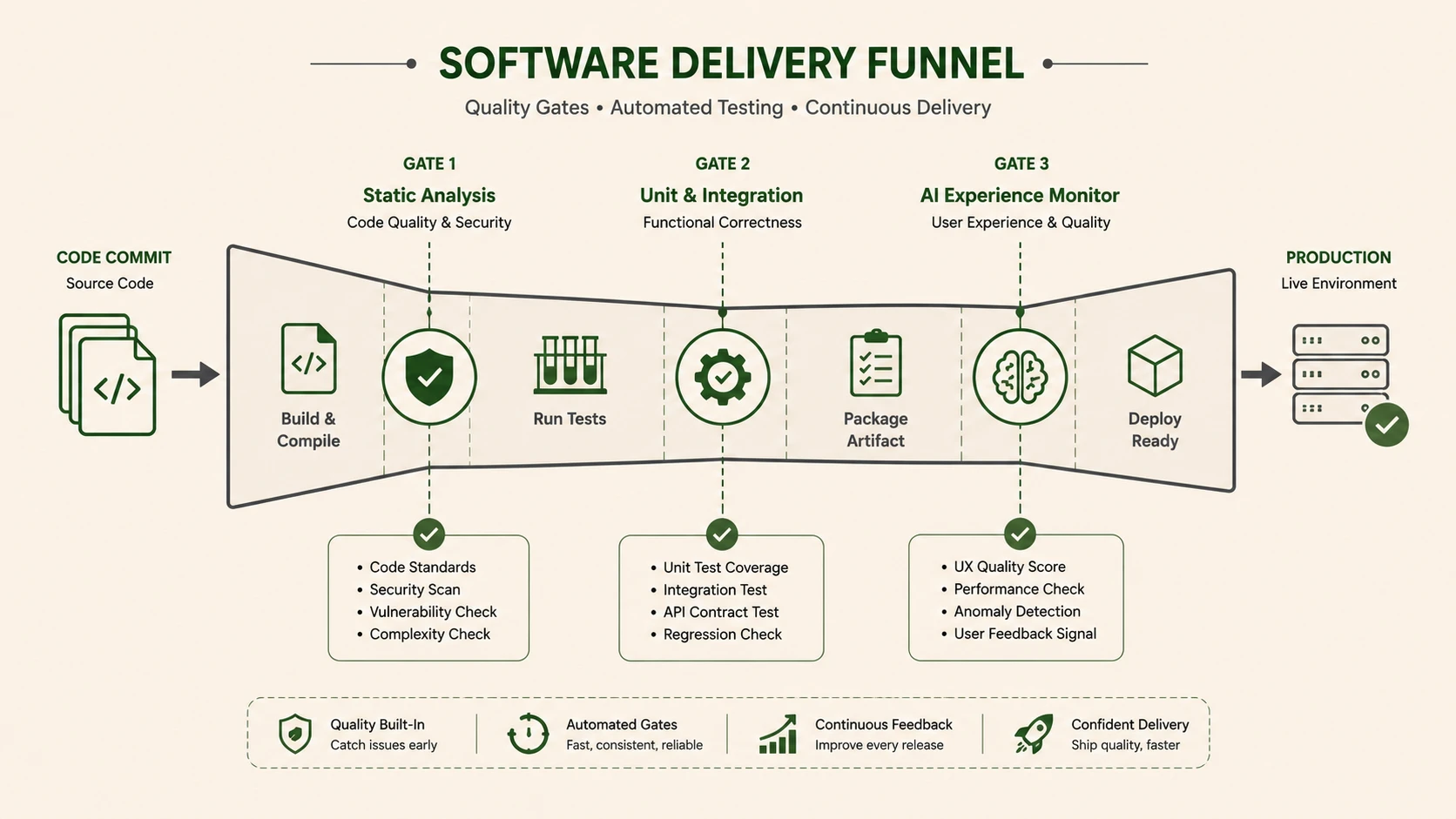
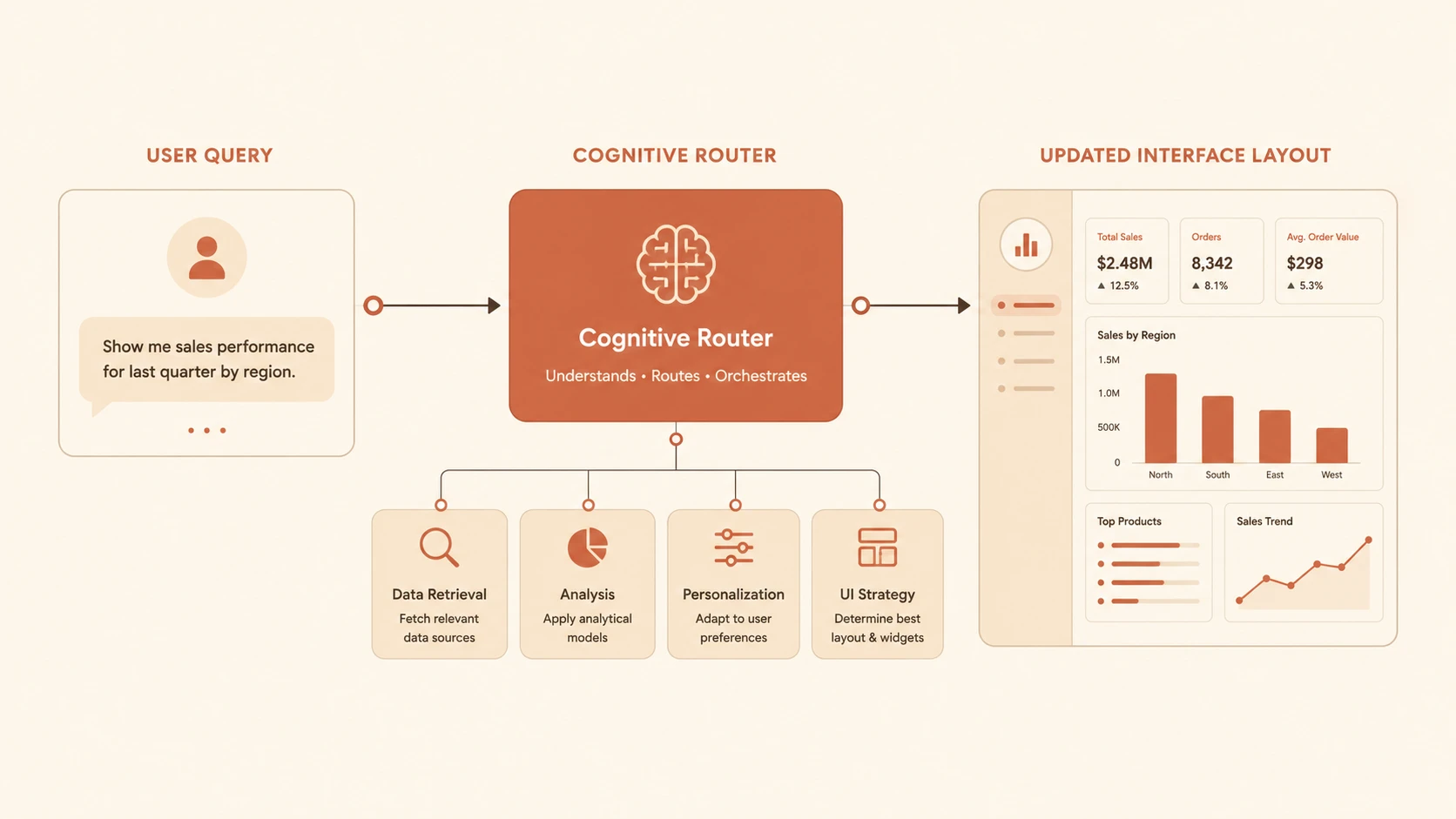
System architecture diagram and conceptual workflow layout for AI-driven QA and Autonomous Testing.
Potential signals include:
- ◆Commit history
- ◆Code churn
- ◆Test failures
- ◆Static analysis
- ◆Deployment history
Predictive insights improve release planning and testing efficiency.
Autonomous Regression Testing
Modern AI platforms increasingly optimize regression execution by:
- ◆Removing duplicate tests
- ◆Selecting high-impact scenarios
- ◆Scheduling test execution intelligently
- ◆Identifying unstable tests
- ◆Prioritizing critical business workflows
Regression suites become faster while preserving meaningful coverage.
Enterprise Use Cases
SaaS Platforms
Accelerate feature validation across rapidly evolving applications.
Financial Services
Improve regression testing for highly regulated software.
Healthcare
Support continuous validation of patient-facing systems while maintaining compliance.
E-Commerce
Continuously verify purchasing workflows during rapid feature releases.
Enterprise Software
Reduce automation maintenance across large business applications.
Performance Considerations
Organizations should evaluate:
- ◆Test execution duration
- ◆Regression suite size
- ◆Automation stability
- ◆AI inference latency
- ◆Coverage improvements
- ◆CI pipeline execution time
Performance improvements should be measured using representative production workflows.
Security Considerations
AI-powered testing systems should operate within secure engineering environments.
Organizations should implement:
- ◆Secure repository access
- ◆Role-based permissions
- ◆Protected test environments
- ◆Data anonymization for test datasets
- ◆Audit logging
- ◆Secure AI model governance
- ◆Responsible handling of production data
AI-assisted testing should comply with existing software development security practices.
Scalability
AI-driven QA supports enterprise scalability through:
- ◆Automated test generation
- ◆Intelligent regression optimization
- ◆Continuous quality monitoring
- ◆Self-healing automation
- ◆Predictive analytics
- ◆Standardized quality engineering processes
These capabilities help organizations maintain quality as software portfolios continue expanding.
Best Practices
- ◆Keep human QA engineers involved in validation and exploratory testing.
- ◆Continuously review AI-generated test cases before production adoption.
- ◆Combine AI insights with traditional automation frameworks.
- ◆Integrate quality metrics into CI/CD pipelines.
- ◆Measure regression effectiveness regularly.
- ◆Prioritize business-critical workflows.
- ◆Maintain high-quality test data.
- ◆Monitor AI recommendations for accuracy and bias.
Common Mistakes
| Mistake | Enterprise Impact |
|---|---|
| Expecting AI to replace all QA activities | Reduced overall software quality |
| Blindly trusting AI-generated tests | Missed business validation |
| Ignoring exploratory testing | Undetected usability issues |
| Poor test data management | Inaccurate AI recommendations |
| Missing governance for AI decisions | Reduced auditability |
| Treating AI as a standalone solution | Limited long-term value |
Technology Comparison
| Capability | Traditional Test Automation | AI-driven QA |
|---|---|---|
| Test Creation | Manual | AI-Assisted |
| Test Maintenance | Manual | Self-Healing Assistance |
| Regression Selection | Fixed Suites | Risk-Based Optimization |
| Defect Prediction | Reactive | Predictive Analytics |
| Root Cause Analysis | Manual Investigation | AI-Assisted Insights |
| Continuous Learning | Limited | Improves with Historical Data |
Adoption Strategy
- 1.Assess the maturity of existing QA processes.
- 2.Introduce AI-assisted test generation in pilot projects.
- 3.Integrate AI capabilities into existing CI/CD pipelines.
- 4.Evaluate self-healing automation for UI testing.
- 5.Measure regression efficiency improvements.
- 6.Train QA engineers on AI-assisted quality engineering.
- 7.Establish governance for AI-generated testing artifacts.
- 8.Expand adoption incrementally while continuously measuring software quality outcomes.
Limitations
As of September 2023, AI-driven QA continues evolving rapidly. While AI significantly improves automation efficiency, it cannot fully replace human judgment, exploratory testing, usability evaluation, accessibility verification, or business-domain expertise. Organizations should view AI as an augmentation technology that strengthens engineering productivity while maintaining experienced QA professionals at the center of software quality decisions.
Looking Ahead
From the perspective of September 2023, AI-driven QA marks the beginning of a new era in software quality engineering. Intelligent test generation, self-healing automation, predictive analytics, and autonomous regression optimization are transforming how enterprise teams validate increasingly complex applications. As AI capabilities continue maturing, quality engineering is expected to evolve from executing predefined test scripts toward continuously learning, adaptive systems that help organizations deliver software more quickly, more reliably, and with greater confidence.