Introduction
Since its public introduction, React has encouraged developers to build user interfaces as reusable, composable components. As applications have grown in complexity, React's component model has become widely adopted across enterprise dashboards, Software-as-a-Service (SaaS) platforms, e-commerce systems, customer portals, and internal business applications.
Until now, React applications have generally relied on two categories of components. Function components have served primarily as lightweight rendering units, while class components have been responsible for managing state, lifecycle methods, and application behavior.
Although this model has proven successful, many large React codebases have accumulated complex class hierarchies containing constructor logic, lifecycle methods, state initialization, method binding, and duplicated side-effect management. As applications mature, these patterns can reduce readability and make component reuse more difficult.
The React team has introduced a preview of Hooks, a new programming model that enables function components to manage state and lifecycle behavior directly. Hooks are designed to simplify component logic while encouraging greater reuse of stateful behavior.
As of December 2018, Hooks remain in preview and should be evaluated carefully by enterprise development teams before broad production adoption. Nevertheless, they represent one of the most significant evolutions of React's programming model since the library's introduction.
Industry Background
Modern enterprise frontend applications increasingly depend upon:
- ◆Component-based architectures
- ◆Single Page Applications
- ◆Progressive Web Applications
- ◆Client-side routing
- ◆State management libraries
- ◆Continuous delivery
- ◆Reusable UI component libraries
As component ecosystems continue expanding, development teams seek approaches that reduce duplication while improving maintainability.
Hooks represent an attempt to simplify state management within function components while preserving React's declarative philosophy.
The Business Problem
Large React applications commonly encounter:
- ◆Complex class components
- ◆Lifecycle method duplication
- ◆Constructor boilerplate
- ◆Method binding requirements
- ◆Difficult state reuse
- ◆Large component implementations
- ◆Reduced maintainability
Development teams increasingly require patterns that allow business logic to be shared independently of component inheritance.
Understanding React Hooks
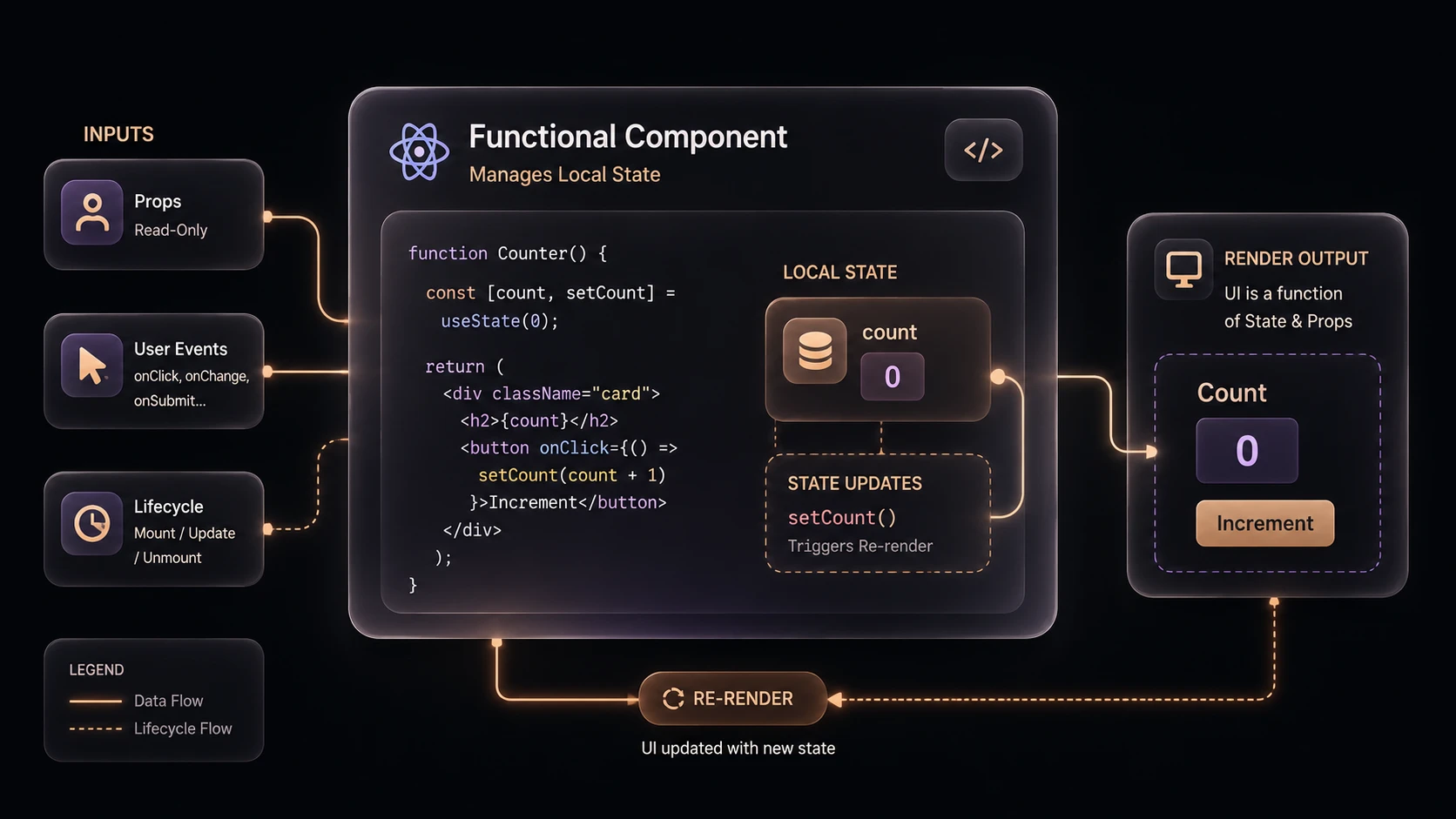
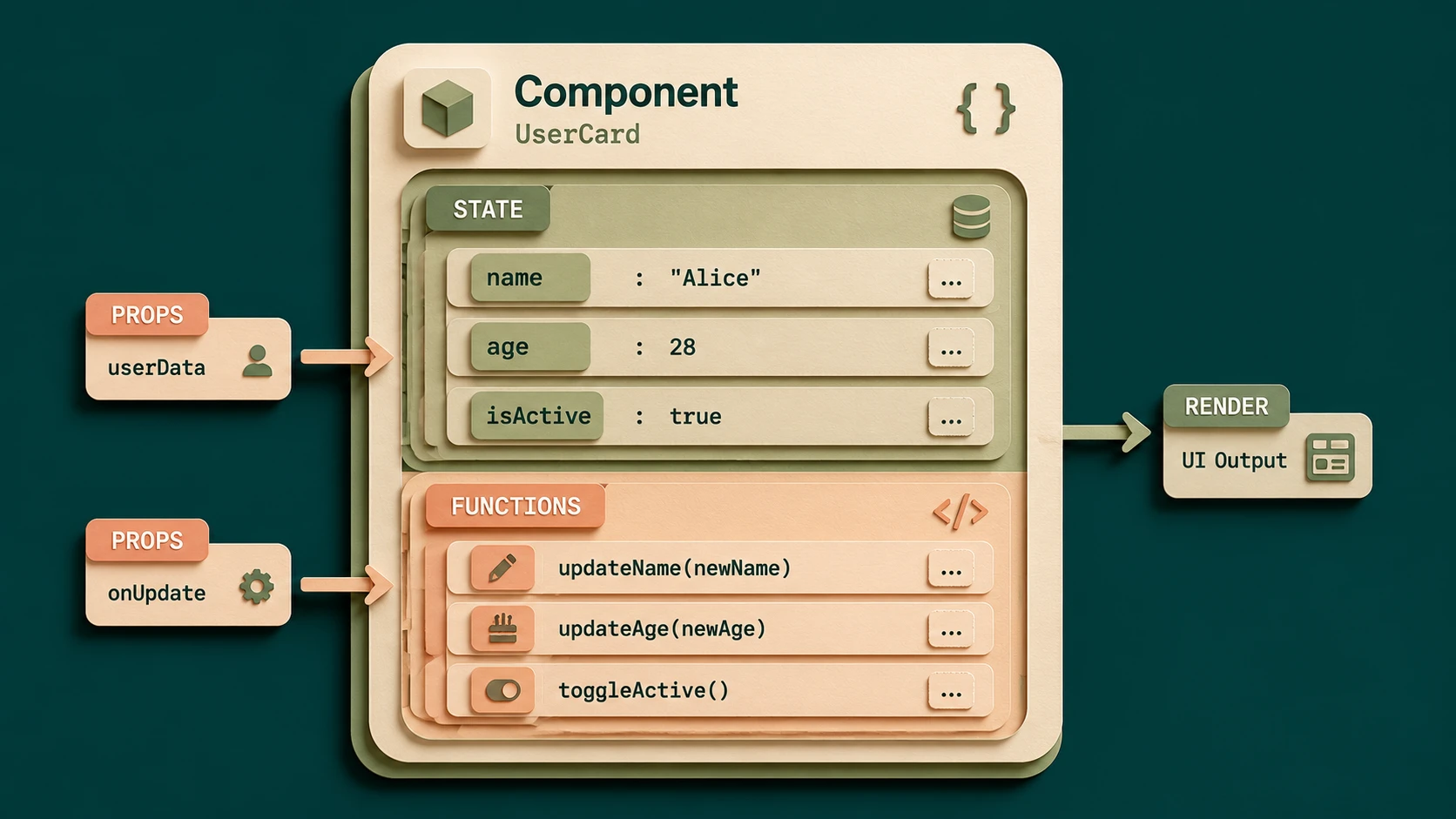
Hooks introduce functions that enable React features within function components.
Rather than relying exclusively on classes, developers can use dedicated Hook APIs to access:
- ◆Component state
- ◆Side effects
- ◆Context
- ◆References
- ◆Additional React capabilities
The initial preview focuses primarily on state management and lifecycle replacement.
Core Architecture
| Component | Responsibility |
|---|---|
| Function Component | Renders UI |
| useState | Manages component state |
| useEffect | Executes side effects |
| React Renderer | Coordinates rendering |
| Reconciliation Engine | Updates the Virtual DOM |
| Browser DOM | Displays rendered output |
Hooks integrate into React's existing rendering architecture without replacing reconciliation or the Virtual DOM.
useState
// Declaring state variables and lifecycles using React Hooks
import React, { useState, useEffect } from 'react';

function UserList() {
  const [users, setUsers] = useState([]);
  const [loading, setLoading] = useState(true);

  useEffect(() => {
    fetch('/api/users')
      .then(res => res.json())
      .then(data => {
        setUsers(data);
        setLoading(false);
      });
  }, []); // Empty array indicates fetch runs once on mount

  if (loading) return <div>Loading users...</div>;

  return (
    <ul>
      {users.map(user => <li key={user.id}>{user.name}</li>)}
    </ul>
  );
}
One of the primary Hooks introduced in the preview is useState.
Historically, local component state has required class components.
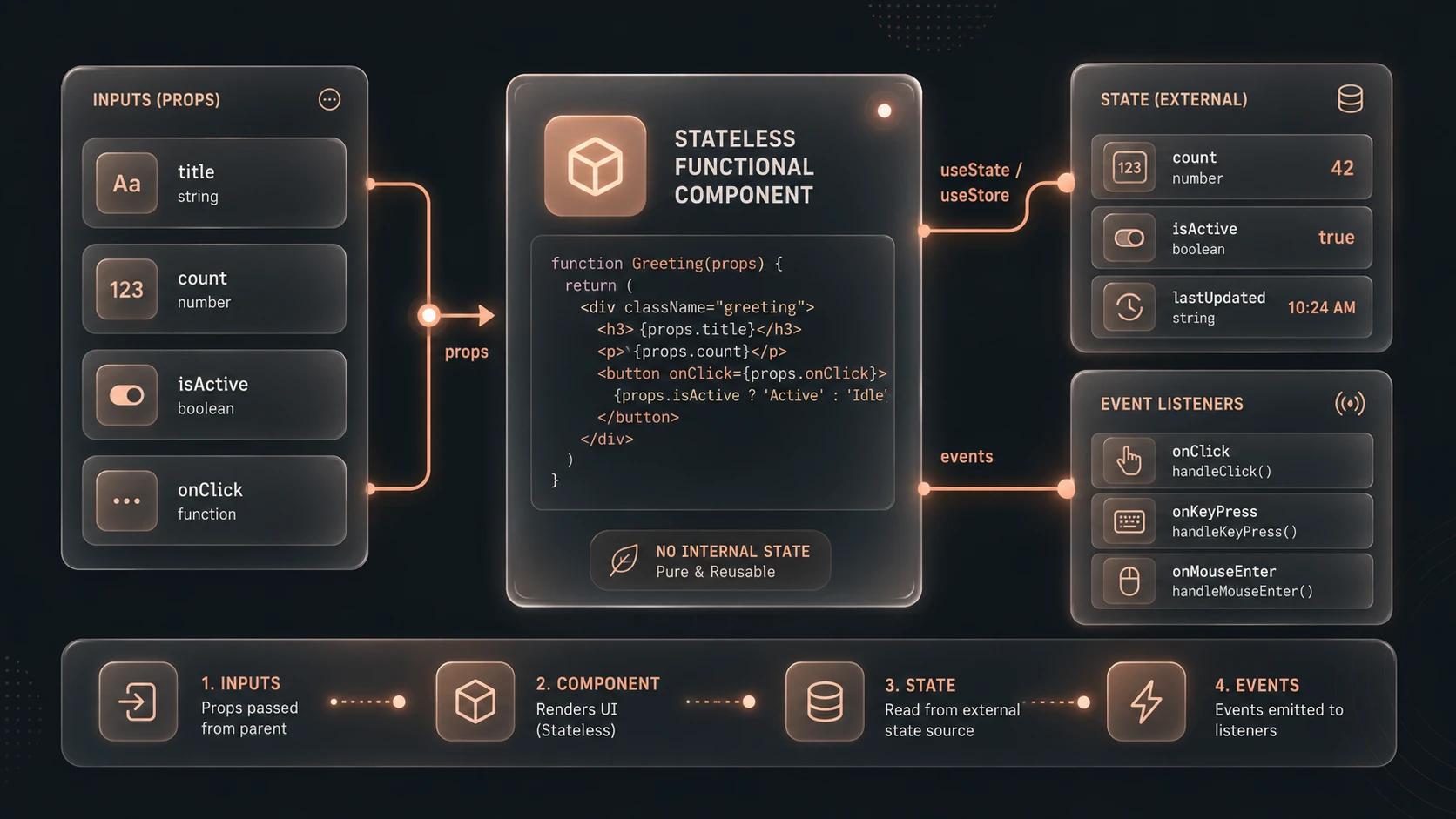
The new Hook enables function components to store and update local state while preserving React's predictable rendering model.
Typical use cases include:
- ◆Form values
- ◆User interface state
- ◆Visibility toggles
- ◆Pagination
- ◆Search filters
- ◆Component preferences
Benefits include:
- ◆Less boilerplate
- ◆Simpler component implementation
- ◆Improved readability
- ◆Easier refactoring
Function components become suitable for a much broader range of application scenarios.
useEffect
The second major Hook introduced in the preview is useEffect.
Historically, developers have relied upon multiple lifecycle methods to perform:
- ◆Data loading
- ◆Subscription management
- ◆DOM interaction
- ◆Logging
- ◆Cleanup operations
These responsibilities have often been distributed across separate lifecycle methods.
useEffect provides a unified mechanism for expressing component side effects.
Potential advantages include:
- ◆Consolidated lifecycle logic
- ◆Reduced duplication
- ◆Improved readability
- ◆Easier maintenance
Rather than organizing code according to lifecycle events, developers can organize logic around related business behavior.
Lifecycle Modernization
One of the most significant conceptual changes introduced by Hooks is the modernization of component lifecycle management.
Traditional class components commonly divide related functionality across multiple methods.
Hooks instead encourage grouping related logic together.
A typical execution flow includes:
- 1.Component renders.
- 2.State is initialized.
- 3.Effects execute after rendering.
- 4.State updates trigger additional renders.
- 5.Effects execute again when dependencies change.
- 6.Cleanup logic executes when appropriate.
This model encourages organizing code around application behavior rather than framework lifecycle terminology.
State Reuse
One longstanding challenge in React development has been sharing stateful logic across components.
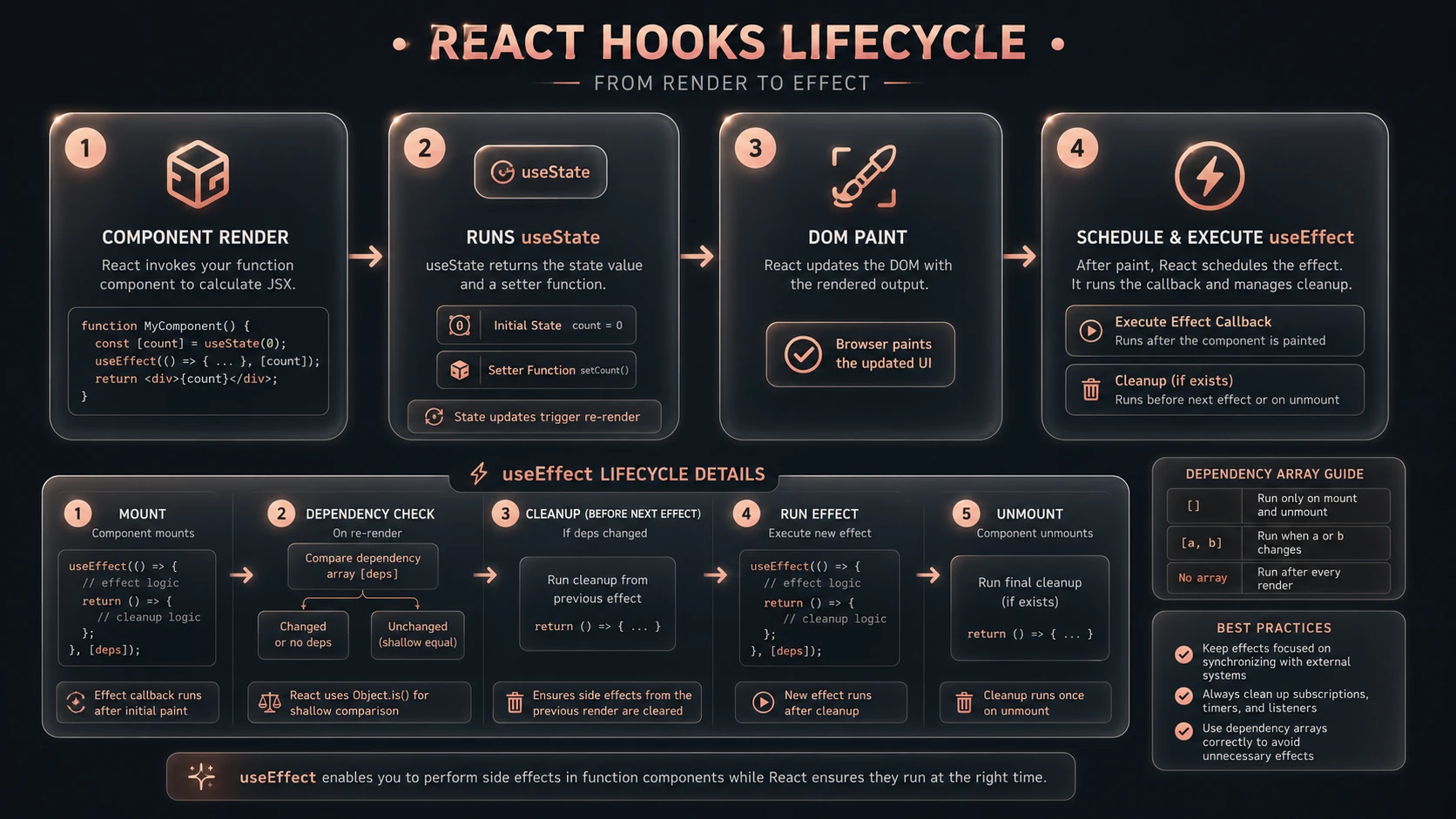
System architecture diagram and conceptual workflow layout for React Hooks Preview.
Developers have historically relied upon:
- ◆Higher-Order Components
- ◆Render Props
- ◆Utility abstractions
Hooks introduce another mechanism for organizing reusable stateful behavior.
Rather than sharing UI through inheritance, developers can compose functionality using reusable Hook-based logic.
This approach may simplify component composition across large applications.
Function Components as First-Class Citizens
Before Hooks, function components were primarily recommended for presentation-focused rendering.
Hooks expand their capabilities by allowing them to participate in:
- ◆Local state management
- ◆Lifecycle behavior
- ◆Side effects
- ◆Application logic
This reduces the distinction between function and class components for many common application scenarios.
Enterprise Use Cases
| Scenario | Benefit |
|---|---|
| Enterprise Dashboards | Simpler component logic |
| SaaS Applications | Cleaner state management |
| Internal Portals | Reduced lifecycle complexity |
| Component Libraries | Better logic reuse |
| Customer Portals | Improved maintainability |
| Administrative Interfaces | Less boilerplate |
Organizations maintaining extensive React codebases may benefit from improved component readability and reuse.
Performance Considerations
Hooks primarily improve code organization rather than rendering performance.
Development teams should continue evaluating:
- ◆Component rendering frequency
- ◆State update patterns
- ◆Memoization strategies
- ◆Virtual DOM reconciliation
- ◆Bundle size
- ◆Browser execution performance
Application architecture remains the primary factor influencing runtime performance.
Security Considerations
Hooks do not alter React's application security model.
Organizations should continue implementing:
- ◆Authentication
- ◆Authorization
- ◆Input validation
- ◆Secure API communication
- ◆Cross-site scripting protections
- ◆Dependency management
Cleaner component organization complements secure development practices but does not replace them.
Scalability
Hooks encourage scalable frontend architecture through:
- ◆Smaller components
- ◆Reusable logic
- ◆Improved readability
- ◆Better separation of concerns
- ◆Reduced lifecycle duplication
These characteristics become increasingly valuable as enterprise React applications continue growing.
Best Practices
Organizations evaluating Hooks should:
- ◆Introduce Hooks gradually in new development.
- ◆Continue supporting existing class components where appropriate.
- ◆Group related effects together.
- ◆Keep Hook-based components focused on a single responsibility.
- ◆Document architectural guidelines.
- ◆Review Hook usage during code reviews.
- ◆Train development teams before large-scale adoption.
- ◆Measure maintainability improvements over time.
Incremental adoption reduces organizational risk while allowing engineering teams to gain experience with the new programming model.
Common Mistakes
Development teams should avoid:
- ◆Immediately rewriting mature applications.
- ◆Combining unrelated responsibilities within a single Hook.
- ◆Assuming Hooks automatically improve performance.
- ◆Ignoring established component architecture.
- ◆Replacing well-designed class components without measurable benefit.
- ◆Adopting preview features without adequate evaluation.
Successful modernization depends upon thoughtful architectural decisions rather than adopting new syntax alone.
Technology Comparison
| Capability | Class Components | Function Components with Hooks |
|---|---|---|
| Local State | Yes | Yes |
| Lifecycle Behavior | Lifecycle methods | useEffect |
| Constructor Required | Often | No |
| Method Binding | Common | Not required |
| Logic Reuse | Higher-Order Components, Render Props | Hook composition |
| Component Simplicity | Moderate | Improved for many scenarios |
Hooks expand the capabilities of function components while preserving React's component model.
Adoption Strategy
Organizations should approach Hooks through measured experimentation.
A practical strategy includes:
- 1.Evaluate the preview release in development environments.
- 2.Train frontend engineering teams.
- 3.Introduce Hooks in new components.
- 4.Continue supporting existing class components.
- 5.Establish coding standards.
- 6.Validate third-party library compatibility.
- 7.Expand adoption only after gaining sufficient implementation experience.
Incremental adoption minimizes operational risk while allowing organizations to evaluate long-term maintainability benefits.
Limitations
As of December 2018, Hooks remain a preview capability.
Current considerations include:
- ◆APIs may continue evolving before final stabilization.
- ◆Existing class components remain fully supported.
- ◆Enterprise teams should avoid unnecessary large-scale migrations during the preview period.
- ◆Documentation, tooling, and ecosystem support continue maturing.
Organizations should evaluate Hooks within pilot projects before broader production adoption.
Looking Ahead
The React Hooks preview represents one of the most significant changes to React's programming model since the framework's introduction. By enabling function components to manage state and lifecycle behavior directly, Hooks simplify component implementation, encourage logic reuse, and reduce reliance on complex class-based patterns.
As of December 2018, enterprise architects and frontend engineering teams should begin evaluating Hooks through controlled pilot projects while continuing to support established class-based applications. Organizations that combine disciplined architecture, incremental adoption, and comprehensive developer education will be well positioned to benefit as Hooks mature into a core part of the React ecosystem.