Introduction
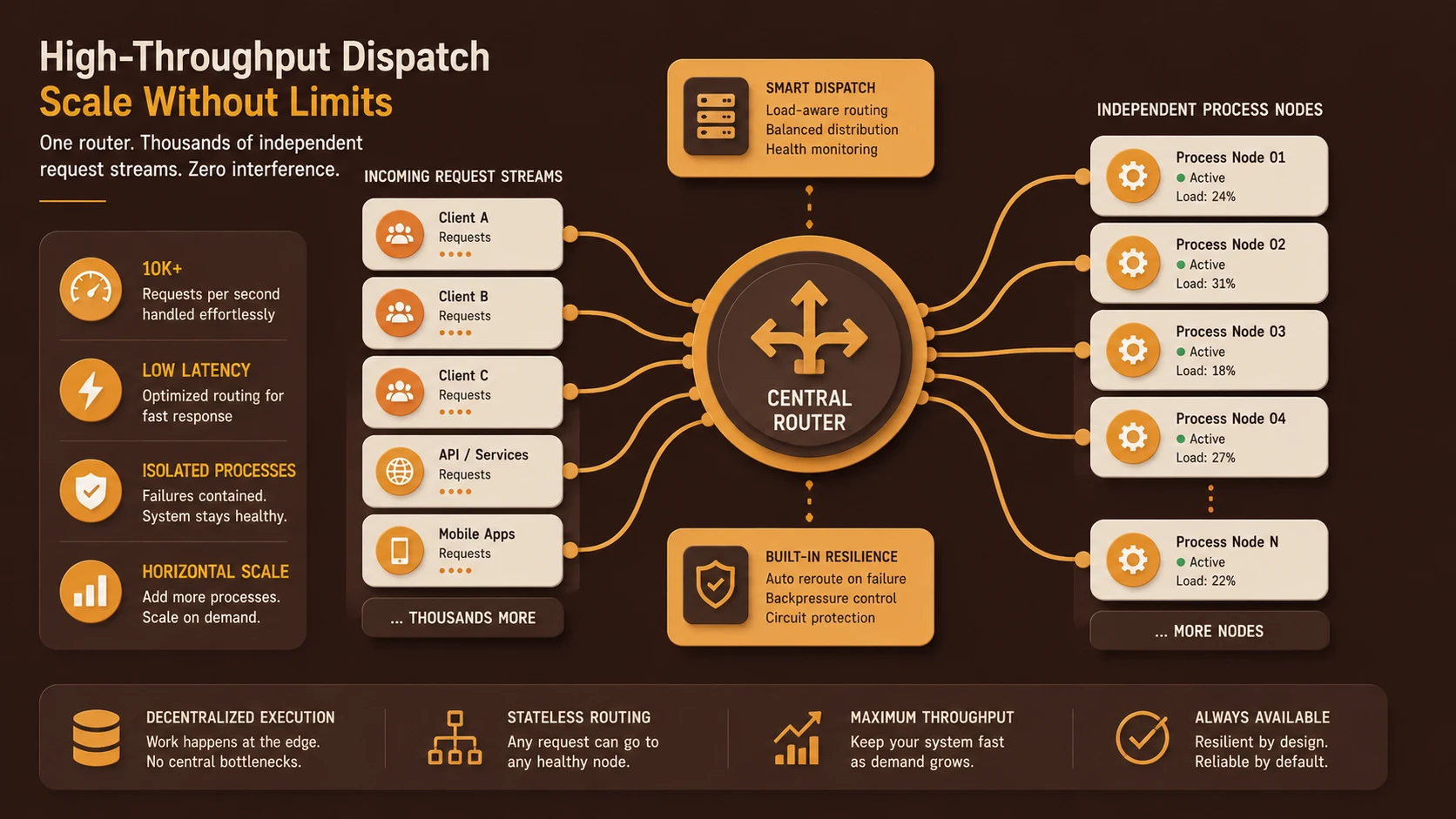
As enterprise applications continue serving larger user bases and increasingly demanding workloads, traditional request-processing architectures are being pushed to their limits. Modern web applications must process thousands of concurrent connections, support real-time communication, remain resilient during hardware failures, and scale horizontally without introducing excessive operational complexity.
The Erlang ecosystem has long been recognized for addressing these challenges through lightweight processes, fault tolerance, and distributed computing. Elixir, a modern functional programming language built on the Erlang Virtual Machine (BEAM), brings these capabilities to a broader developer audience with an expressive syntax and contemporary tooling.
Phoenix Framework extends Elixir into a complete web application platform. By leveraging OTP (Open Telecom Platform), Phoenix enables developers to build scalable REST APIs, real-time communication platforms, and distributed web applications capable of handling high levels of concurrency while maintaining reliability.
For enterprise architects evaluating modern backend technologies, Phoenix presents an attractive combination of productivity, performance, and operational resilience.
Industry Background
Enterprise systems increasingly depend upon:
- ◆Real-time communication
- ◆Mobile backend services
- ◆Distributed APIs
- ◆Event-driven architectures
- ◆Messaging platforms
- ◆Collaborative applications
- ◆IoT gateways
- ◆Financial transaction systems
These workloads require platforms capable of maintaining responsiveness under heavy concurrent demand while minimizing operational downtime.
Traditional thread-based concurrency models often become increasingly difficult to scale efficiently.
The Business Problem
Organizations building modern web platforms commonly encounter:
- ◆High memory consumption
- ◆Thread management complexity
- ◆Resource contention
- ◆Slow horizontal scaling
- ◆Service interruptions
- ◆Difficult fault recovery
As user concurrency grows, maintaining application responsiveness and reliability becomes increasingly challenging.
Understanding Phoenix Framework
Phoenix is a web application framework written in Elixir and designed to leverage the concurrency and fault-tolerant capabilities of the Erlang VM.
Rather than relying on heavyweight operating system threads, Phoenix applications execute lightweight Erlang processes managed by the BEAM runtime.
Core objectives include:
- ◆High concurrency
- ◆Fault tolerance
- ◆Low-latency communication
- ◆Scalable web APIs
- ◆Productive application development
- ◆Reliable distributed systems
Phoenix combines these runtime characteristics with familiar web development concepts such as routing, controllers, templates, and middleware.
Core Architecture
| Component | Responsibility |
|---|---|
| Phoenix Router | Routes incoming HTTP requests |
| Controllers | Process application logic |
| Views | Format responses |
| Ecto | Database interaction |
| Elixir Runtime | Executes application code |
| OTP | Supervises concurrent processes |
| BEAM Virtual Machine | Provides concurrency and fault tolerance |
Together these components enable enterprise-grade application development while preserving scalability.
How Phoenix Works
A typical request lifecycle includes:
- 1.Client sends an HTTP request.
- 2.Phoenix Router identifies the appropriate route.
- 3.Controller executes business logic.
- 4.OTP-managed processes perform concurrent tasks.
- 5.Database operations execute through Ecto.
- 6.Response is generated.
- 7.Supervisor processes monitor application health.
Because each request can leverage lightweight concurrent processes, the application remains responsive under significant workloads.
Understanding OTP
Open Telecom Platform (OTP) provides the architectural foundation underlying Elixir and Phoenix.
OTP introduces several enterprise capabilities:
- ◆Lightweight processes
- ◆Supervisors
- ◆Fault isolation
- ◆Message passing
- ◆Process monitoring
- ◆Distributed execution
Rather than preventing failures entirely, OTP encourages systems that detect, isolate, and recover from failures automatically.
This philosophy contributes significantly to application reliability.
High-Concurrency Architecture
Phoenix benefits directly from the BEAM concurrency model.
Characteristics include:
- ◆Lightweight processes
- ◆Process isolation
- ◆Asynchronous messaging
- ◆Minimal synchronization overhead
- ◆Efficient scheduling
- ◆Automatic failure recovery through supervision
These capabilities allow applications to manage large numbers of simultaneous client connections while maintaining predictable resource utilization.
Key Features
Lightweight Process Model
Applications execute numerous isolated processes without requiring one operating system thread per request.
Fault Tolerance
OTP supervisors automatically restart failed processes according to predefined strategies.
Functional Programming
Immutable data structures reduce shared-state concurrency problems.
Ecto Database Layer
# Elixir Ecto schema and query execution inside Phoenix Controller
defmodule ShivamApp.Catalog.Product do
  use Ecto.Schema
  import Ecto.Changeset

  schema "products" do
    field :name, :string
    field :price, :decimal
    field :sku, :string

    timestamps()
  end

  def changeset(product, attrs) do
    product
    |> cast(attrs, [:name, :price, :sku])
    |> validate_required([:name, :price, :sku])
    |> unique_constraint(:sku)
  end
end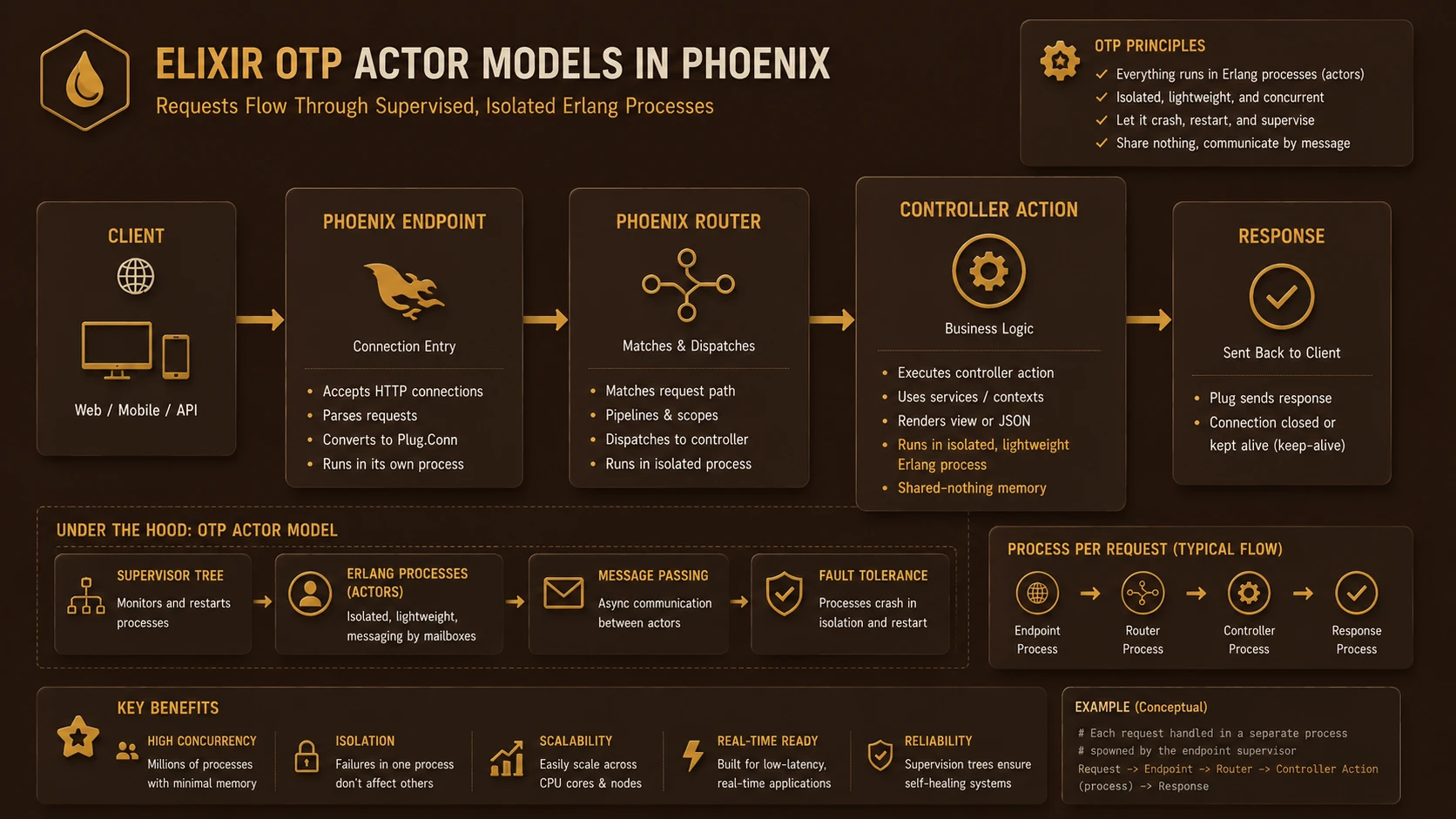
System architecture diagram and conceptual workflow layout for Phoenix Framework.
Phoenix applications interact with relational databases through Ecto, providing structured data access and migrations.
Real-Time Communication
Phoenix provides built-in support for persistent client communication, making it well suited for collaborative and event-driven applications.
Enterprise Use Cases
REST API Platforms
Phoenix efficiently serves high volumes of concurrent API requests.
Messaging Applications
Real-time communication benefits from lightweight concurrent processes.
Financial Systems
Fault-tolerant execution supports highly available transaction processing.
IoT Platforms
Large numbers of connected devices can communicate simultaneously with backend services.
Collaboration Software
Applications requiring continuous client communication benefit from Phoenix's concurrency architecture.
Performance Considerations
Phoenix emphasizes efficient resource utilization.
Performance advantages include:
- ◆Low memory overhead
- ◆Fast process creation
- ◆Efficient scheduling
- ◆High connection concurrency
- ◆Reduced blocking
- ◆Excellent responsiveness under load
Performance continues to depend upon application architecture, database design, and infrastructure configuration.
Security Considerations
Enterprise deployments should continue implementing:
- ◆Authentication
- ◆Authorization
- ◆HTTPS
- ◆Input validation
- ◆Secure session management
- ◆Database protection
The concurrency model improves reliability but does not replace secure application development practices.
Scalability
Phoenix is designed for distributed environments.
Scalability advantages include:
- ◆Horizontal application deployment
- ◆Distributed Erlang capabilities
- ◆Efficient process scheduling
- ◆Stateless API architecture
- ◆Fault-tolerant supervision
- ◆Resource-efficient concurrency
These characteristics support enterprise systems expected to grow continuously over time.
Best Practices
Organizations adopting Phoenix should consider the following recommendations.
- ◆Design stateless web services.
- ◆Keep OTP supervision trees organized.
- ◆Separate business logic from controllers.
- ◆Use immutable data consistently.
- ◆Benchmark production workloads.
- ◆Monitor process behavior.
- ◆Secure API endpoints.
- ◆Train development teams in functional programming concepts.
Common Mistakes
| Mistake | Enterprise Impact |
|---|---|
| Applying object-oriented design patterns directly | Reduced code quality |
| Creating unnecessary shared state | Lower concurrency |
| Ignoring supervision strategies | Reduced fault tolerance |
| Poor process organization | Operational complexity |
| Insufficient monitoring | Delayed incident detection |
| Treating Phoenix as a conventional thread-based framework | Missed architectural benefits |
Successful adoption depends upon embracing Elixir's functional programming and OTP principles.
Technology Comparison
| Capability | Traditional MVC Frameworks | Phoenix Framework |
|---|---|---|
| Concurrency Model | Threads or Worker Pools | Lightweight Processes |
| Fault Recovery | Application Managed | OTP Supervision |
| Scalability | Moderate | High |
| Real-Time Communication | External Components Often Required | Built-In Support |
| Resource Utilization | Higher | Efficient |
| Distributed Computing | Limited | Native BEAM Support |
Phoenix distinguishes itself primarily through the capabilities inherited from the Erlang ecosystem.
Adoption Strategy
Organizations evaluating Phoenix should:
- 1.Identify highly concurrent workloads.
- 2.Train developers in Elixir fundamentals.
- 3.Learn OTP supervision concepts.
- 4.Build pilot REST services.
- 5.Benchmark production workloads.
- 6.Establish operational monitoring.
- 7.Expand deployment gradually.
- 8.Develop internal best practices for functional architecture.
Incremental adoption allows teams to gain experience with the Elixir ecosystem before migrating larger systems.
Limitations
Although Phoenix offers compelling architectural advantages, organizations should recognize several considerations.
- ◆Functional programming introduces a learning curve.
- ◆Existing development teams may require retraining.
- ◆The ecosystem is newer than many established web frameworks.
- ◆Some enterprise libraries available in other ecosystems may not yet have direct equivalents.
- ◆Successful adoption depends upon understanding OTP design principles.
Organizations should evaluate Phoenix according to workload characteristics rather than familiarity with traditional development approaches.
Looking Ahead
From the perspective of October 2015, Phoenix Framework represents one of the most promising platforms for building highly concurrent web applications. By combining Elixir's modern language features with the proven reliability of the Erlang VM and OTP, Phoenix offers enterprise developers a compelling alternative for services requiring scalability, resilience, and real-time communication. As distributed systems, cloud platforms, and event-driven architectures continue expanding, technologies built upon fault-tolerant concurrency models are expected to receive growing attention within enterprise software engineering.