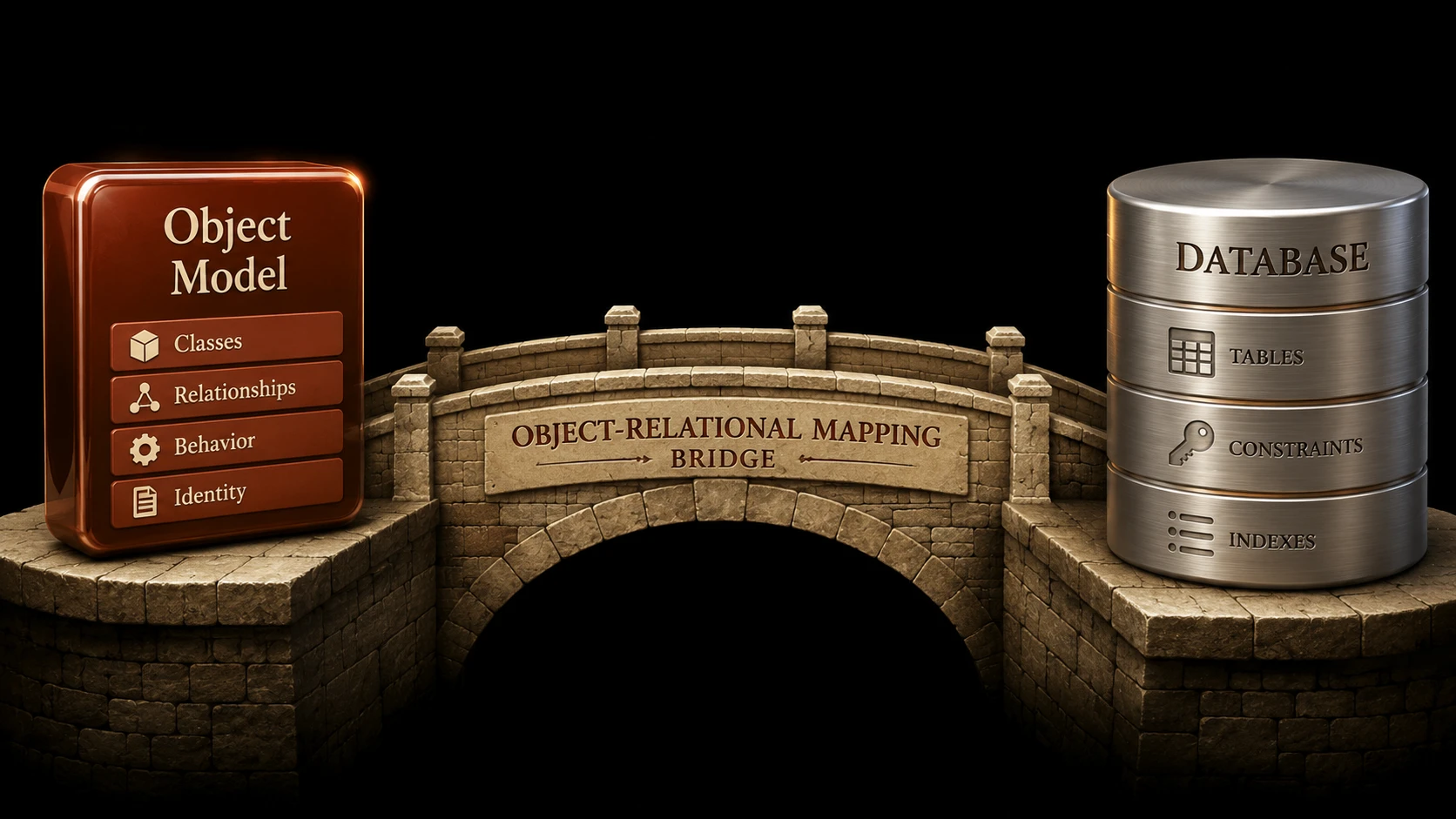
Enterprise software development has always involved one persistent challenge: bridging the gap between object-oriented application code and relational database systems. Business applications are written using classes, inheritance, encapsulation, and object relationships, while enterprise databases organize information into tables, rows, columns, primary keys, and foreign keys.
This fundamental difference is commonly referred to as the Object-Relational Impedance Mismatch. Developers spend a considerable amount of time translating between these two worlds, writing repetitive data access code, maintaining SQL queries, synchronizing object models, and ensuring consistency across application layers.
Microsoft first introduced the Entity Framework to simplify this problem, and with the release of .NET Framework 4.0, Entity Framework has matured considerably. Entity Framework 4.0 introduces several enhancements that address concerns raised by enterprise developers, including better support for Plain Old CLR Objects (POCO), foreign key associations, improved model generation, and greater flexibility for layered architectures.
For organizations building large business systems, these improvements make Entity Framework a compelling option for modernizing enterprise data access.
Understanding the Object-Relational Impedance Mismatch
Object-oriented programming and relational databases solve different problems.
Applications organize information using:
- ◆Classes
- ◆Objects
- ◆Properties
- ◆Inheritance
- ◆Encapsulation
- ◆References
Relational databases organize information using:
- ◆Tables
- ◆Columns
- ◆Rows
- ◆Primary Keys
- ◆Foreign Keys
- ◆Joins
Although both represent the same business information, their structures differ significantly.
For example, an application may define the following classes:
Customer
 ├── CustomerId
 ├── Name
 └── Orders

Order
 ├── OrderId
 ├── OrderDate
 └── Customer
The corresponding relational database might consist of:
Customers Table
Orders Table
CustomerID (FK)
Developers traditionally write extensive mapping logic to synchronize these models.
Traditional Data Access Challenges
Before ORM technologies became widely adopted, enterprise applications commonly relied on:
- ◆ADO.NET
- ◆Stored Procedures
- ◆Inline SQL
- ◆DataReaders
- ◆DataSets
While these approaches remain powerful, large projects often encounter recurring issues:
- ◆Large amounts of repetitive CRUD code
- ◆Manual object mapping
- ◆SQL duplication
- ◆Difficult maintenance
- ◆Tight coupling between business logic and persistence
- ◆Increased testing complexity
As enterprise applications grow, maintaining these layers consumes considerable development effort.
Introducing Entity Framework 4.0
Entity Framework is Microsoft's Object-Relational Mapping (ORM) technology designed to reduce the complexity of data access.
Instead of interacting directly with database tables, developers work primarily with domain objects.
Entity Framework handles:
- ◆Object mapping
- ◆SQL generation
- ◆Change tracking
- ◆Relationship management
- ◆Data persistence
This allows business logic to focus on business rules rather than database infrastructure.
Core Architecture
Entity Framework separates application logic from persistence through multiple abstraction layers.
Typical architecture:
Presentation Layer
        |
Business Services
        |
Entity Framework
        |
Conceptual Model
        |
Mapping Layer
        |
SQL Server Database
This layered architecture promotes maintainability and cleaner separation of concerns.
What's New in Entity Framework 4.0
Entity Framework 4.0 introduces several improvements requested by the development community.
POCO Support
One of the most significant enhancements is support for Plain Old CLR Objects (POCO).
Previous versions often required entity classes to inherit from EntityObject, creating tight coupling between domain models and the framework.
With POCO support, business entities can remain simple .NET classes.
Example:
public class Customer
{
    public int CustomerId { get; set; }
    public string Name { get; set; }
}
Benefits include:
- ◆Cleaner domain models
- ◆Better unit testing
- ◆Greater flexibility
- ◆Reduced framework dependency
Foreign Key Associations
Entity Framework 4.0 introduces native foreign key associations.
Rather than relying exclusively on navigation properties, developers can work directly with foreign key values.
Example:
public int CustomerId { get; set; }This simplifies disconnected scenarios and aligns more naturally with many enterprise application architectures.
Improved Model Generation
The Visual Studio tooling has also improved.
Developers can generate entity models directly from existing databases, reducing manual configuration and accelerating development.
Typical workflow:
- 1.Connect to an existing database.
- 2.Select tables and relationships.
- 3.Generate the Entity Data Model.
- 4.Begin writing business logic.
This approach is particularly useful for organizations modernizing existing SQL Server applications.
LINQ to Entities
One of Entity Framework's greatest strengths is integration with Language Integrated Query (LINQ).
Developers can write strongly typed queries directly in C#.
Example:
var customers =
    context.Customers
           .Where(c => c.City == "London")
           .OrderBy(c => c.Name);
Advantages include:
- ◆Compile-time checking
- ◆IntelliSense support
- ◆Improved readability
- ◆Reduced SQL string manipulation
LINQ encourages a more expressive and maintainable querying style compared to manually constructing SQL statements.
Change Tracking
Entity Framework automatically tracks modifications made to entity objects.
Developers simply update properties.
Example:
customer.Name = "John Smith";
context.SaveChanges();
The framework determines which SQL UPDATE statements are required.
Automatic change tracking reduces repetitive persistence logic while improving developer productivity.
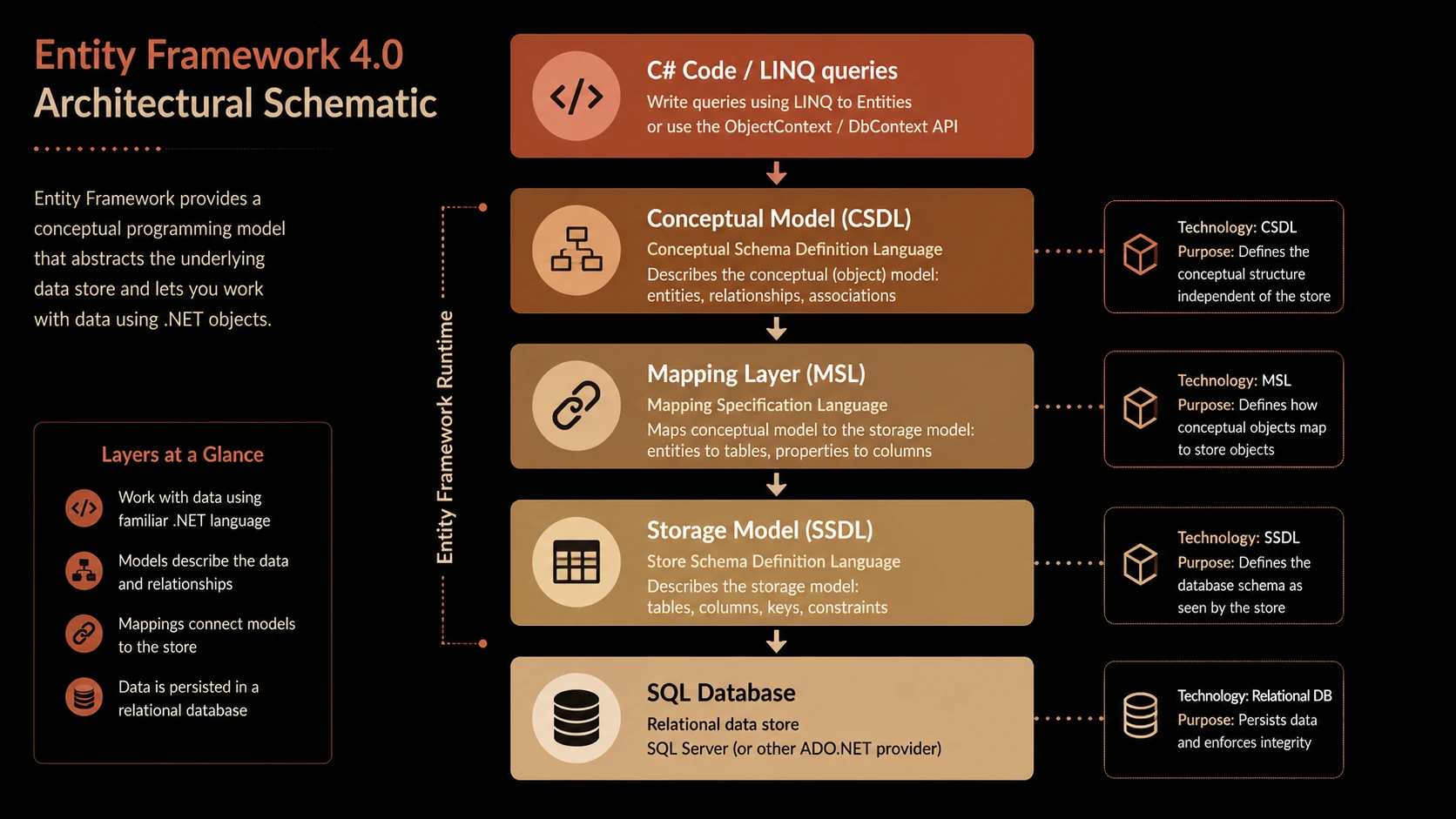
Database mapping layer connecting logical business models with relational schema.
Managing Relationships
Enterprise systems frequently contain complex relationships.
Examples include:
- ◆Customers and Orders
- ◆Products and Categories
- ◆Employees and Departments
- ◆Invoices and Line Items
Entity Framework manages these relationships through navigation properties.
Developers work with object references while the framework manages underlying joins and foreign keys.
Enterprise Layered Architecture
Many organizations adopt Entity Framework as part of a layered architecture.
User Interface
      |
Application Services
      |
Business Logic
      |
Repository Layer
      |
Entity Framework
      |
SQL Server
Separating persistence from business logic improves maintainability and facilitates testing.
Entity Framework Versus Traditional ADO.NET
| Traditional ADO.NET | Entity Framework 4.0 |
|---|---|
| Manual SQL | Generated SQL |
| Manual object mapping | Automatic mapping |
| Extensive CRUD code | Simplified persistence |
| Database-centric | Object-centric |
| Manual relationship handling | Navigation properties |
| Higher maintenance | Improved productivity |
Both approaches remain valuable, and organizations should choose the one best suited to their application's requirements.
Enterprise Use Cases
Customer Relationship Management
Entity Framework simplifies:
- ◆Customer records
- ◆Contact management
- ◆Sales opportunities
- ◆Activity tracking
Financial Systems
Financial applications often manage:
- ◆Accounts
- ◆Transactions
- ◆Invoices
- ◆Reporting
ORM capabilities reduce repetitive persistence logic while improving maintainability.
Healthcare Applications
Healthcare systems frequently contain complex relationships among patients, appointments, physicians, treatments, and billing information.
Entity Framework's navigation model naturally represents these business relationships.
Human Resources
HR systems can manage:
- ◆Employees
- ◆Departments
- ◆Payroll information
- ◆Benefits
- ◆Performance records
through object-oriented domain models.
Performance Considerations
While Entity Framework improves productivity, enterprise teams should still monitor application performance.
Recommended practices include:
- ◆Retrieve only required data.
- ◆Avoid unnecessarily large object graphs.
- ◆Review generated SQL during testing.
- ◆Use appropriate indexing.
- ◆Minimize unnecessary database round trips.
- ◆Batch related operations when practical.
Developers should remember that ORM frameworks simplify development but do not eliminate the need for database optimization.
Best Practices
Organizations adopting Entity Framework 4.0 should consider the following recommendations.
Design a Strong Domain Model
Business entities should represent business concepts rather than database implementation details.
Keep Business Logic Independent
Avoid placing business rules directly inside persistence code.
Use POCO Classes Where Appropriate
POCO entities provide greater flexibility and improve unit testing capabilities.
Organize Large Models
Large enterprise systems should divide functionality into logical modules rather than creating excessively large entity models.
Review Generated SQL
Generated queries should be reviewed during development to ensure they meet application performance expectations.
Common Mistakes
Many organizations adopting ORM technologies encounter similar issues.
Treating the Database as an Afterthought
Entity Framework does not eliminate the importance of sound database design.
Indexes, normalization, and query optimization remain essential.
Loading Excessive Data
Retrieving entire object graphs when only a few fields are required can negatively affect performance.
Mixing Business Logic with Data Access
Business rules should remain separate from persistence responsibilities.
Ignoring Transaction Boundaries
Enterprise applications should define transactions carefully to preserve data consistency.
Expecting ORM to Solve Every Problem
Some specialized reporting or bulk-processing scenarios may still benefit from carefully written SQL or stored procedures.
Migration Strategy
Organizations modernizing existing applications can adopt Entity Framework incrementally.
Recommended roadmap:
- 1.Identify modules with repetitive data access code.
- 2.Introduce Entity Framework in new development.
- 3.Create entity models from existing databases.
- 4.Gradually replace manual CRUD operations.
- 5.Introduce repository abstractions where appropriate.
- 6.Test generated SQL thoroughly.
- 7.Expand adoption across additional business domains.
This phased approach minimizes disruption while allowing teams to gain experience with ORM technologies.
Adoption Recommendations
Entity Framework 4.0 offers significant productivity improvements, but successful adoption requires more than simply replacing SQL statements.
Organizations should:
- ◆Invest in developer training.
- ◆Establish architectural standards.
- ◆Define persistence layer responsibilities.
- ◆Encourage clean domain modeling.
- ◆Review performance regularly.
- ◆Maintain strong database design principles.
With proper planning, Entity Framework can reduce repetitive code while improving long-term maintainability.
Looking Ahead
Enterprise software continues to evolve toward layered architectures that emphasize maintainability, testability, and developer productivity. Entity Framework 4.0 represents an important milestone in Microsoft's ORM strategy by addressing many concerns raised during earlier releases, particularly through POCO support, improved model generation, and enhanced relationship management.
Organizations evaluating modern data access technologies should consider how Entity Framework fits within their broader architectural goals. When combined with sound domain modeling, disciplined persistence practices, and careful performance testing, Entity Framework 4.0 provides a powerful foundation for building scalable enterprise applications while reducing the complexity of the object-relational impedance mismatch.