Introduction
Data access remains one of the most important components of enterprise application development. Whether building financial systems, customer relationship management platforms, inventory applications, or public-facing web portals, developers spend a considerable amount of time designing domain models, mapping objects to relational databases, and implementing data persistence logic.
The Microsoft Entity Framework has steadily evolved as the primary object-relational mapping (ORM) technology within the .NET ecosystem. Earlier releases significantly reduced the amount of manual data access code required compared to traditional ADO.NET programming. However, many developers continued to express concerns regarding model complexity, verbose APIs, and the amount of generated configuration required for relatively simple applications.
Entity Framework 4.1 addresses many of these concerns by introducing Code-First development and the new DbContext API. Together, these features encourage a cleaner programming model that emphasizes domain classes while simplifying database interaction.
As of March 2011, Entity Framework 4.1 represents an important step toward more productive enterprise development. While many organizations continue using existing database-first workflows, Code-First offers an attractive alternative for new projects where domain modeling begins before database implementation.
This article explores the architecture behind Entity Framework 4.1, examines the advantages of Code-First development, discusses the DbContext API, and provides guidance for enterprise adoption.
The Evolution of Object-Relational Mapping
Enterprise developers have long faced the challenge of bridging the gap between object-oriented programming and relational databases.
Business applications typically represent information as objects.
Relational databases organize the same information using:
- ◆Tables
- ◆Rows
- ◆Columns
- ◆Primary keys
- ◆Foreign keys
Mapping between these two models traditionally required significant manual coding.
Object-relational mapping frameworks automate much of this work, allowing developers to focus on business logic instead of repetitive database access code.
Previous Entity Framework Development Models
Earlier versions of Entity Framework primarily supported:
- ◆Database-First development
- ◆Model-First development
Database-First begins with an existing relational schema and generates the entity model.
Model-First allows developers to design conceptual models before generating the database.
Although effective, both approaches often involve graphical designers and generated artifacts that may become increasingly difficult to maintain in large projects.
Introducing Code-First Development
Code-First takes a different approach.
Developers begin by writing Plain Old CLR Objects (POCOs) that represent business entities.
Example:
public class Customer
{
    public int CustomerId { get; set; }
    public string Name { get; set; }
    public string Email { get; set; }
}
Rather than generating domain classes from the database, the domain model becomes the starting point for application development.
This approach aligns well with domain-driven design principles and encourages cleaner separation between business logic and persistence concerns.
The DbContext API
Another significant enhancement in Entity Framework 4.1 is the introduction of DbContext.
Previous versions often required developers to work directly with ObjectContext, which exposed a comprehensive but relatively complex API.
DbContext provides a simpler abstraction for common application scenarios.
Example:
public class SalesContext : DbContext
{
    public DbSet<Customer> Customers { get; set; }
    public DbSet<Order> Orders { get; set; }
}
The resulting code is concise, readable, and easier for new developers to understand.
Working with Data
Querying data using DbContext is straightforward.
using (var db = new SalesContext())
{
    var customers = db.Customers.ToList();
}
Adding new records is equally simple.
var customer = new Customer
{
    Name = "John Smith",
    Email = "john@example.com"
};

using (var db = new SalesContext())
{
    db.Customers.Add(customer);
    db.SaveChanges();
}
The simplified API reduces boilerplate while maintaining the capabilities expected from an enterprise ORM.
Comparing Development Approaches
| Feature | Database-First | Model-First | Code-First |
|---|---|---|---|
| Starting Point | Existing Database | Visual Model | Domain Classes |
| Development Style | Database Driven | Model Driven | Code Driven |
| Designer Dependency | High | Moderate | Minimal |
| Domain Flexibility | Moderate | Moderate | High |
| Learning Curve | Moderate | Moderate | Lower |
| Suitable for Existing Databases | Excellent | Moderate | Possible |
Each approach remains valuable depending on project requirements.
Enterprise Architecture Considerations
Entity Framework fits naturally into layered enterprise architectures.
A common architecture may resemble:
Presentation Layer
        |
Application Services
        |
Business Domain
        |
Entity Framework 4.1
        |
SQL Server Database
The domain model remains independent of database implementation details, improving maintainability and testability.
POCO Support
One of the strengths of Code-First is its emphasis on Plain Old CLR Objects.
POCO classes:
- ◆Reduce framework dependencies.
- ◆Improve readability.
- ◆Simplify unit testing.
- ◆Encourage clean domain modeling.
- ◆Support separation of concerns.
Business entities become ordinary C# classes rather than framework-generated types.
Enterprise Use Cases
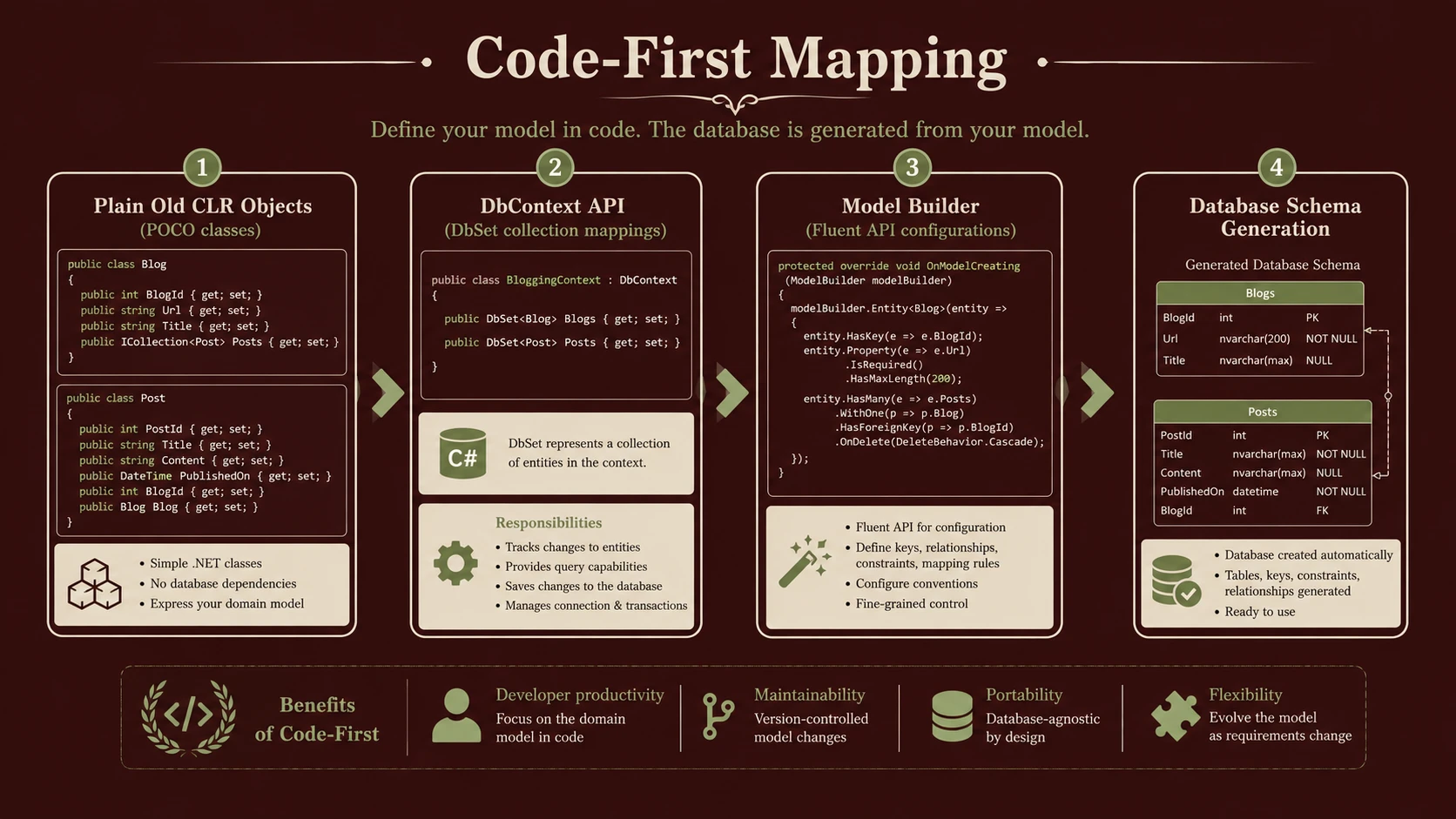
Database mapping layer connecting logical business models with relational schema.
Customer Relationship Management
Organizations building new CRM solutions can model business entities before finalizing database implementation.
Internal Business Applications
Departmental systems often evolve rapidly.
Code-First enables iterative domain modeling during early development phases.
ASP.NET Applications
Web applications benefit from simplified data access and reduced infrastructure code.
Rapid Prototyping
Development teams evaluating new business ideas can begin coding immediately without waiting for complete database designs.
Domain-Driven Design Projects
Projects emphasizing business concepts over database structures align naturally with Code-First principles.
Benefits of DbContext
The DbContext API provides several practical advantages.
- ◆Simpler programming model
- ◆Reduced boilerplate code
- ◆Easier onboarding for new developers
- ◆Improved readability
- ◆Better alignment with common application scenarios
- ◆Cleaner unit of work implementation
These improvements contribute directly to developer productivity.
Performance Considerations
Although Code-First improves the development experience, application performance continues to depend upon several factors.
Organizations should monitor:
- ◆Query efficiency
- ◆Database indexing
- ◆Lazy loading behavior
- ◆Network latency
- ◆Connection management
Entity Framework simplifies persistence but does not eliminate the need for proper database design.
Best Practices
Organizations adopting Entity Framework 4.1 should follow several recommendations.
- ◆Keep entity classes focused on business concepts.
- ◆Use meaningful naming conventions.
- ◆Separate persistence logic from presentation code.
- ◆Review generated SQL during development.
- ◆Design efficient database indexes.
- ◆Validate business rules within the domain layer.
- ◆Keep DbContext instances appropriately scoped.
- ◆Test queries using realistic datasets.
- ◆Document entity relationships clearly.
These practices improve maintainability and long-term scalability.
Common Mistakes
Several implementation issues should be avoided.
Treating Code-First as a Database Design Tool
Good relational design remains essential regardless of development approach.
Large DbContext Classes
Overly broad contexts become difficult to maintain and understand.
Ignoring Query Performance
Convenient APIs should not replace careful performance testing.
Mixing Business Logic and Data Access
Maintaining clear architectural boundaries improves maintainability.
Assuming Code-First Fits Every Project
Organizations with mature existing databases may continue benefiting from Database-First workflows.
Adoption Recommendations
Enterprise teams should evaluate Code-First incrementally.
Phase 1
- ◆Upgrade to Entity Framework 4.1.
- ◆Train development teams.
- ◆Build internal prototypes.
Phase 2
- ◆Adopt DbContext for new development.
- ◆Evaluate Code-First on greenfield projects.
- ◆Establish entity design standards.
Phase 3
- ◆Standardize repository and service patterns.
- ◆Review performance characteristics.
- ◆Expand adoption where appropriate.
Phase 4
- ◆Document development guidelines.
- ◆Continue refining domain models.
- ◆Evaluate future Entity Framework enhancements as they become available.
A phased strategy minimizes migration risk while allowing organizations to realize productivity improvements.
Choosing the Right Development Model
Entity Framework 4.1 does not invalidate previous development approaches. Database-First remains appropriate for organizations working with established enterprise databases, while Model-First continues serving teams that prefer conceptual modeling.
Code-First expands the available options by allowing developers to design applications around business concepts before focusing on persistence details. Selecting the appropriate approach should depend upon project goals, organizational standards, and existing infrastructure.
Looking Ahead
Entity Framework 4.1 represents an important milestone in Microsoft's data access strategy. By introducing Code-First development and the simplified DbContext API, the framework enables developers to create cleaner domain models, reduce infrastructure complexity, and focus more directly on business requirements.
As organizations continue modernizing enterprise applications throughout 2011, Entity Framework 4.1 provides a compelling option for new development projects while remaining compatible with existing database-centric workflows. Teams that thoughtfully evaluate Code-First alongside their current development practices will be better positioned to build maintainable, scalable, and productive enterprise applications using the evolving .NET platform.