Introduction
For more than two decades, the browser has steadily evolved from a document viewer into a sophisticated application runtime capable of supporting enterprise software, productivity suites, engineering tools, multimedia processing, financial platforms, and cloud services. JavaScript has powered much of this transformation, with browser vendors continuously improving execution engines through Just-In-Time compilation, optimization strategies, and advanced garbage collection.
Despite these advances, JavaScript remains a dynamically typed scripting language whose primary design goals differ from those of traditional systems programming languages. Organizations seeking to migrate native desktop software to the browser often encounter challenges involving startup performance, computational efficiency, memory utilization, and language portability.
The approval of the WebAssembly Minimum Viable Product (MVP) represents a significant milestone toward addressing these challenges. Rather than replacing JavaScript, WebAssembly introduces a compact binary execution format designed to complement existing web technologies while enabling languages such as C and C++ to target browsers more efficiently.
From the perspective of March 2017, WebAssembly has established itself as one of the most promising architectural developments for the future of enterprise web applications.
Industry Background
Enterprise software increasingly depends on browser-based delivery.
Organizations are developing:
- ◆Software-as-a-Service platforms.
- ◆Engineering applications.
- ◆Financial analytics systems.
- ◆Image and video processing tools.
- ◆Computer-aided design software.
- ◆Scientific visualization platforms.
- ◆Business intelligence applications.
These workloads frequently demand execution characteristics closer to native software than traditional web applications.
Modern browser engines have significantly improved JavaScript performance, yet organizations continue searching for standardized methods of executing computationally intensive workloads without sacrificing portability or security.
The WebAssembly MVP represents a collaborative effort among major browser vendors to provide such a foundation.
The Business Problem
Organizations building sophisticated browser applications frequently encounter several technical challenges.
Common concerns include:
- ◆Large JavaScript codebases.
- ◆CPU-intensive computation.
- ◆Long application startup times.
- ◆Limited portability from native code.
- ◆Cross-browser consistency.
- ◆High-performance numerical processing.
- ◆Increasing application complexity.
Historically, migrating native applications to browsers often required significant rewrites into JavaScript.
WebAssembly seeks to reduce this effort by providing a standardized compilation target.
Understanding the Technology
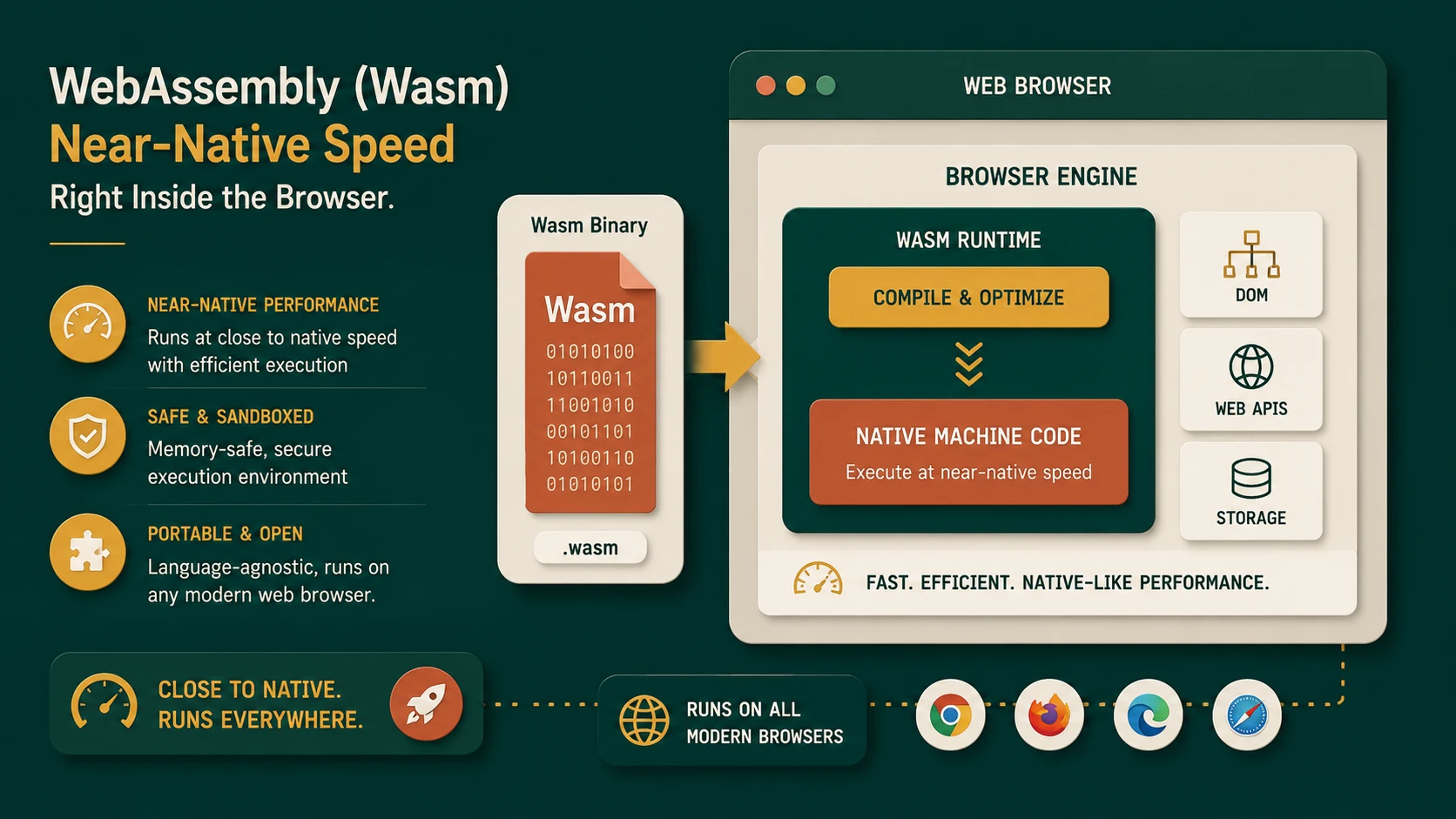
WebAssembly is a portable binary instruction format designed for efficient execution inside modern browser engines.
Major design goals include:
- ◆Compact binary representation.
- ◆Fast decoding.
- ◆Predictable execution.
- ◆Language neutrality.
- ◆Browser portability.
- ◆Security.
- ◆Efficient integration with JavaScript.
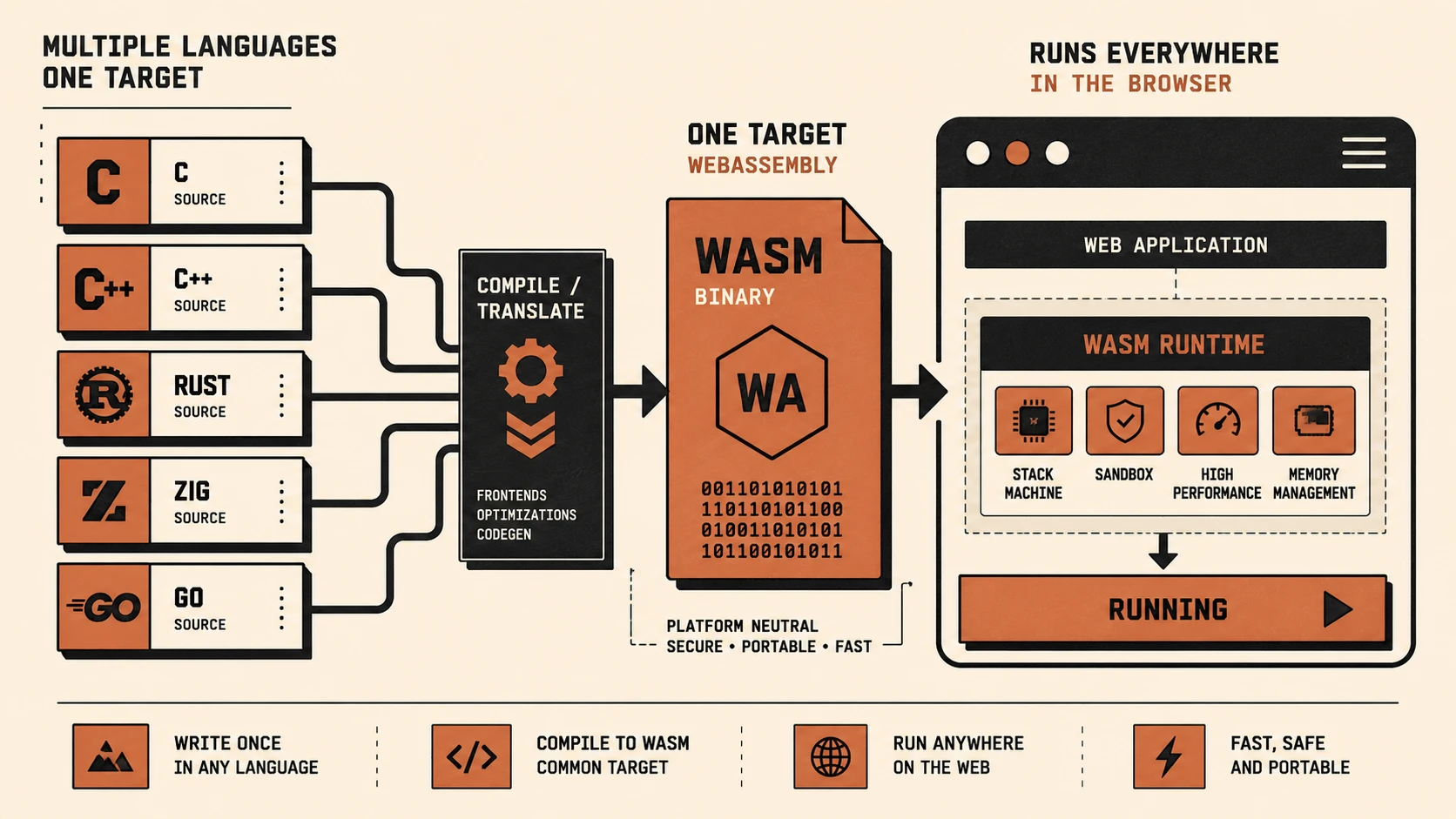
Rather than executing source code directly, browsers load precompiled binary modules generated by external compiler toolchains.
This allows developers to build applications using multiple programming languages while targeting a common execution environment.
Core Architecture
A simplified WebAssembly architecture appears below.
| Component | Responsibility |
|---|---|
| Source Language | Application implementation |
| Compiler Toolchain | Produces WebAssembly modules |
| WebAssembly Binary | Portable executable representation |
| Browser Runtime | Validates and executes modules |
| JavaScript Environment | Coordinates application logic |
| Web APIs | Browser capabilities |
This architecture separates language implementation from browser execution while maintaining interoperability with the existing web platform.
Key Features
Portable Binary Format
WebAssembly modules are distributed in a compact binary format optimized for efficient transmission and decoding.
Compared with large JavaScript applications, binary modules reduce parsing overhead and improve startup characteristics.
Universal Compilation Target
One of WebAssembly's most significant architectural contributions is establishing the browser as a compilation target rather than a JavaScript-only runtime.
Compiler toolchains may generate WebAssembly modules from multiple programming languages, allowing organizations to reuse existing engineering expertise and software assets.
Near-Native Execution Model
WebAssembly is designed for efficient execution while preserving browser portability.
Applications continue operating within the browser security model rather than executing as unrestricted native programs.
JavaScript Interoperability
JavaScript remains an essential part of browser applications.
WebAssembly modules interact with JavaScript to access browser capabilities, user interfaces, and application workflows.
The two technologies are intended to complement each other rather than compete.
Deterministic Module Validation
Before execution, browsers validate WebAssembly modules to ensure they conform to the specification.
Validation contributes to predictable execution and secure integration within browser environments.
Cross-Browser Collaboration
The WebAssembly initiative reflects collaboration among major browser vendors, increasing the likelihood of consistent implementation across modern web platforms.
How It Works
A simplified execution workflow appears below.
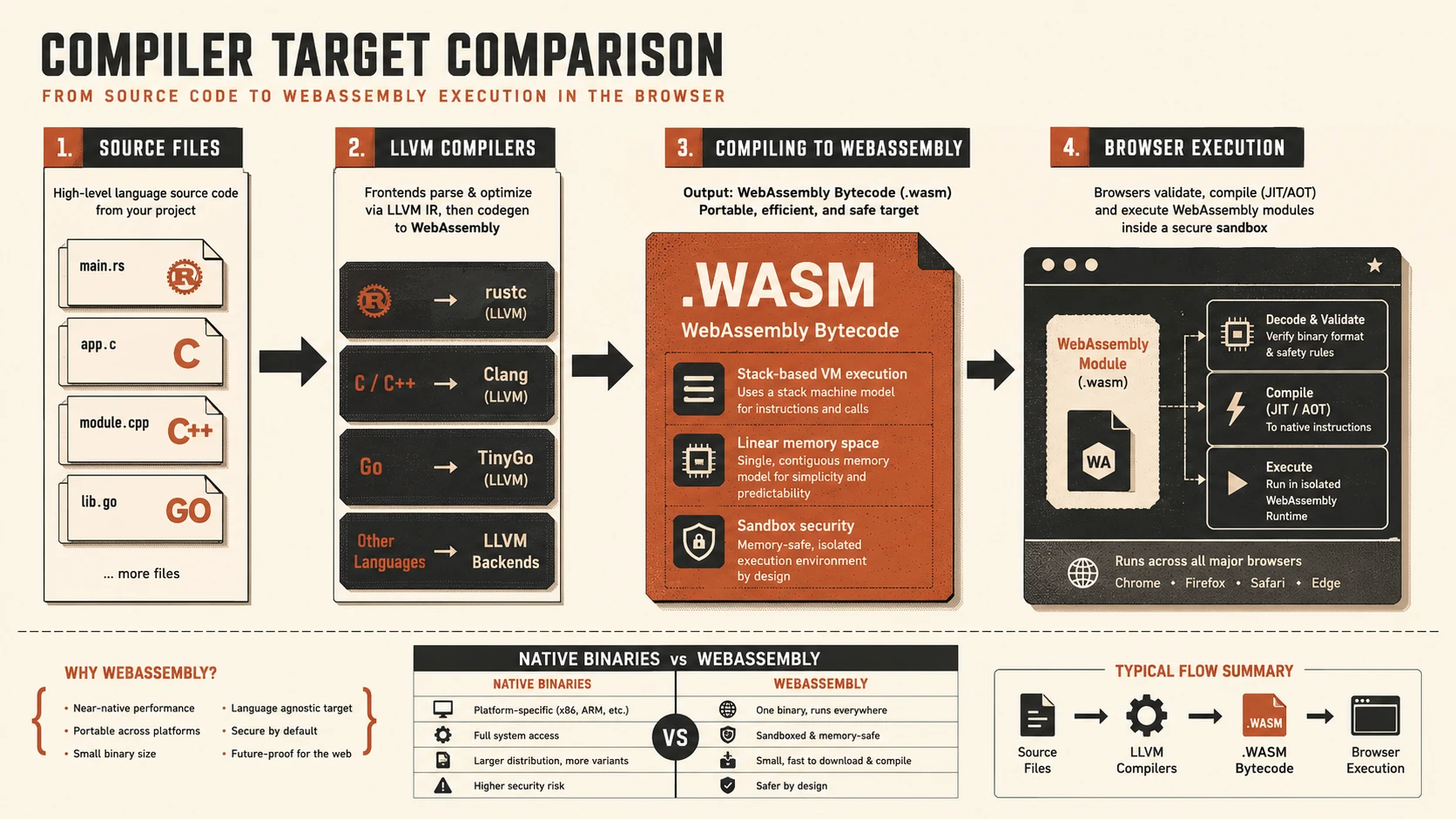
System architecture diagram and conceptual workflow layout for WebAssembly MVP Approval.
Application Source Code
          |
Compiler Toolchain
          |
WebAssembly Module
          |
Browser Downloads Module
          |
Module Validation
          |
WebAssembly Runtime
          |
JavaScript Interaction
          |
User Interface
The browser validates and executes the binary module while JavaScript continues coordinating application behavior and access to browser APIs.
Enterprise Use Cases
Engineering Software
Browser-based simulation and modeling applications can benefit from efficient numerical computation.
Image and Video Processing
Applications performing intensive media manipulation may leverage WebAssembly for computationally demanding algorithms.
Computer-Aided Design
Interactive engineering software requiring significant mathematical computation becomes increasingly practical within browser environments.
Scientific Computing
Research platforms processing large numerical datasets benefit from portable high-performance execution.
Enterprise Software Modernization
Organizations maintaining mature native applications can begin evaluating browser deployment strategies that reuse existing language ecosystems through WebAssembly compilation.
Performance Considerations
WebAssembly is designed to improve computational efficiency.
Important considerations include:
- ◆Module download size.
- ◆Startup performance.
- ◆Binary decoding efficiency.
- ◆CPU utilization.
- ◆JavaScript interoperability overhead.
- ◆Browser implementation quality.
Actual performance gains depend upon workload characteristics, compiler optimization, and browser execution engines.
Security Considerations
WebAssembly preserves the browser's security model.
Organizations should recognize several security characteristics.
- ◆Execution within browser sandbox boundaries.
- ◆Module validation before execution.
- ◆Controlled interaction with browser APIs.
- ◆Same-origin policy enforcement.
- ◆No unrestricted operating system access.
These characteristics enable higher-performance execution without abandoning established browser security principles.
Scalability
WebAssembly provides a scalable foundation for increasingly sophisticated browser applications.
Advantages include:
- ◆Efficient execution.
- ◆Language portability.
- ◆Reusable compiler infrastructure.
- ◆Improved browser application capabilities.
- ◆Consistent execution across supported browsers.
These characteristics support enterprise software modernization while preserving web deployment advantages.
Best Practices
Organizations evaluating WebAssembly should:
- ◆Identify computationally intensive application components.
- ◆Continue using JavaScript for user interface logic.
- ◆Benchmark representative production workloads.
- ◆Evaluate available compiler toolchains.
- ◆Maintain compatibility across supported browsers.
- ◆Introduce WebAssembly incrementally through pilot projects.
- ◆Monitor evolving browser implementations.
A measured adoption strategy minimizes operational risk while allowing organizations to evaluate practical performance improvements.
Common Mistakes
| Mistake | Business Impact |
|---|---|
| Assuming WebAssembly replaces JavaScript entirely | Architectural misunderstanding |
| Migrating applications without profiling bottlenecks | Limited performance improvement |
| Treating WebAssembly as unrestricted native execution | Security misconceptions |
| Ignoring browser compatibility testing | Deployment inconsistency |
| Overlooking JavaScript integration requirements | Increased implementation complexity |
| Expecting identical performance across all workloads | Unrealistic expectations |
Successful adoption depends on selecting appropriate workloads rather than attempting wholesale migration.
Technology Comparison
| Characteristic | JavaScript | WebAssembly MVP |
|---|---|---|
| Representation | Source code | Binary module |
| Primary Purpose | General-purpose web programming | Portable compiled execution format |
| Language Origin | JavaScript | Multiple compiler-supported languages |
| Browser Integration | Native | Native through WebAssembly runtime |
| User Interface Access | Direct Web APIs | Through JavaScript interoperability |
WebAssembly complements JavaScript by providing an efficient execution target for performance-sensitive application components.
Adoption Strategy
Organizations should adopt WebAssembly through phased experimentation.
- 1.Profile existing applications.
- 2.Identify computational bottlenecks.
- 3.Evaluate compiler toolchains.
- 4.Prototype WebAssembly modules.
- 5.Benchmark production-like workloads.
- 6.Expand deployment following operational validation.
This incremental approach balances innovation with enterprise stability.
Limitations
As of March 2017, the WebAssembly MVP represents the initial standardized feature set.
Organizations should recognize several considerations.
- ◆The specification continues evolving.
- ◆Tooling ecosystems are still maturing.
- ◆Enterprise operational practices continue developing.
- ◆Browser implementations should be validated individually.
- ◆Many applications will continue relying extensively on JavaScript.
These considerations should guide enterprise evaluation before broad production adoption.
Looking Ahead
From the perspective of March 2017, the approval of the WebAssembly Minimum Viable Product represents one of the most important milestones in the evolution of the web platform. By establishing a standardized binary execution format supported across major browser vendors, WebAssembly positions the browser as a universal compilation target capable of supporting increasingly sophisticated enterprise software.
Although JavaScript will remain central to browser application development, WebAssembly significantly expands the architectural possibilities available to software engineers. Organizations building computationally intensive applications, modernizing native software, or investing in long-term browser platforms should closely evaluate WebAssembly as an emerging foundation for the next generation of enterprise web applications.