Introduction
RESTful APIs have become the preferred integration mechanism for enterprise applications, mobile platforms, cloud services, and Software as a Service (SaaS) solutions. Organizations increasingly expose business capabilities through HTTP interfaces consumed by browsers, mobile applications, business partners, and internal systems.
As APIs mature, change becomes inevitable. Business requirements evolve, resource models expand, security requirements change, and new capabilities must be introduced. While adding functionality is straightforward from a development perspective, maintaining compatibility with existing client applications presents a far more significant architectural challenge.
Unlike browser-based applications that can often be updated centrally, API consumers may operate independently, update on different schedules, or remain deployed for extended periods. Breaking changes can therefore disrupt business operations, partner integrations, and production systems.
API versioning provides a structured approach for evolving interfaces while allowing existing consumers to continue operating. Selecting an appropriate versioning strategy is not merely an implementation decision—it is an architectural decision that influences maintainability, governance, documentation, testing, and long-term service evolution.
Industry Background
Enterprise software increasingly relies upon service-oriented architectures and HTTP-based APIs for system integration. Mobile applications, JavaScript front-end frameworks, cloud platforms, and distributed business systems all depend upon stable interfaces.
Many organizations initially publish APIs without considering long-term evolution. As additional consumers adopt those interfaces, even seemingly minor changes become difficult to introduce without affecting production applications.
This challenge has led many development teams to establish formal API lifecycle management processes, where versioning becomes an essential part of interface governance.
The Business Problem
Without a clear versioning strategy, organizations commonly encounter:
- ◆Breaking client applications after deployments
- ◆Multiple incompatible API consumers
- ◆Difficult migration planning
- ◆Growing maintenance costs
- ◆Inconsistent documentation
- ◆Duplicate service implementations
- ◆Limited ability to evolve resource models
A disciplined versioning strategy allows APIs to introduce improvements while minimizing disruption for existing consumers.
Understanding REST API Versioning
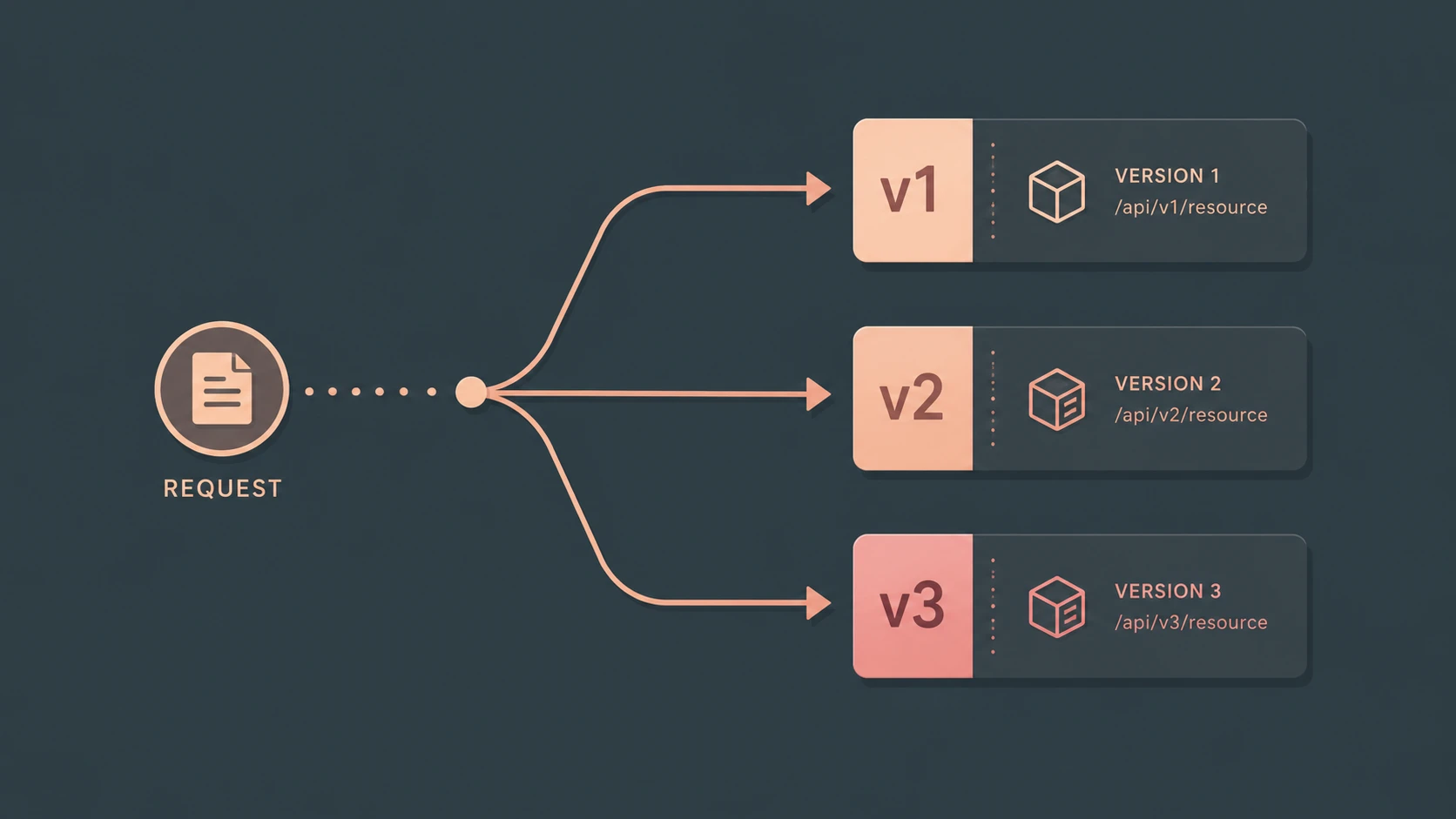
API versioning provides a mechanism for introducing incompatible interface changes while allowing multiple API contracts to coexist.
A version may represent changes involving:
- ◆Resource structure
- ◆Request formats
- ◆Response formats
- ◆Business rules
- ◆Authentication requirements
- ◆Media representations
Well-designed versioning allows consumers to migrate according to their own operational schedules rather than being forced into immediate upgrades.
Core Architecture
A versioned REST API typically includes several architectural components.
| Component | Responsibility |
|---|---|
| Client Application | Requests a specific API version |
| API Gateway or Router | Directs requests to the appropriate implementation |
| Versioned Controller Layer | Processes version-specific behavior |
| Business Services | Implements shared business logic |
| Resource Representation | Produces version-specific responses |
| Documentation | Defines supported contracts |
Separating business logic from version-specific representations helps reduce duplication while simplifying maintenance.
Why Version APIs?
Versioning should be considered when introducing changes that are not backward compatible.
Examples include:
- ◆Removing fields
- ◆Renaming properties
- ◆Changing resource structures
- ◆Modifying required parameters
- ◆Altering response semantics
- ◆Introducing incompatible authentication behavior
Backward-compatible enhancements, such as adding optional fields, often do not require a new version when existing clients continue functioning correctly.
URI Versioning
One of the most widely adopted approaches places the version directly within the resource path.
Examples include:
/api/v1/customers
/api/v2/customers
Advantages include:
- ◆Simple implementation
- ◆Easy routing
- ◆Clear documentation
- ◆Readable URLs
- ◆Straightforward testing
Potential disadvantages include exposing version information as part of the resource identifier and maintaining multiple endpoint structures.
Header-Based Versioning
Some organizations specify API versions using custom HTTP request headers.
Example:
API-Version: 2Advantages include:
- ◆Cleaner resource URLs
- ◆Separation of resource identity from representation version
- ◆Flexible request handling
Challenges include:
- ◆Reduced visibility during manual testing
- ◆More complex debugging
- ◆Additional tooling requirements
Development teams should ensure testing and documentation tools adequately support custom request headers.
Media Type Versioning
Media type negotiation places version information within the Accept request header.
Example:
Accept: application/vnd.company.v2+jsonThis approach aligns closely with HTTP content negotiation.
Potential benefits include:
- ◆Representation-focused versioning
- ◆Stable resource URLs
- ◆Flexible response negotiation
However, it may increase implementation complexity and require greater familiarity with HTTP semantics.
Query Parameter Versioning
Another strategy specifies versions through query parameters.
Example:
/api/customers?version=2Advantages include:
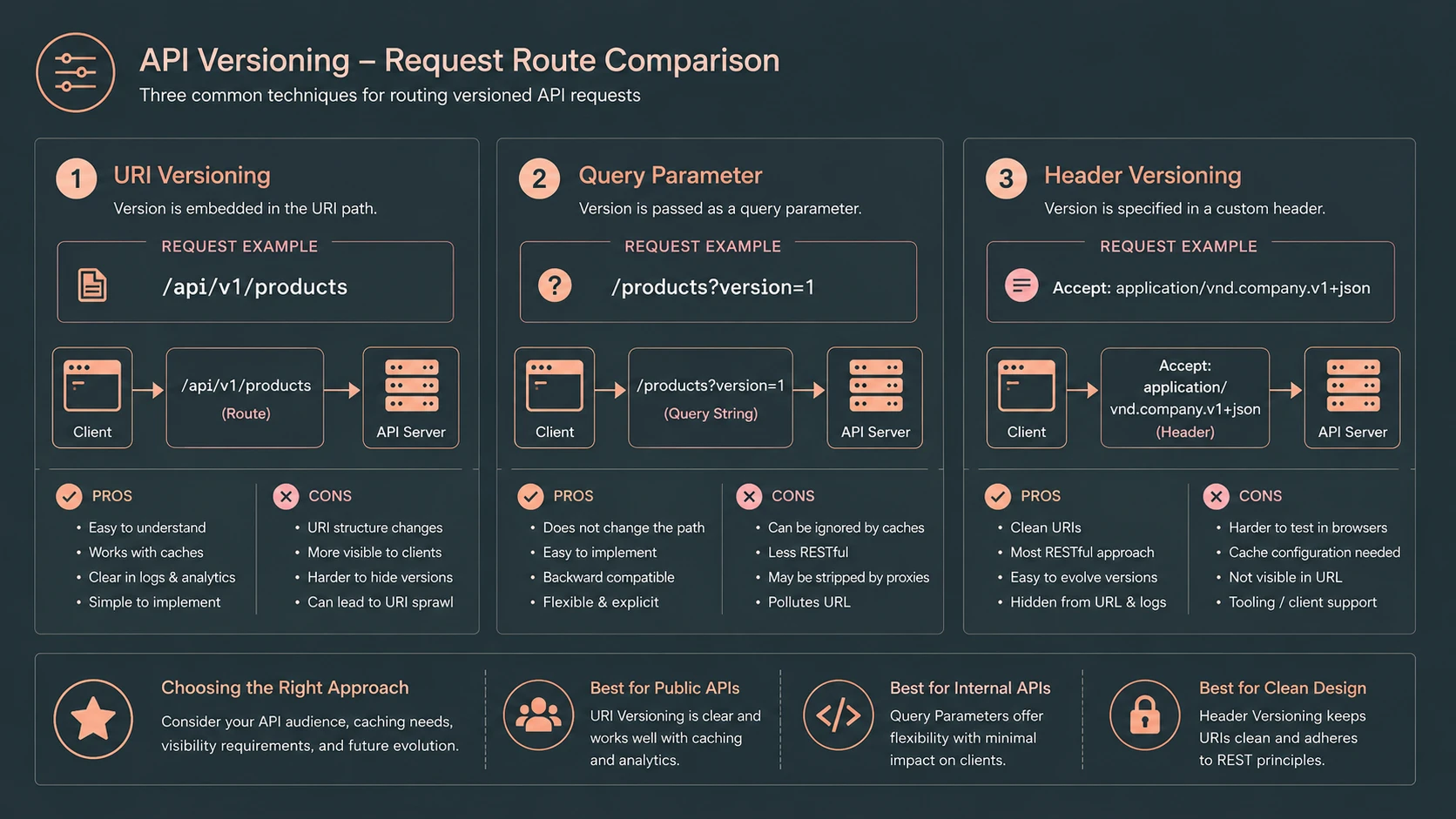
System architecture diagram and conceptual workflow layout for REST API Versioning.
- ◆Simple implementation
- ◆Easy experimentation
- ◆Minimal routing changes
Potential disadvantages include:
- ◆Reduced consistency across APIs
- ◆Less prominent version visibility
- ◆Possible ambiguity when mixed with business query parameters
Organizations should establish clear conventions if this strategy is adopted.
Comparison of Versioning Strategies
| Strategy | Advantages | Considerations |
|---|---|---|
| URI Versioning | Simple, visible, easy to document | Version becomes part of the URI |
| Header Versioning | Clean URLs, flexible | Less visible, tooling considerations |
| Media Type Versioning | Uses HTTP content negotiation | More complex implementation |
| Query Parameter Versioning | Easy to implement | Can reduce URL clarity |
No single strategy is universally appropriate. Selection should align with organizational standards and operational requirements.
Maintaining Backward Compatibility
Successful versioning involves more than assigning version numbers.
Organizations should:
- ◆Preserve existing contracts where practical.
- ◆Introduce breaking changes deliberately.
- ◆Communicate deprecation schedules clearly.
- ◆Provide migration guidance.
- ◆Maintain comprehensive testing across supported versions.
Compatibility planning is often more valuable than the version identifier itself.
Documentation and Governance
Versioned APIs require disciplined documentation.
Documentation should define:
- ◆Supported versions
- ◆Resource contracts
- ◆Authentication requirements
- ◆Error responses
- ◆Migration considerations
- ◆Deprecation policies
Clear governance reduces confusion among development teams and external consumers.
Enterprise Use Cases
| Scenario | Benefit |
|---|---|
| Public developer APIs | Controlled interface evolution |
| Mobile backends | Independent client upgrades |
| Internal enterprise services | Stable integrations |
| SaaS platforms | Long-term compatibility |
| Business partner APIs | Predictable migration planning |
| Cloud services | Incremental feature delivery |
Versioning enables organizations to evolve services without requiring simultaneous updates across every client.
Performance Considerations
API versioning itself introduces minimal runtime overhead.
Performance planning should instead focus on:
- ◆Efficient request routing
- ◆Shared business logic
- ◆Response serialization
- ◆Cache behavior
- ◆Documentation generation
Multiple versions should avoid unnecessary duplication of processing pipelines whenever possible.
Security Considerations
Every supported API version should maintain consistent security controls.
Recommended practices include:
- ◆HTTPS for all endpoints
- ◆Consistent authentication mechanisms
- ◆Authorization enforcement
- ◆Input validation
- ◆Secure error handling
- ◆Comprehensive audit logging
Retiring outdated versions promptly reduces long-term security exposure.
Scalability
Supporting multiple API versions increases operational complexity.
Scalable API architectures typically:
- ◆Separate routing from business logic
- ◆Reuse shared services
- ◆Isolate representation differences
- ◆Automate testing across versions
- ◆Monitor version usage
Architectural modularity simplifies long-term maintenance.
Best Practices
Organizations implementing REST API versioning should:
- ◆Define versioning policies before public release.
- ◆Minimize breaking changes.
- ◆Maintain backward compatibility whenever practical.
- ◆Establish deprecation procedures.
- ◆Monitor client adoption.
- ◆Document every supported version.
- ◆Test compatibility continuously.
- ◆Keep business logic independent of version-specific representations.
Consistent governance contributes to long-term API stability.
Common Mistakes
Development teams frequently encounter several versioning issues.
Common mistakes include:
- ◆Introducing breaking changes without version updates.
- ◆Supporting obsolete versions indefinitely.
- ◆Duplicating business logic across versions.
- ◆Mixing versioning strategies within the same API.
- ◆Failing to document migration paths.
- ◆Treating version numbers as substitutes for governance.
Well-defined lifecycle management helps avoid these problems.
Adoption Strategy
Organizations planning enterprise API programs should establish versioning standards early.
A practical approach includes:
- 1.Define enterprise API governance policies.
- 2.Select a single versioning strategy.
- 3.Separate routing from business services.
- 4.Implement automated compatibility testing.
- 5.Publish clear documentation.
- 6.Monitor client adoption metrics.
- 7.Communicate deprecation timelines before removing older versions.
Consistency across services simplifies both development and long-term operations.
Limitations
Although API versioning enables interface evolution, it introduces additional maintenance responsibilities.
Current considerations include:
- ◆Supporting multiple versions increases operational complexity.
- ◆Documentation effort grows as versions accumulate.
- ◆Testing requirements expand significantly.
- ◆Long-lived legacy clients may delay retirement of older versions.
Organizations should balance compatibility with maintainability when defining support policies.
Looking Ahead
As of July 2014, REST APIs are becoming foundational infrastructure for enterprise software, cloud computing, and mobile platforms. As API ecosystems continue expanding, disciplined versioning strategies will play an increasingly important role in maintaining stability while allowing services to evolve.
Whether organizations choose URI versioning, header-based negotiation, media type versioning, or query parameters, long-term success depends less on the specific mechanism and more on consistent governance, comprehensive documentation, backward compatibility planning, and a clear migration strategy that supports both current and future API consumers.