Introduction
Since its earliest releases, Kubernetes has become the industry's leading container orchestration platform, enabling organizations to automate deployment, scaling, networking, and lifecycle management for cloud-native applications. Enterprises across finance, healthcare, retail, manufacturing, telecommunications, and government increasingly depend on Kubernetes to operate production workloads at massive scale.
One of Kubernetes' defining architectural principles is abstraction. Rather than depending directly on infrastructure vendors or implementation-specific technologies, Kubernetes defines standardized interfaces that allow different implementations to integrate without changing application behavior.
The Container Runtime Interface (CRI) exemplifies this philosophy. Instead of embedding support for every container runtime within Kubernetes itself, CRI provides a standardized interface through which compliant runtimes communicate with the kubelet.
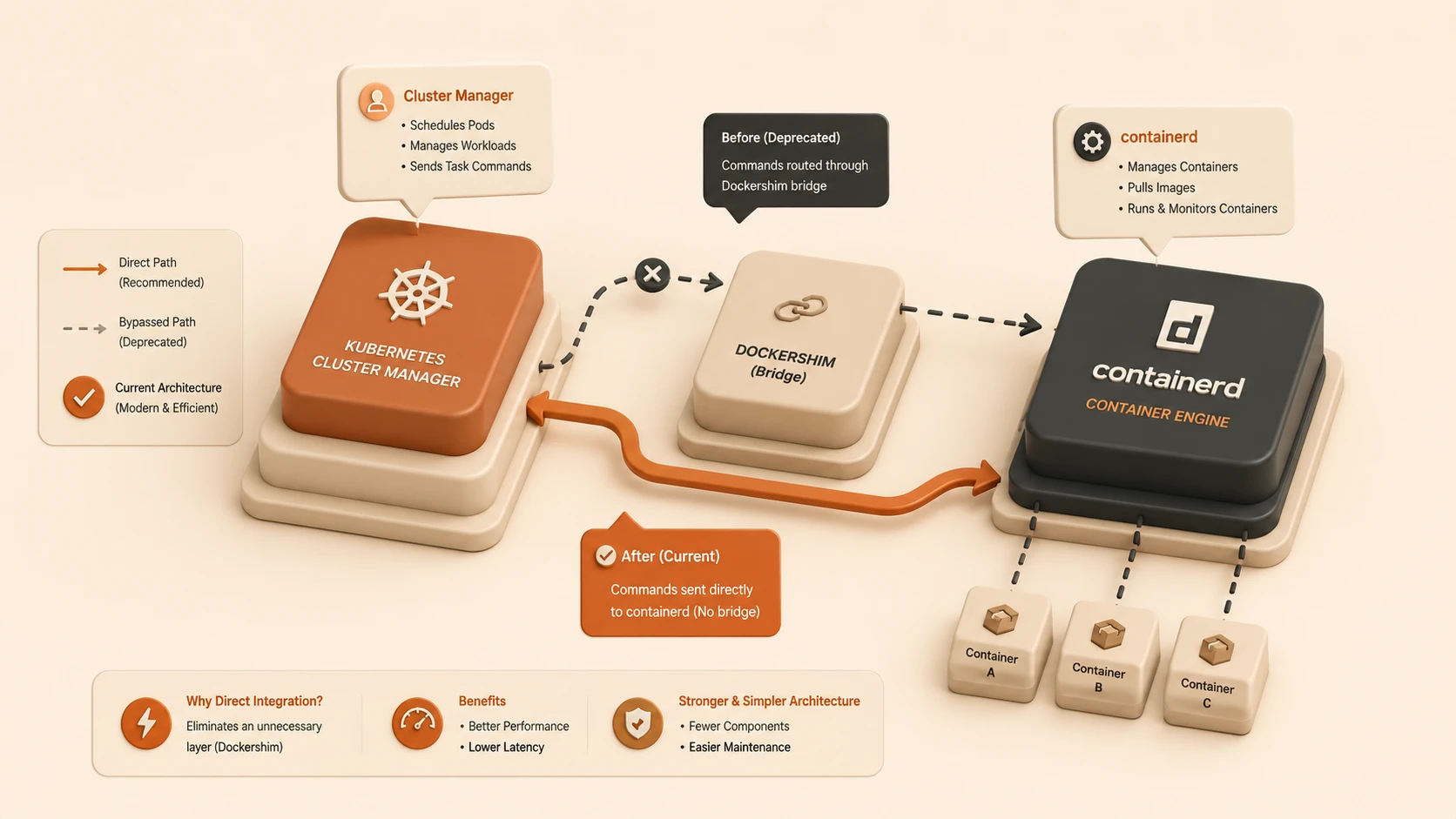
Historically, Kubernetes included Dockershim, a compatibility layer allowing Docker Engine to function as the underlying container runtime. While valuable during Kubernetes' early growth, maintaining Dockershim inside Kubernetes introduced additional engineering complexity and duplicated functionality already provided by modern CRI-compliant runtimes.
Kubernetes 1.20 formally announces the deprecation of Dockershim, encouraging organizations to begin planning migration toward native CRI implementations such as containerd and CRI-O.
From the perspective of December 2020, this represents one of the most significant infrastructure architecture changes in Kubernetes since the platform's introduction.
Industry Background
Enterprise container adoption continues accelerating across industries.
Organizations increasingly deploy:
- ◆Microservices.
- ◆Enterprise APIs.
- ◆Event-driven platforms.
- ◆Machine learning services.
- ◆Continuous Integration systems.
- ◆Data processing pipelines.
- ◆Internal developer platforms.
Modern infrastructure priorities increasingly include:
- ◆Cloud portability.
- ◆Runtime standardization.
- ◆Platform modularity.
- ◆Automated operations.
- ◆Security.
- ◆Operational consistency.
Container runtime abstraction plays an essential role in achieving these objectives.
The Business Problem
Large Kubernetes environments frequently encounter several operational challenges.
Organizations commonly experience:
- ◆Runtime maintenance complexity.
- ◆Infrastructure coupling.
- ◆Platform upgrade overhead.
- ◆Duplicate runtime functionality.
- ◆Compatibility management.
- ◆Operational inconsistency.
- ◆Long-term maintenance costs.
Maintaining runtime-specific integrations inside Kubernetes core slows platform evolution while increasing engineering effort.
Kubernetes 1.20 addresses these concerns by accelerating adoption of standardized CRI implementations.
Understanding the Technology
The Container Runtime Interface defines a standardized communication layer between Kubernetes and container runtimes.
Rather than interacting directly with Docker-specific APIs, kubelet communicates with any runtime implementing the CRI specification.
Major architectural components include:
- ◆Kubernetes API Server.
- ◆Kubelet.
- ◆Container Runtime Interface.
- ◆CRI-compliant runtime.
- ◆Container images.
- ◆Pods.
- ◆Node operating system.
This abstraction improves flexibility while reducing runtime dependencies.
Core Architecture
A simplified Kubernetes runtime architecture appears below.
| Component | Responsibility |
|---|---|
| Kubernetes API Server | Cluster management |
| Scheduler | Workload placement |
| Kubelet | Node management |
| Container Runtime Interface (CRI) | Standard runtime abstraction |
| CRI Runtime (containerd or CRI-O) | Container execution |
| Operating System | Process and resource management |
| Pods | Application workloads |
The kubelet communicates exclusively through CRI, allowing different runtime implementations without modifying Kubernetes itself.
Key Features
Dockershim Deprecation
The defining announcement in Kubernetes 1.20 is the deprecation of Dockershim.
Dockershim previously translated Kubernetes runtime operations into Docker Engine interactions.
With mature CRI implementations now widely available, Kubernetes no longer requires an internal compatibility layer dedicated to Docker.
Deprecation simplifies:
- ◆Kubernetes maintenance.
- ◆Runtime architecture.
- ◆Future platform evolution.
- ◆Community engineering effort.
Organizations should view this announcement as the beginning of a migration process rather than an immediate removal.
Container Runtime Interface (CRI)
CRI remains the foundation for runtime interoperability.
The interface standardizes communication between kubelet and container runtimes, enabling Kubernetes to remain independent of implementation details.
Benefits include:
- ◆Runtime portability.
- ◆Cleaner architecture.
- ◆Vendor flexibility.
- ◆Simplified maintenance.
This abstraction reflects Kubernetes' broader commitment to modular platform design.
Native CRI Runtimes
Modern runtimes such as containerd and CRI-O implement the Container Runtime Interface directly.
These runtimes focus specifically on container execution rather than broader development workflows, making them well suited for production Kubernetes clusters.
Their architecture reduces unnecessary translation layers while improving operational simplicity.
Cleaner Kubernetes Architecture
Removing runtime-specific code from Kubernetes core allows project maintainers to focus on orchestration responsibilities rather than runtime compatibility.
This contributes to a cleaner separation of concerns across the cloud-native ecosystem.
Improved Maintainability
Reducing duplicated functionality simplifies long-term maintenance for both Kubernetes maintainers and enterprise platform teams.
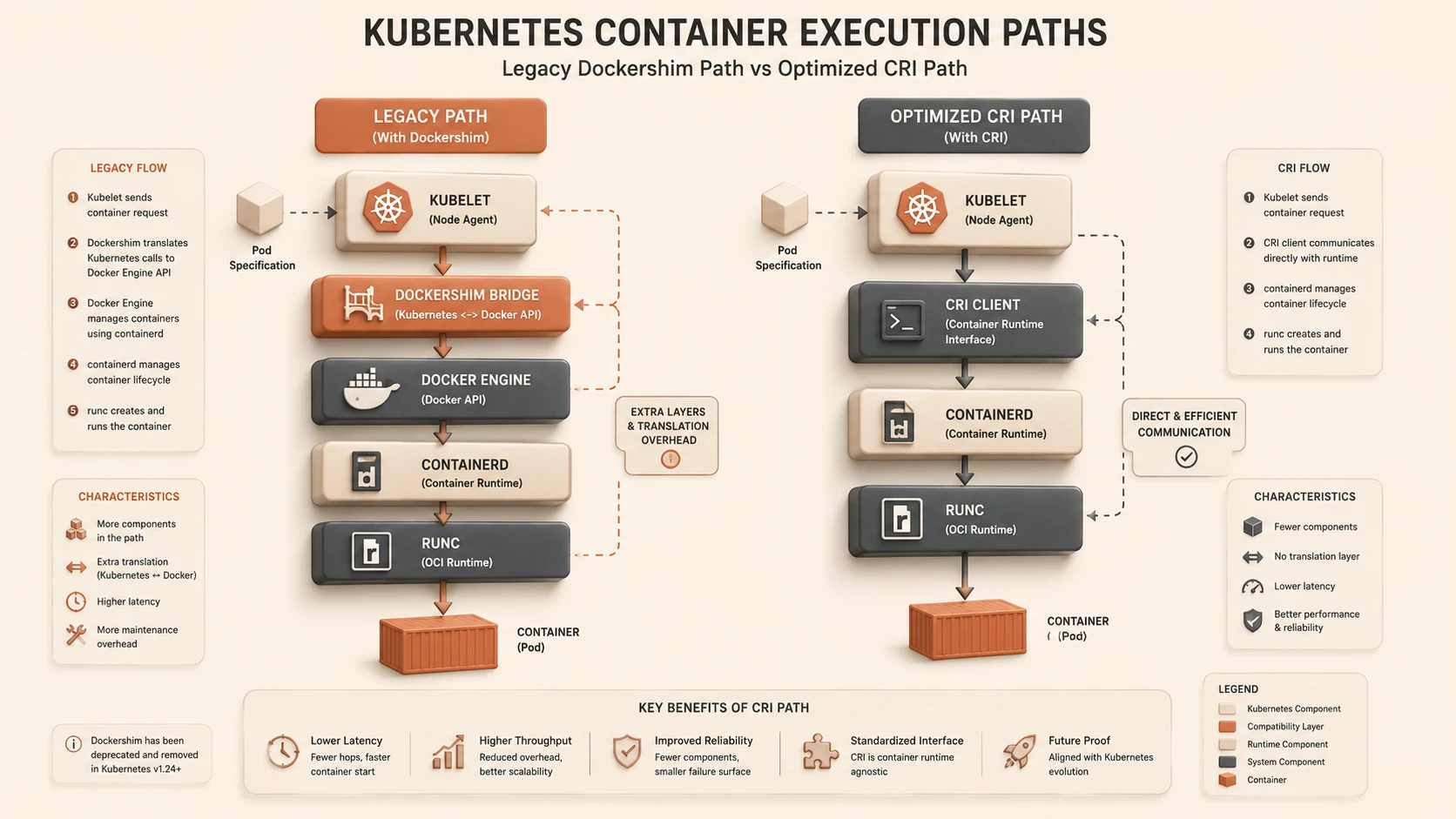
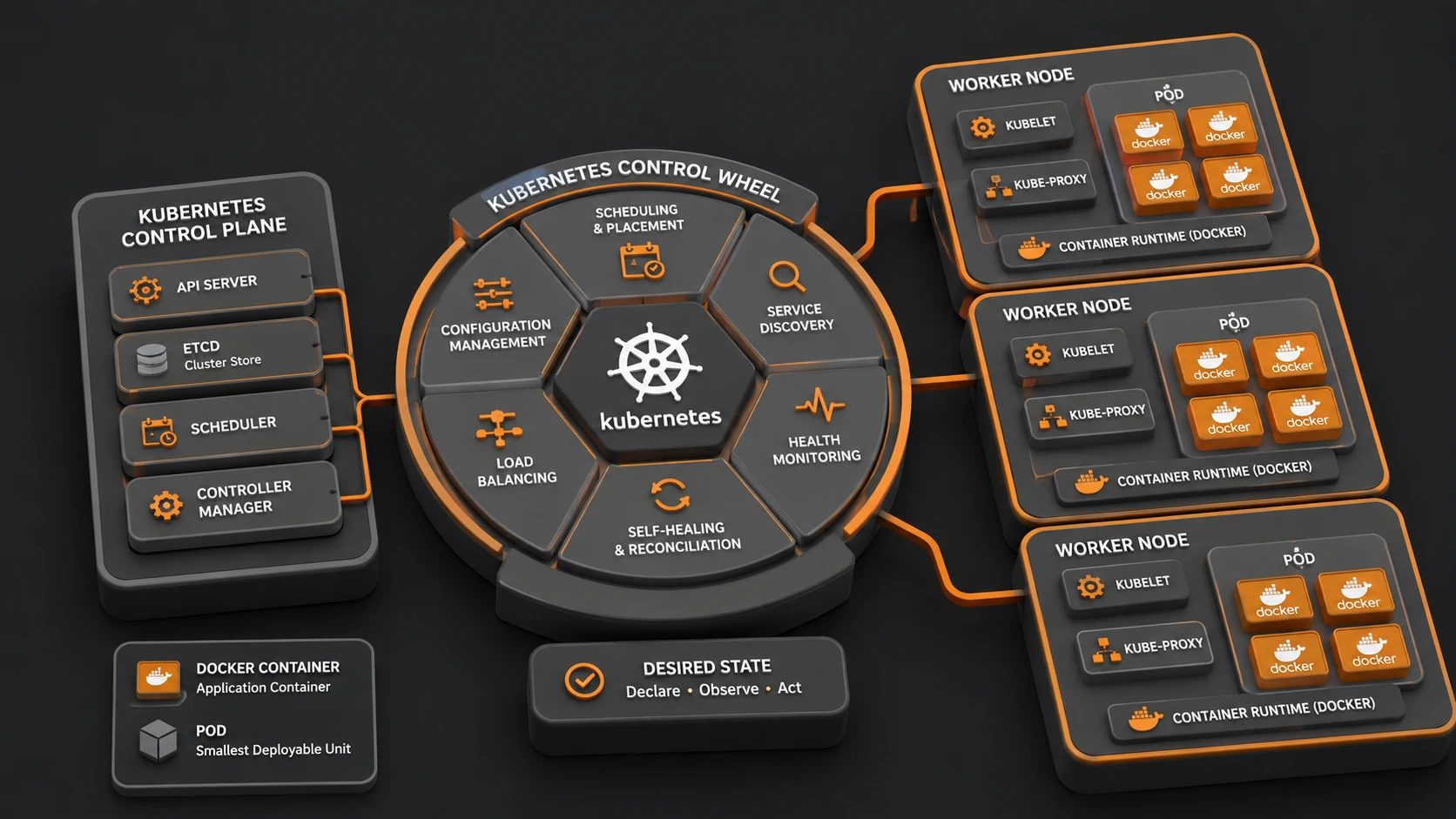
System architecture diagram and conceptual workflow layout for Kubernetes 1.20.
Operational tooling increasingly aligns around standardized runtime interfaces instead of vendor-specific implementations.
Continued Platform Maturity
Kubernetes 1.20 demonstrates the project's willingness to simplify internal architecture as the surrounding cloud-native ecosystem matures.
This evolution supports long-term sustainability while encouraging ecosystem standardization.
How It Works
A simplified runtime workflow appears below.
Deployment
      |
Kubernetes API
      |
Scheduler
      |
Kubelet
      |
Container Runtime Interface
      |
CRI Runtime
      |
Container Execution
The kubelet communicates through CRI regardless of the underlying runtime implementation.
Enterprise Use Cases
Hybrid Cloud Platforms
Organizations operating clusters across multiple environments benefit from standardized runtime interfaces.
Platform Engineering
Internal platform teams gain a cleaner foundation for long-term Kubernetes operations.
Enterprise DevOps
Deployment pipelines become less dependent upon runtime-specific assumptions.
Managed Kubernetes Services
Cloud providers can continue evolving runtime implementations independently from Kubernetes itself.
Large Production Clusters
Standardized runtimes improve consistency across thousands of worker nodes.
Performance Considerations
Native CRI runtimes simplify container execution architecture.
Organizations should evaluate:
- ◆Pod startup time.
- ◆Runtime stability.
- ◆Node resource utilization.
- ◆Image management.
- ◆Operational overhead.
- ◆Upgrade procedures.
Performance should be benchmarked before and after runtime migration using representative production workloads.
Security Considerations
Standardized runtimes strengthen operational consistency but do not replace comprehensive cluster security.
Organizations should continue implementing:
- ◆Role-Based Access Control.
- ◆Network Policies.
- ◆Pod Security practices.
- ◆Image vulnerability scanning.
- ◆Secrets management.
- ◆Audit logging.
Runtime modernization should support broader cloud-native security strategies.
Scalability
Kubernetes 1.20 improves long-term scalability through:
- ◆Modular runtime architecture.
- ◆Standardized interfaces.
- ◆Reduced maintenance complexity.
- ◆Cleaner platform evolution.
- ◆Greater runtime flexibility.
These characteristics support increasingly large enterprise Kubernetes environments.
Best Practices
Organizations adopting Kubernetes 1.20 should:
- ◆Inventory existing cluster runtime configurations.
- ◆Begin evaluating CRI-compliant runtimes.
- ◆Review operational tooling for Docker-specific assumptions.
- ◆Test runtime migration in staging environments.
- ◆Benchmark representative workloads.
- ◆Update operational documentation.
- ◆Train infrastructure teams on CRI architecture.
Planning migration early reduces operational risk before Dockershim removal in future Kubernetes releases.
Common Mistakes
| Mistake | Business Impact |
|---|---|
| Treating Dockershim deprecation as an immediate runtime failure | Unnecessary operational concern |
| Delaying migration planning until runtime removal | Increased upgrade risk |
| Assuming Docker image formats become unsupported | Architectural misunderstanding |
| Skipping staging validation during runtime migration | Production instability |
| Using runtime-specific automation unnecessarily | Reduced portability |
| Ignoring infrastructure documentation updates | Operational inconsistency |
Successful adoption depends upon proactive migration planning rather than reactive infrastructure changes.
Technology Comparison
| Characteristic | Kubernetes with Dockershim | Kubernetes with Native CRI Runtime |
|---|---|---|
| Runtime Integration | Docker compatibility layer | Direct CRI implementation |
| Architecture | Additional translation layer | Simplified runtime communication |
| Kubernetes Maintenance | Higher complexity | Reduced core maintenance |
| Runtime Portability | More Docker-centric | Runtime agnostic |
| Long-Term Strategy | Transitional approach | Preferred architecture |
Native CRI runtimes strengthen Kubernetes' modular architecture while reducing long-term maintenance complexity.
Adoption Strategy
Organizations should approach Kubernetes 1.20 through structured modernization.
- 1.Upgrade non-production clusters first.
- 2.Identify worker nodes using Dockershim.
- 3.Evaluate CRI-compliant runtime compatibility.
- 4.Validate deployment automation and monitoring.
- 5.Benchmark production-equivalent workloads.
- 6.Schedule runtime migration before future Kubernetes upgrades.
This phased strategy minimizes operational disruption while preparing infrastructure for future Kubernetes releases.
Limitations
As of December 2020, organizations should recognize several considerations.
- ◆Dockershim is deprecated but remains available in Kubernetes 1.20.
- ◆Future Kubernetes releases will eventually remove Dockershim, making migration planning essential.
- ◆Existing Docker image formats continue to function because CRI runtimes support the Open Container Initiative (OCI) image format.
- ◆Runtime migration should be validated thoroughly in representative environments.
- ◆Third-party operational tooling should be reviewed for runtime-specific assumptions.
These considerations should guide enterprise Kubernetes modernization planning.
Looking Ahead
From the perspective of December 2020, Kubernetes 1.20 marks an important architectural milestone by beginning the transition away from Dockershim and reinforcing the Container Runtime Interface as the long-term foundation for container execution. Rather than signaling the end of Docker-built container images, this change reflects Kubernetes' continued commitment to modular design, standardized interfaces, and infrastructure portability.
Organizations operating production Kubernetes clusters should view this release as an opportunity to modernize runtime architecture proactively. By adopting CRI-compliant runtimes such as containerd or CRI-O, enterprises can simplify operations, reduce maintenance complexity, and align their infrastructure with Kubernetes' long-term architectural direction while continuing to build scalable, portable, and cloud-native applications.