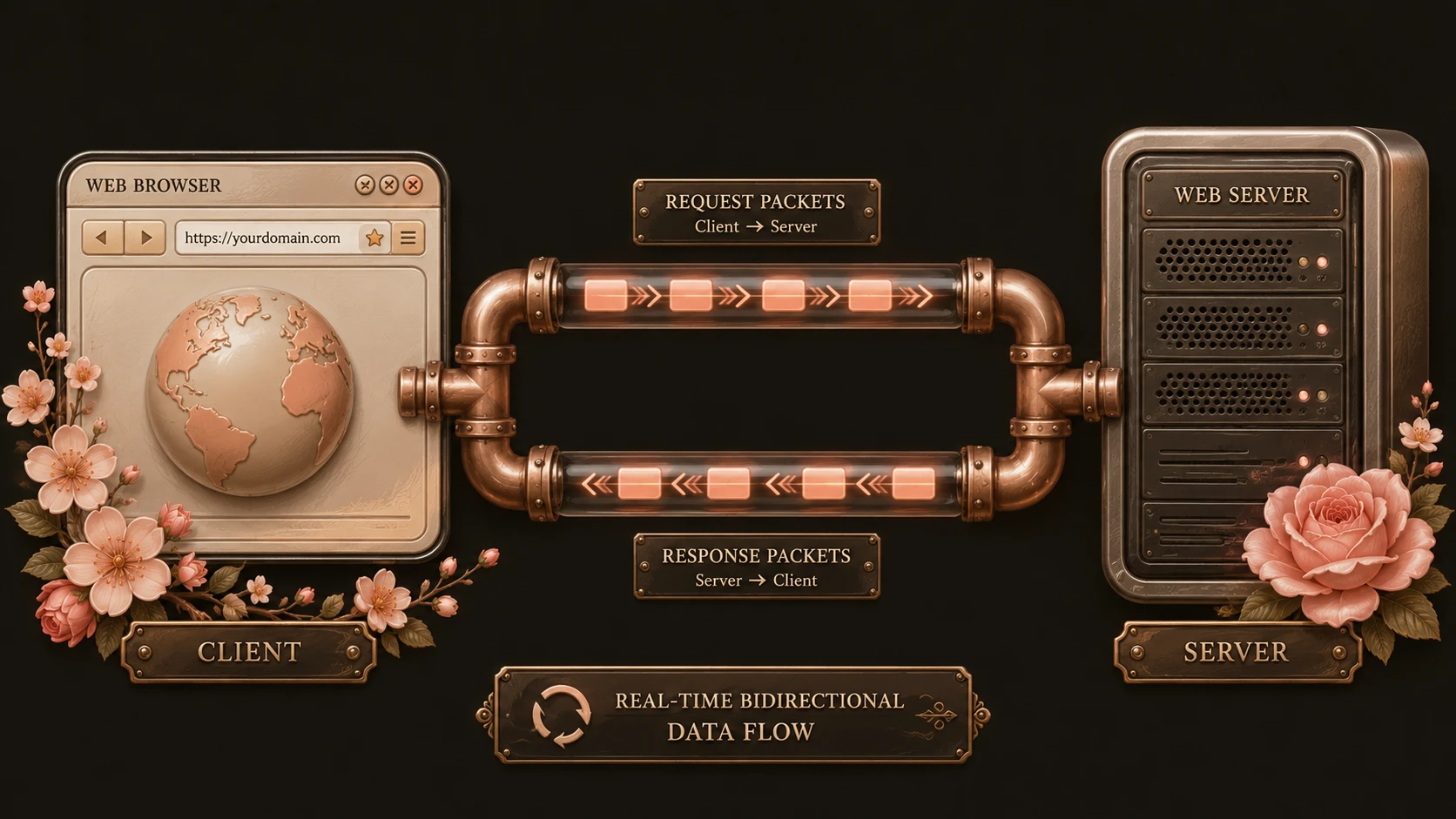
For many years, the web has been built around a fundamentally request-response communication model. Browsers initiate requests, servers generate responses, and the connection is typically closed once the exchange is complete. This architecture has proven remarkably successful for traditional websites, but it becomes increasingly inefficient as applications demand continuous interaction and real-time updates.
Modern web applications are no longer limited to displaying static information. Financial trading platforms, collaborative business tools, online communication systems, operational dashboards, multiplayer applications, and monitoring solutions all require servers to deliver information immediately as events occur.
Developers have responded with techniques such as polling, long polling, and streaming, each attempting to approximate real-time communication over HTTP. While effective in many situations, these approaches often introduce additional complexity, unnecessary network traffic, and increased server overhead.
The publication of RFC 6455, which standardizes the WebSocket Protocol, represents an important milestone in the evolution of the web. By enabling persistent, full-duplex communication between browsers and servers, WebSockets provide developers with a standardized foundation for building responsive, event-driven web applications.
For enterprise architects, this standard offers new opportunities to simplify application design while improving efficiency for real-time systems.
The Limitations of Traditional HTTP
HTTP has become one of the most successful application protocols ever created.
Its request-response model works extremely well for:
- ◆Web pages
- ◆Content delivery
- ◆Forms
- ◆Document retrieval
- ◆Search applications
However, applications requiring frequent updates often encounter challenges.
Examples include:
- ◆Live stock prices
- ◆Instant messaging
- ◆Monitoring dashboards
- ◆Multiplayer applications
- ◆Collaboration tools
Repeated HTTP requests introduce additional latency and unnecessary network overhead.
Earlier Real-Time Techniques
Before WebSockets, developers relied on several techniques to simulate real-time communication.
Polling
Clients repeatedly request updates at regular intervals.
Advantages:
- ◆Simple implementation
- ◆Broad browser support
Disadvantages:
- ◆Frequent unnecessary requests
- ◆Increased server load
- ◆Higher latency
Long Polling
The server delays its response until new information becomes available.
Advantages:
- ◆Reduced unnecessary traffic
- ◆Better responsiveness than traditional polling
Disadvantages:
- ◆More complex implementation
- ◆Increased connection management
Streaming
Some applications maintain long-lived HTTP connections to continuously deliver data.
Although useful, streaming approaches vary in implementation and browser behavior.
These limitations highlighted the need for a standardized communication mechanism.
Introducing WebSockets
The WebSocket Protocol establishes a persistent communication channel between browser and server.
After an initial HTTP-based handshake, communication continues through a dedicated WebSocket connection.
Both client and server can exchange messages independently without requiring repeated HTTP requests.
This enables true bidirectional communication.
Connection Lifecycle
A simplified WebSocket communication flow appears as follows.
Browser
    |
HTTP Upgrade Request
    |
Web Server
    |
WebSocket Handshake
    |
Persistent Connection
    |
Bidirectional Messages
Once established, the connection remains open until either side closes it.
Full-Duplex Communication
One of the protocol's most significant advantages is full-duplex communication.
Unlike traditional HTTP interactions, both endpoints may send messages whenever necessary.
Benefits include:
- ◆Reduced latency
- ◆Lower network overhead
- ◆Simplified application logic
- ◆Improved responsiveness
This model aligns naturally with event-driven applications.
RFC 6455 Standardization
The publication of RFC 6455 provides developers with a standardized protocol specification.
Standardization offers several important benefits.
- ◆Consistent browser implementation
- ◆Interoperable server platforms
- ◆Predictable communication behavior
- ◆Stable protocol definition
- ◆Greater confidence for enterprise adoption
Standards are particularly valuable for enterprise environments where interoperability and long-term support are essential.
Enterprise Architecture
A typical WebSocket-enabled enterprise architecture may resemble:
Browser
      |
WebSocket Connection
      |
Application Server
      |
Business Services
      |
Enterprise Database
Business services continue managing application logic while WebSockets provide efficient communication between client and server.
Event-Driven Application Design
WebSockets encourage applications built around events rather than repeated client requests.
Typical events include:
- ◆New messages
- ◆Status updates
- ◆Transaction notifications
- ◆Monitoring alerts
- ◆User activity
Applications respond immediately when information becomes available.
This approach improves responsiveness while reducing unnecessary communication.
Enterprise Use Cases
Financial Trading Platforms
Market information changes continuously throughout the trading day.
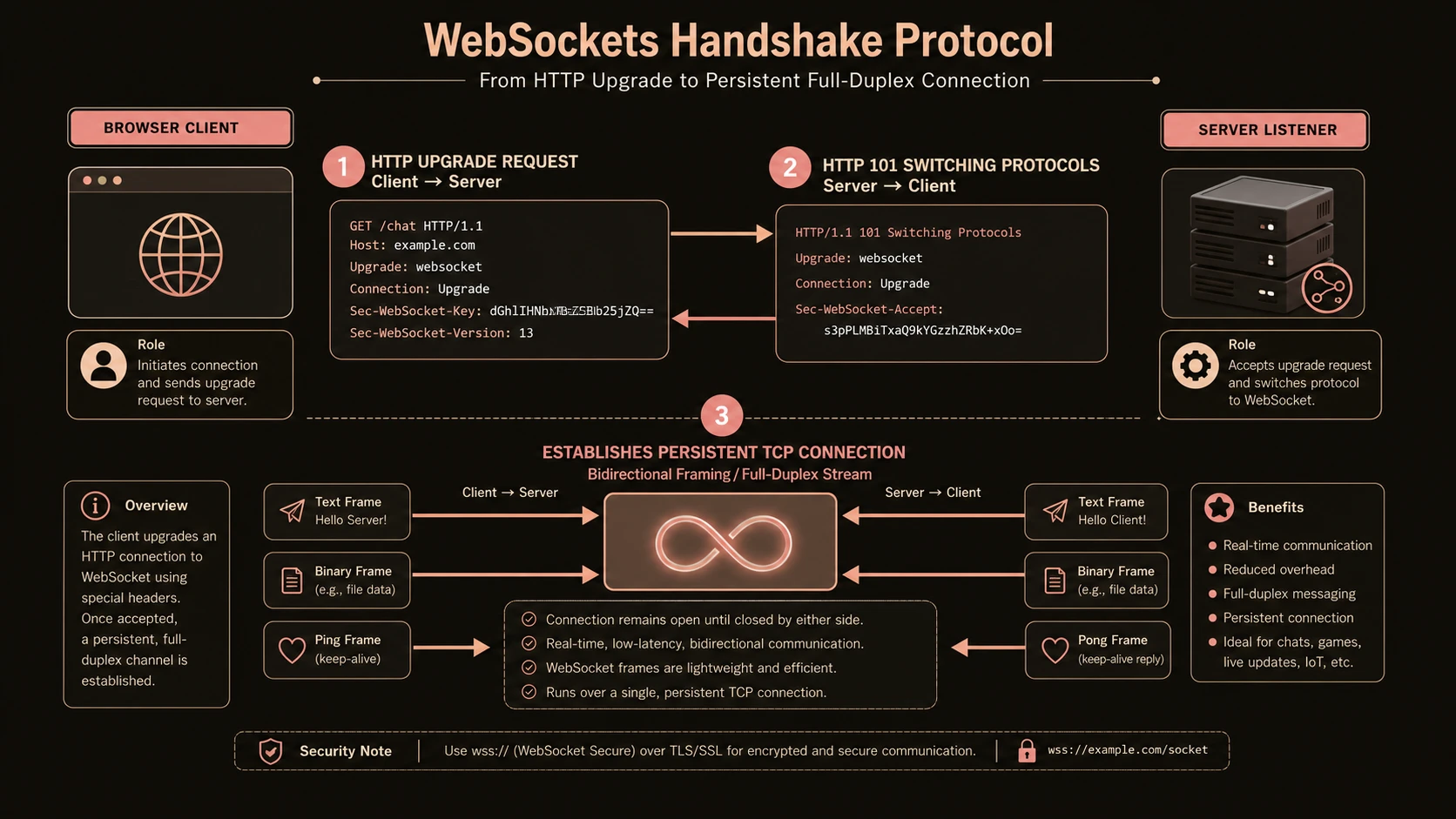
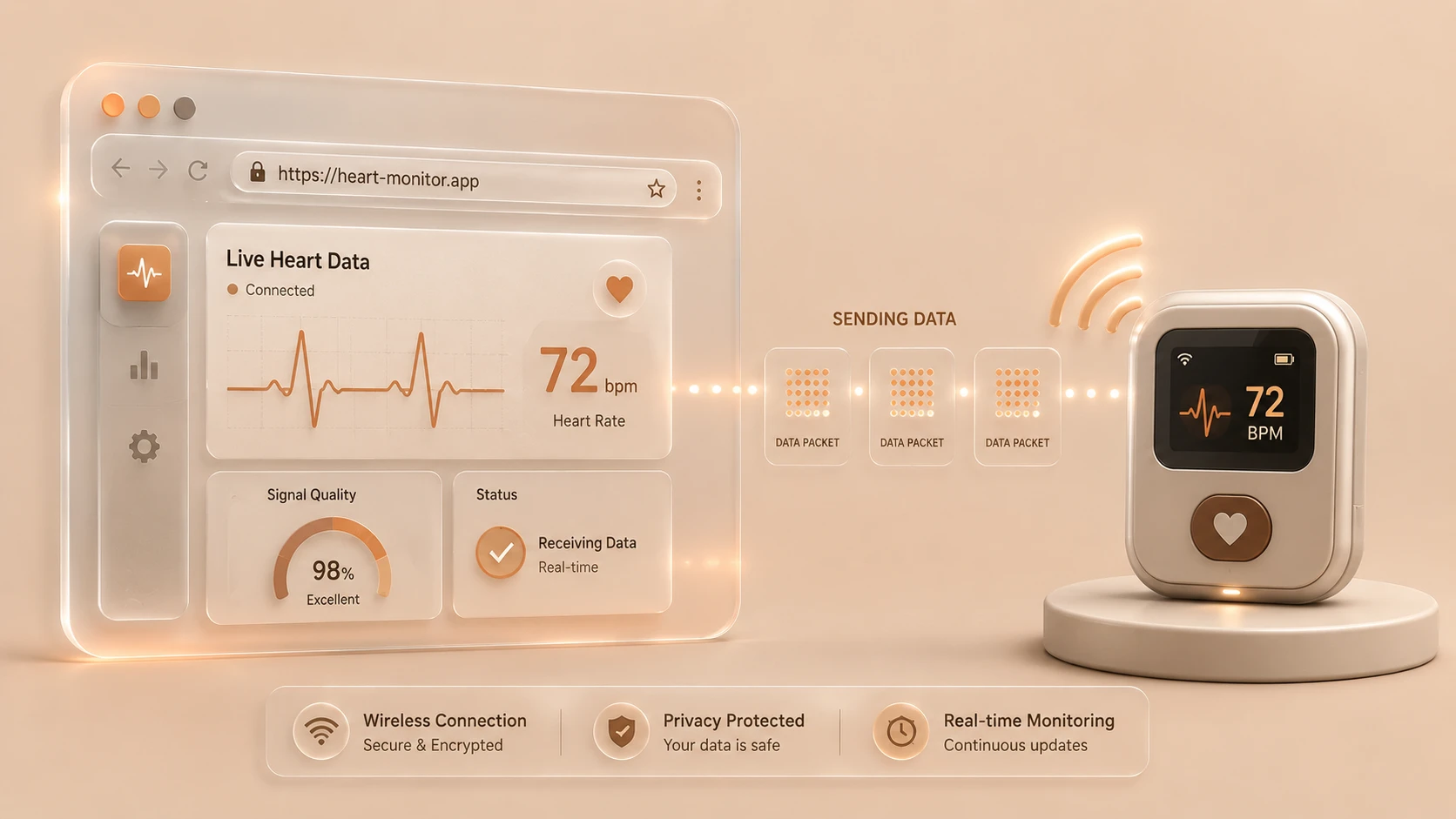
System architecture diagram and conceptual workflow layout for WebSockets RFC 6455.
WebSockets enable efficient delivery of:
- ◆Price updates
- ◆Market events
- ◆Portfolio information
- ◆Trading notifications
without requiring constant polling.
Business Dashboards
Operational dashboards may display:
- ◆Sales metrics
- ◆Manufacturing statistics
- ◆Infrastructure health
- ◆Service availability
Real-time updates improve operational awareness.
Collaboration Applications
Team collaboration systems benefit from:
- ◆Instant messaging
- ◆Presence information
- ◆Shared notifications
- ◆Activity updates
Persistent communication improves user experience.
Monitoring Systems
Infrastructure monitoring platforms often require immediate notification when operational conditions change.
WebSockets simplify event delivery while reducing network overhead.
Performance Advantages
Persistent connections reduce many inefficiencies associated with repeated HTTP requests.
Potential benefits include:
- ◆Lower latency
- ◆Fewer HTTP headers
- ◆Reduced bandwidth usage
- ◆Faster event delivery
- ◆Improved scalability for interactive workloads
Performance improvements will vary according to application architecture and workload characteristics.
Security Considerations
Enterprise WebSocket deployments should continue following established security practices.
Organizations should evaluate:
- ◆Authentication
- ◆Authorization
- ◆Secure transport
- ◆Input validation
- ◆Session management
- ◆Connection monitoring
Security remains a shared responsibility between application developers and infrastructure teams.
Integration with Existing Systems
WebSockets complement rather than replace existing enterprise architectures.
Organizations may continue using:
- ◆HTTP APIs
- ◆REST services
- ◆SOAP services
- ◆Databases
- ◆Messaging systems
WebSockets primarily improve communication between clients and application servers.
Comparing HTTP Polling and WebSockets
| HTTP Polling | WebSockets |
|---|---|
| Repeated client requests | Persistent connection |
| Higher protocol overhead | Lower communication overhead |
| Client initiates updates | Client and server exchange messages freely |
| Increased latency | Faster event delivery |
| Less efficient for continuous updates | Well suited for real-time interaction |
Both approaches remain useful depending on application requirements.
Best Practices
Organizations evaluating WebSockets should consider the following recommendations.
Design Event-Driven Applications
Allow business events to drive communication rather than periodic polling.
Separate Business Logic
Communication infrastructure should remain independent from business services.
Monitor Connections
Long-lived connections require operational visibility.
Plan for Connection Recovery
Applications should handle interrupted connections gracefully.
Evaluate Scalability Early
Persistent connections influence server architecture differently than traditional HTTP workloads.
Common Mistakes
Enterprise teams adopting WebSockets may encounter several challenges.
Replacing Every HTTP Request
Traditional HTTP remains appropriate for many application scenarios.
Ignoring Connection Management
Persistent connections require careful lifecycle handling.
Embedding Business Logic in Communication Layers
Keep messaging infrastructure separate from application rules.
Neglecting Security
Persistent connections require the same security discipline as any other enterprise service.
Failing to Test Scalability
Real-time communication patterns should be evaluated under realistic production workloads.
Adoption Recommendations
Organizations considering WebSockets should adopt a structured implementation strategy.
Recommended roadmap:
- 1.Identify applications requiring real-time interaction.
- 2.Build a proof-of-concept implementation.
- 3.Measure latency improvements.
- 4.Evaluate scalability under production-like workloads.
- 5.Integrate with existing enterprise services.
- 6.Establish operational monitoring.
- 7.Expand deployment based on measurable business value.
This incremental approach allows organizations to evaluate the protocol while minimizing implementation risk.
Looking Ahead
The publication of RFC 6455 establishes WebSockets as a standardized foundation for real-time communication on the web. By providing persistent, bidirectional communication between browsers and servers, the protocol addresses many of the limitations developers have encountered with polling and other HTTP-based techniques.
As browser vendors continue implementing the standard and server platforms expand support, enterprise organizations should begin evaluating how WebSockets can improve collaboration systems, operational dashboards, monitoring platforms, financial applications, and other interactive workloads. Teams that combine WebSockets with sound application architecture, scalable infrastructure, and disciplined security practices will be well positioned to build the next generation of responsive web applications.